Wednesday, September 30, 2009

The Shmuz on the Parsha

The Shmuz on the Parsha
by Rabbi Ben Zion Shafier
Published by Feldheim

Reviewed by Shmuel Sofer

The Mussar Movement made famous by R. Yisroel Salanter and his students held that pure Torah study might not adequately train students and adults to perfect their lives and align them with the ethical principles and worldview that is befitting of a “Ben Torah”. Its proponents argued that the Talmud is replete with ethical instruction but, like many of the legal passages, those texts are often distributed throughout the Talmud and rabbinic literature in a manner which makes a programmed study difficult. The classic “mussar texts” such as Mesilas Yesharim, Orchos Tzadikim and Shaarei Teshuva culled through the sea of the Talmud and organized the material into an organized text. Mussarniks advocated regular study of these classic works. An additional component that the mussarniks innovated was the role of the mashgiach ruchani, a spiritual/ethical counselor who would oversee students ethical development. One of the mashgiach's key tasks was to deliver a mussar shmuz or inspirational lecture designed to motivate students. Often topical or arranged according to the weekly parsha, the shmuz became a means of taking the lessons of the mussar works and bringing them to the students in a very practical format.

Click here for moreThe mussar program of R. Yisrael Salanter took root in many yeshivos and has survived today in a somewhat modified form. Some yeshivos minimize the study of mussar while others place a greater emphasis on it. The weekly “shmuz,” though, has become a mainstay feature in virtually all yeshivos, in part because of the practical lessons which students can integrate into their daily lives. In recent years, shmuzen from some of the great mashgichim of the “yeshiva world,“ such as R. Chaim Schmulevitz of Mir and Rabbi Eliahu Dessler of Gateshead, have been published and in some cases translated into English.

In the United States, the Chofetz Chaim networks of yeshivos have earned themselves a reputation of strong emphasis on mussar and ethics. R. Henoch Leibowitz z”tl, the long term Rosh Yeshiva and visionary of the Chofetz Chaim system, was a strong proponent of mussar. In addition, Rabbi Leibowitz recognized that after leaving the “walls of the Bais Medrash” to earn a living, many yeshiva students were at risk of floundering or losing their previously strong connection to the Torah institutions where they had studied previously. To fill this void he charged Rabbi Ben-Tzion (Barry) Shafier, a rebbe from the Chofetz Chaim yeshiva high school system, with creating Torah Programs for “working guys.” His Tiferes Bnei Torah has taken root in Monsey, Queens, Brooklyn and other metro neighborhoods. One of the preeminent features is Rabbi Shafier’s weekly “shmuz.” Following in the mold of the mussar mashgichim of old, Rabbi Shafier delivers a regular lecture on a timely topic, often connected to the weekly parsha or upcoming Yom Tov. The recorded lectures are available on his web site www.theshmuz.com, along with access to several other features.

A popular speaker, Rabbi Shafier is able to combine Torah lessons and infuse them with interesting real life stories and events that bring home his point. Rabbi Shafier often lets slip a personal vignette which allows the listener to recognize that he personally has experienced many of the issues either himself or vicariously through his students over the years. His lectures are well researched and he regularly enhances the discussion with a slew of trivia facts and anecdotes designed to capture his audience's attention as he brings home his message -- fidelity to Torah ethics despite living in a contemporary world. Rabbi Shafier has developed an extensive marketing campaign promoting his product -- Torah and musar. In addition to his organization, he has a website which hosts his lectures and he produces a weekly “parsha sheet” wherein he discusses a classic Torah commentary, midrash or statement of Chazal and analyzes it for the ethical lesson which he can mine from it.

This book The Shmuz on the Parsha is a condensed form of many of these lessons. Rabbi Shafier begins with a direct quote of the statement of Chazal which he then paraphrases and analyzes. He then develops a question based on that analyses and attempts to resolve it with a lesson for the student. The book is designed to be used as “Shabbos Table Vort” which can generate discussion around the table. For optimal benefit the reader would review the “5 minute“ dvar Torah in advance. The book then contains marginal notes and summaries that will assist the user in being able to relay the message without having to read aloud word for word, usually something I find boring a detracting from a dvar Torah.

This is not a book geared to academics or those with a focus on “pshuto shel mikra” in the sense used by modern Bible scholars. It is a book filled with wonderful insights and and lessons directed at American “yeshivishe” Orthodox families. The only criticism that I can offer is that the page format with scant numbers of words on the page, large type etc. results in a 376 page book which could have been much more compact. The 8½ x 11 page size results in a “coffee table” size which is a bit awkward for Shabbos table use. Likewise the “list price” of over $45 is overly expensive, but I suspect that this is but a marketing ploy as the “pre-publication“ price of $29.95 is more in line with other similar works.


Shabbos Elevators and Crocs: Much Ado About Nothing

A ruling by leading authorities in Israel was recently published in a newspaper, prohibiting the use of so-called "Shabbos Elevators" (I, II). This has led to a big confusion, with people objecting and be unsure of how to act.

I'm not sure what the big suprise or confusion is all about. Shabbos Elevators have long been controversial, with authorities on both sides of the issue. See R. Chaim Jachter's four-part essay on this subject (I, II, III, IV). Engineers have attempted to alleviate all possible problems with these elevators but I am not aware that their solutions have been universally accepted. As with most things, this is a matter of debate. I personally never use Shabbos Elevators but I also never really had a need to. The one time I was on a high floor in a hotel in Israel on Shabbos, I used the stairs. But I'm not saying that you have to do that. Ask your rabbi.

Click here for moreWhat concerned me, though, was that the newspaper ruling was blanket. It did not mention that people with extenuating circumstances should consult with their rabbi. There are leniencies, which understandably vary based on a rabbi's views on the relevant subjects but there are nevertheless leniencies in some situations according to everyone. The last thing we need is someone old or sick having a heart attack because they read in the newspaper that leading Torah authorities say they have to take the stairs.

Similarly, there was a bit of a ruckus before Yom Kippur when a newspaper reported that R. Yosef Shalom Elyashiv recommends against wearing Crocs on Yom Kippur (link). This is something that he has been saying for years and that the Arukh Ha-Shulchan (Orach Chaim 614:5) and R. Joseph B. Soloveitchik (Nefesh Ha-Rav, p. 210) shared this view. It's a disagreement, and an old one at that.

The bottom line is, as I've been saying for a long time, don't decide halakhah based on what you read in newspapers. Ask your rabbi, just like you did in the past and will continue doing in the future.


"Leishev Basukka"

By: Rabbi Ari Enkin

The only instance that the "leishev basukka" blessing may be recited according to all opinions is prior to eating a meal which includes bread. When beginning a meal, the leishev basukka blessing is recited immediately following the hamotzi blessing, even before one begins to eat the bread.[1] Similarly, common custom is to recite the leishev basukka blessing in a sukka when eating a snack made of grain products such as cake and cookies, as well.[2]

According to the Talmud[3] one should actually recite the leishev basukka blessing each and every time one enters a sukka. Indeed, many halachic authorities in the past have ruled that this is the way we are to conduct ourselves.[4] The prevalent practice, however, is not like this view. Most contemporary halachic authorities insist that the leishev basukka blessing be reserved exclusively for meal time in the sukka.[5]

Click here for moreThe decision to reserve the leishev basukka blessing exclusively for eating was made because it is generally eating which makes up one's primary use of the sukka.[6] Additionally, the sages wanted to ensure that the blessing would only be recited when benefiting from the sukka in a significant manner and not when entering merely to fetch something, or the like.[7]

Nevertheless, in deference to the view that we should be reciting the blessing upon any visit to the sukka, it is best to arrange that there will be a food upon which to recite the leishev basukka blessing even when truly intending to use the sukka for other purposes.[8] It is interesting to note that in the event that one used one's sukka for sleeping, studying or other similar activities (in which case a blessing would not have been recited) – the leishev basukka blessing recited when one eventually eats will retroactively cover those earlier activities as well![9]

When visiting a friend's sukka, however, the halacha may be slightly different.[10] When one visits a friend's sukka and intends to spend a considerable amount of time there, the leishev basukka blessing may be recited even if no food is served. Even so, it is preferable to try and eat something there in order to justify the blessing according to all views.[11] Indeed, if for whatever reason one has no intention of eating all day, the blessing leishev basukka may even be recited upon entering one's own sukka when intending to remain there for a considerable amount of time.[12] Any time one recites a leishev basukka one should have in mind that the blessing extend to all other activities one may engage in throughout the course of the day, such as sitting with friends or sleeping.

If one forgot to recite the leishev basukka before beginning one's meal it may be recited any time one remembers.[13] It may even be recited after one has finished eating as long as one intends to spend some additional time in the sukka.[14] One who does not leave the sukka between meals does not recite a new leishev basukka when beginning his next meal.[15] There is a dispute among the halachic authorities whether the leishev basukka blessing is to be recited as part of havdala. Some authorities consider the drinking of havdala wine to be a transitory act unworthy of the blessing while others argue that since the wine is being drunk in conjunction with a mitzva then the leishev basukka should be said.[16]


My next post will be the Tuesday after Sukkot (Oct. 13). I wish everyone a true "vesamachta bechagecha" over Sukkot!!

***************************************

[1] O.C. 643:3, Shulchan Aruch Harav 643:4
[2] Mishna Berura 639:15,16
[3] Sukka 46a
[4] Rambam Sukka 6:12, Gra O.C. 639
[5] O.C. 639:8
[6] Aruch Hashulchan 639:26,27
[7] Sha'ar Hatziun 639:93
[8] Mishna Berura 639:46
[9] Shulchan Aruch Harav 639:12
[10] Sha'ar Hatziun 639:93
[11] Sha'ar Hatziun 639:93, Nitei Gavriel 46:3
[12] Mishna Berura 639:48
[13] Shulchan Aruch Harav 639:16
[14] Shulchan Aruch Harav 639:16, Aruch Hashulchan 639:28
[15] Shulchan Aruch Harav 639:13, Mishna Berura 639:47
[16] Piskei Teshuvot 639:10


Monday, September 28, 2009

When Values Collide: Women's Ordination

An essay of mine was published on the First Things website (link). Please keep in mind that this was written for a general audience and that space limitations required brevity:
The term “Modern Orthodox” is, in a sense, self-contradictory, which makes one wonder why it has been used for so long to describe a significant portion of the Jewish community. The “Orthodox” part refers to the community’s strong commitment to traditional core beliefs and practices. The “Modern” part implies a willingness to absorb practices and values from contemporary culture. Sometimes the two complement each other, but often they conflict.

So how should we adjudicate the conflict between religious tradition and our moral intuitions?

Click here to read more
So how should we adjudicate the conflict between religious tradition and our moral intuitions? As moderns, we instinctively maintain the equality of all people and uphold their freedom to choose their own paths without legal or social impediments. But this presents a challenge to religious traditions that limit certain positions to particular categories of people.

Judaism is one such religion, egalitarian in some respects, but emphatically not in others. During the times of the temples in Jerusalem, priests had roles, privileges, and responsibilities that differed from those of the Levites and Israelites. Orthodox Jews eagerly await the messianic era, when these ancient divisions will be reinstated. The case of bastard children is even more jarring to our modern sensibilities. In Jewish law bastard is highly defined: the child of an incestuous relationship, or an adulterous one, between a married Jewish woman and a Jewish man not her husband. Such a person is considered a mamzer and may marry only another mamzer—a heartbreakingly severe disadvantage.

There are more examples, of course, but particularly pressing today is the question of the role of women in the Orthodox Jewish community. The amply attested tradition is that women have been exempt from most time-related rituals, such as the requirements for daily prayer. This lack of obligation prevents them from serving as communal representatives for these rituals, a role which is limited to those who are obligated.

While women were excluded from public ritual for thousands of years without much debate, the modern notion of equality challenges that exclusion. By what moral justification does the tradition differentiate by gender? The challenge is particularly strong because Judaism sees moral intuitions as legitimate religious directives.

In the late 1970s and early 1980s, the Conservative Jewish movement debated exactly this question in the context of the rabbinic ordination of women. The issue was so contentious that the final decision to ordain women led to a schism within the movement. Along the way, the Conservative debate produced three opposing views:

Rejectionism-an approach that openly acknowledges the conflict and allows tradition to prevail. Accepting the differentiation of gender roles, rejectionism holds that there is a profound spiritual reason for limiting the roles of women in public rituals, one that should be celebrated rather than dismissed.

Legalism-an approach that treats the matter merely as a regular legal inquiry: What does Jewish law say about the ordination of women? Setting aside all issues of theology and ethics, legalists allow the legal texts to speak for themselves-which, in practice, leads to the same answer as the rejectionist approach: No.

Revisionism-an approach that redefines Jewish law to accommodate modern values. While insisting that it upholds the primacy of Jewish law, it undermines the values that inform tradition by a radical restatement of those laws. Thus, for example, Jewish law does not allow a woman to be called to the Torah in synagogue, but a revisionist strategy would redefine “ascending to the Torah” as merely a ceremonial rather than religious role that has the effect of preserving the form while neutralizing the restriction.

Each approach has its advantages and drawbacks. The rejectionist approach seems truest to tradition, but by simply denying our modern moral intuition, it fails to take seriously the tension we genuinely feel. The legalist approach, meanwhile, purports to have a neutral view, but only succeeds in doing implicitly what rejectionism does explicitly—ignoring the ethical questions facing religious people today.

The revisionist approach seems to resolve the tension but does so at the expense of transforming public worship into an arbitrary collection of rituals. To include women in public rituals, revisionism has to deprive those practices of their religious significance—which, in its own way, leaves the moral dilemma intact. Additionally, there are some rituals that are immune to redefinition within the boundaries of the Orthodox legal process.

If none of these approaches seems satisfying, perhaps we have put the question in the wrong way. Jewish decision-making is not about choosing between absolute right and absolute wrong. It requires weighing the issues to maximize right and minimize wrong. Modern Jews face not simply a conflict between tradition and ethics, but a matrix of demands that includes ethics, customs, history, community, and education.

Each of these must be weighed by its importance to Judaism. Sometimes specific values are so powerful that they override all other considerations. Some innovations are relatively unobtrusive and the “slippery slope” argument does not seem conclusive, while others are driven by an agenda whose momentum guarantees further changes in the near future.

So how do we weigh all of these considerations? Many in the Modern Orthodox community were raised with a Jewish pedagogy at odds with modern institutional standards. Those who favor mimetic transmission of practice over a textual education want to maintain continuity with past custom and observance. It is clear that the traditional methods of teaching militate generally against increasing roles for women in the synagogue and specifically against the ordination of women. Such changes would do significant damage to traditional religious education.

A related issue is that of continuity of communal custom, which Jewish law requires us to maintain. That is important even when what’s being discussed is the absence of a practice—in this case, the lack of expanded roles for women in the community.

Women never served as ritual slaughterers, for example, although an actual prohibition was rejected in the Medieval legal literature. Nonetheless, when the question arose of whether a woman could, in actual practice, be a slaughterer of animals, the answer given by authoritative Ashkenazic scholars was no. Analogously, even if it is conceptually possible for women to serve as rabbis, communal custom—no small matter in the Jewish tradition—rejects the possibility, just as it rejects women prayer leaders and Torah readers.

Finally, the slippery-slope argument must be given its due. Over the past two centuries, radical changes in communal structure and religious practice have proved, in every case, impossible to control. The evidence seems clear that when radical innovations to ritual originate within tight legal limitations, they quickly exceed those bounds.

The Orthodox response to these changes has been to maintain, the consistency of ritual conservatism. Orthodoxy—including its Modern segment—has refused to legitimate non-Orthodox changes to Jewish practice by giving even the appearance of adopting liberal positions.

Certainly, egalitarianism is a value to be considered, but so is communal unity. There can be no question that the ordination of women would divide the Orthodox community. Whatever their reasons, the majority of Orthodox Jews would essentially excommunicate congregations and organizations led by women rabbis or allowing women to preside at Jewish rituals. Local rabbinical councils would split in half; schools would have to choose sides when making hiring decisions; family members would refuse to attend weddings over which a female rabbi presides.

Would such a price be worthwhile? In the final analysis, it is possible (I believe likely) that we will decide that ordaining women and changing their roles in public ritual are not allowed. The kind of values-analysis I’ve been conducting does not resolve our moral problem—but that is not the point. The main outcome is not the resolution of conflict but the process, through which we become more aware of the conflicting elements of the dilemma.

As with many issues—the differences between priests, Levites, and Israelites, for instance, and the case of bastardy—we must sometimes live with ethical dilemmas simply because we recognize that change would cause more damage than preservation. We understand that the moral value of egalitarianism does not automatically trump all other values.

Living with conflicting moral demands is difficult, but it is integral to developing and maintaining our awareness of the complex ethical world in which we function, and it is the only way to grow and thrive as moral beings. We Modern Orthodox Jews refer to ourselves with the oxymoronic term “Modern Orthodox” not because we have found a way to resolve all difficulties but because we are willing to acknowledge the importance of conflicting values. And we attempt to balance their demands without negating them.


Sunday, September 27, 2009

Yom Kippur

Gemar chasimah tovah

May you be inscribed for good


Friday, September 25, 2009

Covenant and Conversation

In case you haven't seen it yet in stores, Rabbi Jonathan Sack's collected essays on Genesis -- Covenant and Conversation: Genesis - The Book of Beginnings (co-published by OU Press and Maggid, an imprint of Koren Publishers) -- is on sale now. Buy it now in order to receive it in time for Simchas Torah: link


Yom Kippur Message and E-Book from the Chief Rabbi

Here is an e-book by R. Jonathan Sacks -- Letters to the Next Generation: Reflections for Yom Kippur: link (PDF)

And below is his Yom Kippur message:


Happy Fifth Anniversary

Five years ago, the Slifkin Torah-Science Affair began: link. I only began posting about it a few months later: link.


Thursday, September 24, 2009

Audio Roundup LX

by Joel Rich

Question: Why is the practice (anecdotal data) to ask for mechila (forgiveness) from each other during asseret ymei Tshuva and not during Elul?

www.jwisdom.com is a new site with short, professionally recorded uplifting shiurim messages. If this is your cup of tea, it’s a good resource.

  • Rabbi Hershel Schachter - Q&A in Vilna, Essex County: link

    Direct from the Vilna of Essex county! Congratulations to whomever thought up the idea of doing a plain Q&A with the Rosh Kollel! View answers as directional, not psak:
    1. Kibbudim to non shomer Shabbat – generally today not an issue due to high % of non-observant. General rule for these is if 51% of the community object to someone, no good. Discusses R’Moshe’s Tshuva on chanifa – inappropriate praise (I have an IMHO good set of sources if anyone wants).

    Click here for more
    2. Doctor’s/Shabbat/Pikuach Nefesh/allowable treatment – ouch (but then again I’m not a doctor nor do I play one on TV [what is a TV anyway]). Great article by some local products on this topic in the current issue of the Journal of Halacha and contemporary society.
    3. Make your Sukkah habitable (e.g. use a heater if need be). Don’t use paper plates unless real shalom bayit (pay help if needed).
    4. Alarms/time clocks on Shabbat – no music. Found Rambam commentary on Talmud which probably would have led to prohibiting time clocks but left as is! Issue of kavod Shabbat needs to be considered. No dishwasher timers (noise/closing circuit). Shouldn’t use timers just to save $.
    5. Asking a 2nd Rabbi? Fine, if you tell him first. If it’s a debatable issue, 2nd should tell him to listen to the first.
    6. Slide to right – yes, but earlier generations (who we need to thank for keeping orthodoxy alive) really didn’t know all the rules.
    7. Ashkenaz Glatt in U.S. – really was just an excuse not to use non shomer Shabbat butchers.
    8. Hebrew National – doesn’t really know about it, new machgiach assured him all is ok.
    9. Electricity – all Rabbis should get together to reevaluate – assume Makeh B Patish Drabbanan.
    10. Don’t use elevator heter (asking non Ben Brit) on an ongoing basis! (Hmmmm - see #2 above as well)
    11. Great R’Moshe story – caller said he dreamed he davened mincha, does he still have to daven? R’Moshe responded (through son) if you dreamed you ate dinner, would you still have to eat?
    12. Baal Hatanya says it’s a form of usury to say thank you. R’HS thinks it’s appropriate to say something.
    13. Listerine strips – not considered eating.
    14. Avoid non-Kosher vitamins if you can, else probably ok (though could be timtum halev issue).
    15. Smoking is prohibited, so is eating too much junk.
    16. Davening speed issues & approaches.

  • Rabbi Hershel Schachter - Parsha Shiur - Nitzavim, VaYeilech, Ha'azinu, V'zos HaBracha: link

    Talmud missing 150 years of bayit sheni compared secular sources. Who is right? Gdolim disagree. R’Schwab felt gemara was purposefully “wrong” to throw off those who would calculate end of days. (me – didn’t he recant?)
    The second covenant is as a nation, thus binding on all future generations.
    Jews are the only true “goy” since HKB”H set aside Israel for them.
    Shechina only in galut with us when we don’t have Israel (me - get it???).
    Modern psychologists don’t believe in free will.
    Mitzvat ktivat sefer torah (writing a torah).
    R’Schwab asked R’HS a question about what Josephus said (assumed at YU one would have read Josephus!)
    Hester Panim doesn’t mean no hashgacha, just we don’t see it. (Hmmm, I’m pretty sure he didn’t hear this from his rebbi!!!).

  • Rabbi Dovid Gottlieb - Simcha on Rosh Hashana: link

    Simcha on Rosh Hashana – Is there a requirement, what is its nature as seen through allowability of fasting, prayer text, hallel and the Rambam’s famous statement on no “simcha yeteira” (extra joy). Nice close with tie in of R’YBS of simcha being lifnei hasheim (in front of HKB”H) and Rosh Hashana is a time of closeness (in front of) HKB”H of a different kind. [me – the dialectic of Rosh Hashana as joy of coronation yet yom hadin are 2 sides of a coin, but still palpable]

  • Rabbi Ezra Schwartz - Minhagim of Rosh Hashana: link

    Very worthwhile discussion on the development of Rosh Hashana minhagim. The Talmud discusses simanei milta (signs/practices) have impact?
    The simanim on Rosh Hashana – are they to be eaten or to be looked at (sources for both).
    Great discussion of the gematria of Egoz (nuts) being equal to cheit (sin) – but it’s off one. Quotes R’Sperber (we’re up to book 6 at Shalosh Seudot in Cong. Beth Israel) on Yerushalmi spelling cheit without an alef (so the gematria works!) – much better explanation IMHO of the issue then a lot of the hand waving.
    Differing reasons given for not eating nuts (e.g. phlegm) and the differences based on them. Mentions some extensions quoted by halacha compendiums but not supported elsewhere (that’s what happens when someone “starts” a quote IMHO).
    Interesting Meiri on why this is not nichush (divination). Perhaps because they are to inspire us to act and that’s why some say Yihi ratzon – as a prayer. Perhaps it’s like an audio visual aide (me – is it important what philosophers say it is or what people think it is?) to provide more intent. This doesn’t really explain passive ones (e.g. not eating nuts). Perhaps that’s why Maharam didn’t mention any of these.

  • Rabbi Daniel Z. Feldman - Sheiv Vi'al Ta'aseh: link

    Analysis on R’Elchanan Wasserman’s analysis of rabbinic authority to “uproot” torah requirements (e.g. not blowing shofar on Shabbat). Do they actually uproot or do they tell us to ignore? Classic differentiations include passive vs. active, as well as gavra cheftza.

  • Rabbi Dovid Gottlieb - Aseres Yamei Teshuva: What Should be Be Doing?: link

    Asseret Ymei tshuva (10 days on pentinence) practices and differing opinions on whether to defer Kiddush levana, marriage and court oaths. Why wouldn’t we want to do them before Yom Kippur to add to our mitzvah counts? Perhaps (quoting R’Rosensweig) because it’s not so much a matter of counting points as it is directionally what you are committed to (e.g. eating - pat yisrael during this time isn’t a “segulah” [magic?] but an attempt to be transformative).

  • Rabbi A Weiss - Selichos: link

    An analysis of the issues regarding machnisei rachamim (angels who bring in prayers). Bottom line if you say it, know it’s all up to HKB”H.

  • Rav Mayer Lichtenstein - Introduction to Tractate Chanukah: link

    Analysis of Ner Shabbat and Ner Mikdash as sources for Ner Chanukah. Chanukah is pirsumei nisa (publicize miracle) from the home. Shabbat is internalized within the home and mikdash is symbolic within HKB”H’s home.

  • Rabbi Mayer E. Twersky - 3 Paradoxes of Rosh HaShanah: link

    Why no mention of Chet (sin) on Rosh Hashana if it’s part of theme? It’s inconsistent with recognizing HKB”H as King.
    Discussion of Shabbat recognition and mackhut (kingship) recognition as alternative repentance tracks and relationship to pure din (judgment).
    Recognition of din as part of kingship and as act of chesed (loving kindness).

  • Rabbi Shlomo Brody - Angels are Not Necessary: Shame, Selichot, and Standing Directly Before God: link

    Praying to angels – Rambam wouldn’t! Nice thoughts on shame as a positive driver and the need to repent concerning wasted potential (me – killing me softly with his words! – the Big D’s final summation – Great potential, still untapped).

  • Rav Mayer Lichtenstein - Contemporary Lessons from Bamidbar 28-29: link

    Looking at sacrifices (karbanot) – Tamid (daily) vs. mussaf (additional), Shabbat, Yom Tov. Famous posit of Torah Temima that we should mention name of each Yom Tov in the bracha of “mkadesh Yisrael V_ _ _ _ _ “. R’YBS said he had all the right questions (but not the answers) – here R’YBS posits it’s the unity of theme of all Yom Tovim.

  • Rabbi A Mintz - The Limits of a Posek's Authority: link

    Limits on authority of posek? In times of gaonim (after “close” of Talmud) there were 2 trends – gathering all the talmudic sources on a topic and giving psak (rulings). There is an ongoing debate as to where the line is drawn as far as not being able to “change” halacha (is it now the mishna brura? The S”A? the gemara?).

  • Rabbi A Mintz - Extra-Legal Material: link

    When do societal changes change halacha? Early examples – Yibum not preferred in later Talmud times due to changes in men’s intent in act. Rashbam explaining Rashi vs. yerushalmi on people fasting due to them being weaker.
    Other examples – Chatam Sofer on acceptability of a mail posted letter as evidence and the chofetz chaim on women learning. All examples of what could be called “extra halachic” influences.

  • Rav Tabory - Rosh HaShana That Falls on Shabbat: link

    Discussion of the close tie between the blowing of the shofar and the beit hamikdash. Halacha and Hashkafa of Shofar blowing (not) when Rosh Hashana falls on Shabbat.

  • Whitewashing History

    In this week's issue of Newsweek, editor Jon Meacham points out that it is untrue to say that President Obama is facing unprecedented hostility (link). Hostility to a President during times of great difficulty and change is the rule and not the exception. We need to remember the truth about history because otherwise we will end up incorrectly evaluating current events: "[T]he airbrushing of what has come before leaves us ill equipped to judge the significance of the passing scene."

    This made me think about the importance of historical truth in Jewish history as well. We often hear romanticizing about Jewish life in Europe, or even about the way Jews related to Torah scholars as recently as 30 years ago. People now seem to believe that when R. Moshe Feinstein and R. Yaakov Kamenetsky were alive, these Torah scholars were treated with universal respect and admiration. When we ignore the disrespect shown to them and the irreligiosity experienced in Europe, we end up mistakenly evaluating the present.

    Click here for moreI'm recently hearing more and more about infidelity in the Orthodox community, with claims that it is at an unprecedented level (which is then blamed on the internet). Personally, I'm not sure whether there is a greater incidence of it today or simply a greater awareness of it, or just a convenient forgetfulness. Surely there has always been infidelity among any community of significant size, human nature being frail as it is. We do ourselves a disservice when we think that our parents' generation never had such problems. Now it may be that the problem is worse today. Perhaps the internet and other forms of electronic communication aggravate the problem. But I think it behooves those with access to communal information (such as rabbis who counsel couples and arrange divorces) to think about whether it is worse now or we are simply misrepresenting the past.

    On the other hand, there is value to retaining a mythology of the past. If we think that previous generations were exemplary then we will try to live up to their high standards. This vision of them serves as goals for propriety and as guards against impropriety. If, however, we say that people have sinned before and will continue to sin in the future, then we leave open for ourselves an easy way out of the struggle to control human nature (see this Semak: link).

    So what's the answer? Do we whitewash history or not? I lean towards not, because I see truth as a value unto itself, but I can see both sides of the coin.

    [You can see the discussion about this in R. Nosson Kamenetsky's introduction to The Making of a Godol here: link (PDF)]


    Announcements #116: Timely TorahWeb Audios

    Timely TorahWeb Audios
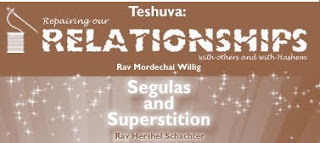

    Rav Mayer Twersky - Tefillah: Your Personal Connection: link
    Rav Hershel Schachter - "The Chumra of The Week": A Communal Cheshbon Hanefesh: link


    Rav Mordechai Willig - Teshuva: Repairing Our Relationships with Others and with Hashem: link
    Rav Hershel Schachter - Segulas and Superstition: link


    (Announce your simchah or Torah lectures by clicking on the button in the top right corner of Hirhurim. See here for readership statistics and here for instructions on buying an announcement.)


    Wednesday, September 23, 2009

    Parashah Roundup: Aseres Yemei Teshuvah through Simchas Torah 5770

    by Steve Brizel

    L'Zecher Nishmas R Pesach Oratz, Z”L

    Aseres Yemei Teshuvah
  • R Dr. Shnayer Leiman traces the origin of saying Psalm 27: link (audio)
  • R Yitzchak Etshalom discusses why the 132 Midos of Rachamim are the means of forgiveness: link
  • R Josh Flug discusses the acceptance of Chumros during Aseres Ymei Teshuvah: link
  • R Yonasan Sacks explores the emphasis on Kaparah and Taharah: link (audio)
  • R Dovid Gottlieb investigates the halachic consequences of not saying HaMelech HaKadosh: link (audio)
  • R Shmuel Maybruch discusses Pas Akum and Bishul Akum in the context of butternut squash: link (audio)
  • R Eytan Feiner explores many of the lesser known chumros associated with the Aseres Ymei Teshuvah: link

  • Click here for moreYom HaKippurim
  • Rav Soloveitchik ZTL discusses the halachic and hashkafic aspects of the Avodas Yom HaKippurim: link (audio)
  • R Hershel Shachter, based upon the teachings of Rav Soloveitchik, ZTL, explains why Yom HaKippurim is the Yom Tov of Torah SheBaal Peh: link
  • R Aharon Lichtenstein suggests that we think about Hesech HaDaas in the sense of our neglect and lack of conscious attention , examines Teshuvah rooted in spiritual maintenance and crisis and investigates the nature of the mitzvah of Shabbason on Yom HaKippurim: link 1, link 2
  • R Asher Weiss and R David Brofsky investigate the nature of the requirement of Inui on Yom HaKippurim: link 1 (audio), link 2, link 3
  • R Mordechai Willig and R Michael Rosensweig remind us of the importance of Teshuvah on Yom HaKippurim: link 1, link 2
  • R Ephraim Buchwald explains why Yom KaKippurim is referred to in the Torah as Shabbas Shabason-The Ultimate Shabbos: link
  • R Sir Jonathan Sacks contrasts the emphasis on Yom HaKippuim on receiving another year of life with the secular euthanasia rooted ethic that posits that man has the right to terminate his own life: link
  • R Berel Wein explains why Yom HaKipurrim is designed to allow us to investigate ourselves: link
  • R Aharon Lichtenstein suggests that we think about Hesech HaDaas in the sense of our neglect and lack of conscious attention , examines Teshuvah rooted in spiritual maintenance and crisis and investigates the nature of the mitzvah of Shabbason on Yom HaKippurim: link 1, link 2, link 3
  • R Ezra Bick examines the role of Selichos within the Tefilos of Yom HaKippurim: link
  • R Shlomoh Riskin explores the many moods of Yom HaKippurim: link
  • R Steven Weil , based upon the teachings of Rav Soloveitchik, ZTL, explores many aspects of the Machzor of Yom HaKippurim: link (video)
  • R Zvi Sobolofsky discusses the issues of Cholim on Yom HaKippurim: link (audio)

  • Sukkos
  • Rav Soloveitchik discusses Mitzvah HaBaah Bavera, Naanumim , various aspects of Sukkos and Hoshanah Rabbah: link (audio)
  • R Hershel Schachter discusses many aspects of Hilcos Sukkah and Arbaah Minim and the unique connection between the mitzvos of Sukkah and Arbaah Minim as representing the continuum of Jewish history: link 1 (audio), link 2 (audio), link 3
  • R Baruch Simon examines contemporary aspects of Hilcos Sukkah: link (audio)
  • R Michael Rosensweig explores the relationship between Yom HaKippurim and Sukkos: link 1 (PDF), link 2
  • R Zvi Sobolofsky discusses the halachic requirement of sleeping in tbe Sukkah: link (PDF)
  • R Michoel Zylberman examines the nature of the Mitzvah of Simcha on Yom Tov: link (PDF)
  • R Avraham Gordimer explores a Machlokes Tanaim between R Akiva and R Eliezer as to the nature of the commemoration that we mark by celebrating Sukkos and the unique halachos related to the first day of Sukkos: link 1, link 2
  • R Aaron Segal discusses the halachic ramifications of a Lulav Hayavesh: link (PDF)
  • R Daniel Stein examines the halachic issues associated with traveling during Sukkos: link (PDF)
  • R Joshua Flug explores many of the halachic issues involved with staying in a hotel on Shabbos and Yom Tov: link (PDF)
  • R Dr. Norman Lamm and R Hayyim Angel discuss many of the issues raised by Sefer Koheles: link 1 (PDF), link 2 (PDF)
  • R Shmuel Marcus and R Assaf Bednarsh discuss the Halachic and Hashkafic aspects of Hoshannah Rabbah: link 1 (audio), link 2 (audio)
  • R Michael Rosenweig and R Elchanan Adler explores the unique Simcha of Shemini Atzeres: link 1, link 2 (audio)
  • R Hershel Schachter reminds us of the nature of Simcha on Simchas Torah-the study of Torah and its pivotal role in Am Yisrael being the Am HaNivchar: link
  • R Daniel Z. Feldman, R David Hirsch and R Shalom Rosner discuss halachic and hashkafic issues associated with the last eight verses of the Torah: link 1 (audio), link 2 (audio), link 3 (audio)
  • R David Horwitz examines the connection between Parshas Vzos HaBracha and Parshas Breishis: link
  • R Avraham Gordimer contrasts the transition in Parshas Vayechi and the absence of a transition in Parshas Vzos HaBracha: link

  • Reason, Faith and Liberals

    About two weeks ago, I went to an author lecture sponsored by the Templeton Foundation. I knew nothing about the author or the book (Terry Eagleton, Reason, Faith, and Revolution: Reflections on the God Debate) -- just a high recommendation from the respected individual who invited me. I, therefore, expected, based on the book's title, to be treated to a thoughtful, professorial, slightly boring lecture on the arguments for and against God's existence, with an emphasis on the "for" side of the debate.

    Instead, I was greeted by a snide, condescending, ultra-liberal, anti-American socialist who -- despite having all the credentials and character traits of an atheist -- gave a profound critique of the "New Atheists" and a defense of religion. Despite his offputting nature, or perhaps because of it, I was sufficiently intrigued to read his book. Eagleton had given lectures in Yale's Terry Lecture Series on Religion in the Light of Science and Philosophy, which were then adapted into this book.

    Click here for moreThe first chapter of the book consists of Eagleton's unorthodox version of Christian theology -- anti-establishment, very liberal, and nothing that interests me for a variety of reasons. Aside from the witty and clever insults he throws at the New Atheists, whom he bizarrely combines into a single figure he calls Ditchkins. For example, and one that interests me for more than one reason: "From the viewpoint of Jewish tradition, a murdered Messiah is as much an outrageous anomaly or contradiction in terms as the sentence 'Ditchkins them humbly allowed that there was something to be said for the other side'" (p. 19). Clever but not very mature.

    The second chapter is all about politics, where Eagleton tries to show that his idiosyncratic version of Christianity is more liberal than the Atheism of the New Atheists. Again, not a theme that interests me. However, he also makes the strong point that the New Atheist critique of religion is extremely shallow. Collecting the most extreme examples from a variety of different religions and sects, and stringing them together to portray this hodgepodge of oddities as representative of religion in general, is neither honest nor convincing. As Eagleton puts it, they "buy their atheism or agnosticism on the cheap" (p. 91) by not putting together a solid critique of organized religion. Eagleton also points out the historical flaws in "Enlightenment" views, such as Marxist and Nazi atrocities. He does this while acknowledging that religion is also guilty of such atrocities and that the Enlightenment brought us many invaluable ideas.

    The third chapter, titled "Faith and Reason," is what I consider to be the heart of the book. This is where Eagleton makes his important points. In short, he says that reason does not "go all the way down" (p. 109). We use reason as much as possible but ultimately we have to take many things on faith. The Enlightment, the "Age of Reason," is long over because reason is itself unprovable. How do we know that reason even exists or that it is the right path to take? Science is built on unproven assumptions such as the existence of consistent laws of nature. "We need, for example, a commitment to reason itself, which is not itself reducible to reason. We can always ask ourselves why discovering the truth should be considered so desirable in the first place. Certainly Nietzsche did not think so, while Henrik Ibsen and Joseph Conrad both had their doubts about it" (p. 128). And there are so many unproven assumptions underlying the rationalist project that it is not just circular but impossible to build a worldview purely on empirically proven facts.

    More importantly, life is full of faith. Everyone, even the most ardent of rationalists, takes many things on faith. You can hardly function in a social setting without inferring and assuming. Eagleton writes sarcastically about the worldview of the New Atheists: "It involves, for example, no trust in men and women's rationality or desire for freedom, no conviction of the evils of tyranny and oppression, no passionate faith that men and women are at their best when not laboring under myth and superstition" (p. 124).

    Faith, conviction, passionate opinions are natural. "A hunger for absolute justification is a neurosis, not a tenacity to be admired. It is like checking every five minutes that there is no nest of hissing cobras under your bed, or like the man in Wittgenstein's Philosophical Investigations who buys a second copy of the daily newspaper to assure himself that what the first copy said was true. Justifications must come to an end somewhere; and where they generally come to an end is in some kind of faith" (p. 124).

    This is not to say that Eagleton is a Post-Modernist. Post-Modernism is philosophical nihilism: nothing can be proven and nothing is true. Eagleton goes in the other direction. Nothing can be proven and we therefore have to rely on faith to perceive truth. It is not that we choose what we believe (like Harry Potter) but that we reach conclusions without full rational justification. "Faith -- any kind of faith -- is not in the first place a matter of choice. It is more common to find oneself believing something than to make a conscious decision to do so -- or at least to make such a conscious decision because you find yourself leaning that way already" (p. 137). We do not jettison reason but we instead take it as far as it goes and then use our best judgment, with our full range of cognitive faculties, to continue the journey.

    A particularly well-spoken and antagonistic attendee at the author lecture asked Eagleton how he distinguishes between belief in God and superstition. Are all beliefs equally valid? Eagleton responded that there isn't a clear line between belief and superstition. There is a continuum and, presumably, you have to decide on your own where to draw that line.

    The final chapter sums up many of the ideas of the book and continues to emphasize the point that the New Atheists are very outdated. They subscribe to an idealistic notion of Progress, that Reason can save humanity. Not only is this an unproven claim that must be taken on faith, it is contradicted by history. Eagleton calls the New Atheists liberal humanists while he is a tragic humanist. The New Atheists believe "that if we can only shake off a poisonous legacy of myth and superstition, we can be free" (p. 168). Eagleton, however, has no such optimism and sees only tragedy in the human condition. Regardless of this Christian theology of his, the Marxist and Nazi atrocities show that Progress does not go in a straight line and the ejection of religious belief does not lead to freedom and peace.


    Tuesday, September 22, 2009

    The Problem of Chumras II

    In a post last year, I summarized R. Avigdor Nebenzahl's list of reasons why being overly strict has negative consequences (link). In the same book but a different section (Sichos Le-Yom Ha-Kippurim, pp. 18-20), R. Nebenzahl points out that Gedaliah, the last Jewish ruler over whose assasination we fasted this past Monday, was killed because he was too strict. He was warned that Yishmael, the renegade soldier, was plotting to assasinate him.

    However, he refused to listen to the lashon ha-ra. He insisted that he must dismiss the gossip. Really, he should have refrained from believing the rumor but taken precautions in case it was true. Because Gedaliah was too strict on the laws of lashon ha-ra and refused to listen to the accusations, the Gemara (Nidah 61a) considers him guilty of the murders that Yishmael ended up committing.

    Click here for moreIn life, we need to maintain a delicate balance. R. Nebenzahl illustrates this from the fast days over the destruction of the Temples, described in Zechariah (8:19): "The fast of the fourth month [17th of Tammuz], the fast of the fifth [9th of Av], the fast of the seventh [3rd of Tishrei], and the fast of the tenth [10th of Teves], shall be joy and gladness and cheerful feasts for the house of Judah. Therefore love truth and peace." Why does the verse end by telling us to love truth and peace?

    Gedaliah, in the above-mentioned story, preferred peace over truth and that sealed the destruction of the First Temple. R. Zechariah ben Avkulas insisted on rejecting a sacrifice from the king so as not to mislead people regarding the law (story here: link). He preferred truth over peace, which led to the destruction of the Second Temple. Rather, the key to success is to love both truth and peace (cf. Messilas Yesharim, ch. 20).


    The Holiness of Yom Kippur

    By: Rabbi Ari Enkin

    As this week is more of a time for contemplation and introspection, mussar rather than halacha, allow me to simply leave you with something I found to be very inspirational:

    "The Holiness of an ordinary weekday in Eretz Yisrael is like that of a Shabbat in Chutz La'aretz. The Holiness of Shabbat in Eretz Yisrael is like that of Yom Kippur in Chutz La'aretz. The Holiness of Yom Kippur in Eretz Yisrael cannot be found anywhere else in the world" -Zohar

    I first saw this teaching shortly after making Aliya five years ago and it has been with me daily ever since. Frankly, for me it is one of the most compelling pieces of introspection and mussar – to know that I am in the palace of the King, where the Holiness is incomparably powerful - and even tangible. How those of us who live in Eretz Yisrael must properly prepare for, utilize, and appreciate Yom Kippur.

    Click here for moreI implore you to keep in mind throughout the day on Yom Kippur that it is a happy day - one of the happiest days of the year, in fact! (Ta'anit 26b). It is the day that God puts His hand on your shoulder and says: "It's O.k. I forgive you." Think about it. GOD forgives YOU. As usual, I'll be with Rav Boaz and Yeshivat Lev Hatora on Yom Kippur – a place where Yom Kippur is entirely a day of simcha of ahava and yirah.

    To R' Gil, my co-bloggers, readers, and friends di bechol atar v'atar – May God bless you with everything good and seal you in the book of life.


    Sunday, September 20, 2009

    New Periodical: RJJ Journal no. LVIII

    The Succot 5770/Fall 2009 issue of The Journal of Halacha and Contemporary Society has been published:
    • Correcting the Ba'al Koreh: Punctilious Performance vs. Public Embarrassment by R. Moshe Rosenberg - A fantastic discussion of the multiple views over whether you have to correct a mistaken Torah reader, concluding that we must follow the view of the Rema and correct grammatical mistakes that change the meaning. Exceptions include when the reader does not normally differentiate in that grammatical sense. Plenty of examples of mistakes that can be made. And then practical advice on how to avoid these problems. My only comments are that he doesn't quote Tosafos (Avodah Zarah 22b) among the lenient authorities even though it seems to me that Tosafos is lenient; R. Tzvi Hirsch Grodzenski (Mikra'ei Kodesh ch.7 n. 35) seems to lean towards being lenient on this but leaves it "tzarikh iyun"; and, finally, R. Rosenberg seems to get way too much joy from this whole subject, there's enthusiasm bouncing out of every page of this article.

    • Click here for more
    • Shomer-Shabbat Residency by R. Dr. Raymond Sultan and Dr. Sammy Sultan - Oh boy. Basically an article arguing that medical students must forgo specialties that do not allow for Shomer Shabbos residencies. Quickly dismisses what I've been told by doctors (and I find hard to believe) that any residency can be made Shomer Shabbos if you know what you are doing.
    • Morgue Construction and Tum'at Kohanim by R. Yaakov Jaffe and R. David Shabtai - Discussing the theory and details of their advisory role in constructing a morgue for a nursing home that allow kohanim to enter the nursing home's building. Very interesting, even if somewhat specific to their case.
    • "Concierge" Medicine and Halacha by Noam Salamon - Discusses if and why doctors are allowed to be paid, with a little topicality in its application to "concierge" medicine. He could have benefited from seeing R. Yosef Kafach's commentary to Mishneh Torah (Hilkhos Talmud Torah 3:10) - discussed in these posts: I & II.
    • The Investment Advisor: Liabilities and Halachic Identity by R. Dr. A. Yehuda Warburg - Analyzing whether Ezra Merkin has to pay back his investors from the perspectives of the laws of damages (nezikin), bailors (shomerim) and agents (shelichim).


    New Periodical: Jewish Bible Quarterly XXXVII:3 (147)

    (Please bear with me as I catch up on periodicals over the next week or so)

    The July-September 2009 issue of Jewish Bible Quarterly:
    • Moonlit Leadership: A Midrashic Reading of Joshua's Success by R. Hayyim Angel - Great explanation of the different leadership styles and impacts of Moshe and Yehoshua, based on textual cues and reflecting the midrash that Moshe was like the sun and Yehoshua was like the moon. As always, a great article by R. Angel.

    • Click here for more
    • Lot's Failed Trial by Dr. Berel Dov Lerner - A speculative but thoughtful analysis of what Lot knew and was thinking as he was saved from Sodom.
    • Suicide in the Bible by Dr. Yael Shemesh - A comparison and contrast of the six suicides mentioned in the Bible, with some interesting conclusions. I think it could have used some halakhic discussion as well, but space was limited.
    • Critical Notes on Psalm 22:30 by Dr. Shaul Bar - A suggested interpretation of a difficult verse in Tehillim by making speculative textual emendations. Even if this isn't heretical, it makes me extremely uncomfortable.
    • Interpreting B-R-KH in Genesis 47 by Michael Alan Stein - Interesting attempt to analyze all uses of the root Barekh in Bereishis. I'm not quite sure if his findings are conclusive, but it's a good beginning.
    • At the Crossroads of Halakha and Narrative by Isaac Shalev - A clever midrashic analysis of the abortion passage (Ex. 21:22-25), connecting it to the story of Yaakov and Rachel running away from Lavan. Cute but far from peshat.
    • Life and Death in the Power of One's Tongue: The Case of the Son of Shelomith Bat-Dibri by (Reform) Rabbi Yossi Feintuch - Brief description of the dilemma facing the blasphemer (Lev. 24:10-12).
    • The Function of the Root Y-R-KH in Genesis by Dr. Ben Zion Katz - An interesting explanation of Yaakov's approach to deceit, based on the contextual meaning of the word Yerekh.
    • Serving God Out of Gratitude by Dr. Shubert Spero - Addresses the issue of why we need to serve God out of gratitude. This is the big question on the Chovos Ha-Levavos (Sha'ar Avodas Hashem) and Dr. Spero tries to show that it is really a biblical idea (oddly, he doesn't quote the Chovos Ha-Levavos). His conclusion is that it is some sort of natural law to respond in gratitude by fulfilling a request. I didn't find it compelling.
    • Seize the Moment by (Reform) Rabbi David J. Zucker - An interesting parallel between Yosef's and Yehudah's statements, and an application to everyday life.
    • Book Review: The Book of Genesis (by Sol Scharfstein) by Dr. Dan Vogel - I appreciated this review. When I first saw the book, I set it aside almost immediately as simplistically imprecise. Dr. Vogel explains what Scharfstein was trying to do and how he succeeded (and where he did not). I think I'll give the book a second look.


    Friday, September 18, 2009

    Happy New Year

    Le-shanah tovah tikasevu ve-sechasemu

    May you be inscribed and sealed for a good year


    תהא שנת עשירות

    or

    תהא שנת עלייה


    Click here for the Ezras Torah synagogue calendar for Rosh Hashanah: link.


    Announcements #115: YU Erev Yom Kippur Leil Iyun

    Erev Yom Kippur Leil Iyun

    Yeshiva University Center for the Jewish Future - Rabbi Isaac Elchanan Theological Seminary invite you to an
    Erev Yom Kippur Leil Iyun

    Motzei Shabbat, September 26, 2009
    9:30pm - Rabbi Dr. Jacob J Schacter
    Senior Scholar, Center for the Jewish Future
    Optimism, Hope, & Human Greatness: A Different Perspective on Yom Kippur

    10:30pm - Rabbi Aaron Kahn
    Rosh Yeshiva, RIETS
    Erev Yom Kippur - What Is It?

    Open to Men and Women • No Registration Required
    Complimentary Parking Available

    Yeshiva University Wilf Campus • Lamport Auditorium
    Entrance on Amsterdam Ave, between W. 186th and W. 187th St (Zysman Hall)

    For more information, please visit www.kollelyomrishon.org

    The Abraham Arbesfeld Kollel Yom Rishon Sunday Morning Learning Program for Men www.kollelyomrishon.org
    The Millie Arbesfeld Midreshet Yom Rishon Sunday Morning Learning Program for Women www.midreshetyomrishon.org


    (Announce your simchah or Torah lectures by clicking on the button in the top right corner of Hirhurim. See here for readership statistics and here for instructions on buying an announcement.)


    Thursday, September 17, 2009

    Audio Roundup LIX

    by Joel Rich

    I'd like to extend my wishes for a ktiva Vchatima tova to all and ask mechilla if in any way if I offended anyone in these posts (or in any other manner). I'd especially like to ask mechilla from all those whose shiurim I've reviewed if I didn't capture their essence or show proper respect.

    Question: If one has offended another and asks mechilla 3 times and is rejected and his halachic authority tells him to stop asking, what is his status vis-a -vis the "sin" he had committed (i.e. is he forgiven or just can't ask anymore but still has a blemish?)

    Click here for moreLastly, my answer to Richard Joel's reflections letter - Ask yourself (or better yet survey) what are the various publics' perceptions of YU? Is it viewed as an institution that fulfills "lo taguru" (fear no man) or is it one that defers to money or who you know? ( i don't know the answer) On this issue I defer to those wiser than me - as avi mori vrabbi ZLL"HH taught me: "Do not say things. What you are stands over you
    and thunders so I cannot hear what you say
    to the contrary."
    --Ralph Waldo Emerson


  • Rabbi Yehoshua Grunstein - Checking Tefillin in Elul - Law or Folklore?: link

    Shulchan Aruch says there’s no need to check tfillin (if they have a chezkat kashrut [presumption of Kosher] ). Mishneh Brura says if there’s a reason to suspect, then check. Elul practice of “anshei maaseh” (men of {good} acts) to check??
    So why check if there is a chezkat kashrut? Perhaps based on Mishkenot Yaakov’s famous “miyut hamatzui” concept (common, (e.g. 10%) occurrence) – unclear where Mishneh Brura knew it was a 10% probability of defect.
    Perhaps reason for concern is based on Meshech Chochma – if there is a defect in the tfilin and you wear them, you’re not Yotzeh. Thus, it’s a “good idea”. [me – so if you follow halacha re chezkat kashrut, you can still have a problem – does this follow for treifot that we don’t check for as well?]

  • Rabbi Noach Orlowek - Life in Turbulent Times: link

    Current financial crisis is a nisayon (test). Our generation is weaker but we can excel at chesed.
    Money Quotes – R’Simcha Wasserman – “In our times the Ribbono shel olam made a miracle; what’s the miracle? The girls only want to marry people who can’t earn a living”.
    R’Orlawek “People are sending their kids to schools where maybe with a calculator they’ll be able to add when they finish 8th grade. Why? Because the ruchniyot is better” [IIUC he thinks this is a positive].
    Money is important, the problem when it stands for something else.
    HKB”H made Rebbi and Rav Ashi wealthy and brilliant because everyone had to respect them so they could seal the mishna and Talmud(?).
    Worth the rest – don’t measure success on something outside yourself (me – be careful though, I know some people who are harder on themselves because they don’t achieve every iota they are capable of).

  • Rabbi Dr. Aharon Lichtenstein - Ramban on Devarim (hakdama): link

    Ramban on the torah as an irreplaceable commentary. Unlike Rashi and Ibn Ezra, his approach was to go wide and deep (no, not a fly pattern). This is compared to his commentary on shas which is continuing an existing stream.

  • Rav Mayer Lichtenstein - The Transmission of the Oral Law in the Thought of Rambam and Rabbeinu Tam: link

    Fascinating “inside baseball” look at two views of halachic history. Rambam took the “sealing” of the Talmud very seriously, tied to the disappearance of Bet Din Hagadol, there was a radical change in the nature of the mesora (passing on tradition). Rabbeinu Tam saw Geonic literature re as a continuation of the Talmud in terms of authority.
    Interesting (to me due to my lack of insight) thoughts on how Shulchan Aruch really aligned with “we’re not capable” school by not going back to explicating gemara for psak but by taking vote (Rambam, RIF, Rosh). Maharil took him to task on this.
    R’M Lichtenstein explains his father’s conceptual approach – explain all shitot but don’t focus on psak based on above. [me – don’t we lose touch with original basis by so many years of “don’t touch that dial?”]

  • Rabbi Meir Goldwicht - Tekah BeShofar Gadol LeChairutainu: link

    Classic R’Goldvicht – 3 seemingly unrelated questions tied together to one answer (Pilei Plaim – wonder of wonders). Here focused on Torah heard by the heart!

  • Rabbi Michael Taubes - Parshas SHoftim Non Mourning Kaddish: link

    R’YBS – chatzi (short) kaddish precedes prayer to create tzibbur (communal unit), Kaddish Shalem (whole) concludes the prayer. No interruptions allowed!
    Discussion of Rabbi’s Kaddish after aggadita or after any learning and/or after psukim.

  • Rav Mayer Lichtenstein - Shmita 2008 - Kashrut and Ideology: link

    Do we want an agricultural sector? How is the holiness of the land of Israel best maintained? What is the responsibility of the individual to society (e.g. if one is machmir for themselves and it causes society as a whole to suffer). Focus on kedusha from a positive viewpoint. Very thought provoking (somehow the expression Chosid in Peltz comes to mind).

  • Rabbi Dovid Gottlieb - Simcha on Rosh Hashana: link

    Simcha on Rosh Hashana – Is there a requirement, what is its nature as seen through allowability of tasting, prayer text, hallel and the Rambam’s famous statement on no “simcha yeteira” (extra joy). Nice close with tie in of R’YBS of simcha being lifhei hasheim (in front of HKB”H) and Rosh Hashana is a time of closeness (in front of) HKB”H of a different kind.

  • Rabbi Y Rimon - Hilchot Sukkot 1: link

    Halacha and Hashkafa concerning tiyulim (trips) on chol hamoed sukkot (keep the very big picture in mind).

  • Rav Mordechai Willig - Teshuva: Repairing Our Relationships with Others and with Hashem: link

    Act with tzedaka and chesed in our relationships with each other and HKB”H will repair our relationship with him.

  • Rav Hershel Schachter - Segulas and Superstition: link

    Halacha must be based on reality and must check out what reality is. My summary – no “superstition” except those mentioned in the Talmud (which are grounded in creation/reality). Minhag shtus is forbidden and must ask a Rav.
    Reminds me of R’Klapper’s comments concerning picking a general worldview and then go forward, to an extent ignoring the contradictory cases.

  • Rabbi B Lehman - Inyanei Tshuva 2: link

    Bechira Chofshit (freewill), personal responsibility, and R’Kook. Why the Rambam had to include mention of Bechira in hilchot tshuva.

  • Rabbi Y Rimon - Hilchot Sukkot 2: link

    Eating and drinking outside the sukkah. Why some are machmir not to do so at all.

  • Rav Mayer Lichtenstein - Meshuach Milchama: link

    Be a machaneh kadosh (“holy camp”) and then HKB”H will want to help. Discussion of war exemptions as well.

  • Rav Mayer Lichtenstein - tfillin: link

    Why talking between putting on tfillin is enough of a sin to get a draft deferment!

  • Rav Moshe Taragin - Tefilot of Yamim Noraim: link

    Section of Malchiyot (kingship) in Rosh Hashana davening analyzed.

  • Rav Yair Kahn - Ahavat Hashem Mei-Ahava: link

    Why is Ahavat Hashem (love of HKB”H) revisited in hilchot tshuva (laws of repentance) after being in sefer ahavah. Perhaps because reporting from far is a local issue (don’t want punishment) but from bvl is from a gbbal feeling of alienation and loss of connection. This would explain why in repentance from love, sins turn into brownie points since they were an integral part of process which brought man back to HKB”H.

  • Rashbash on the Judgment of Rosh Hashanah

    (repost of an earlier topic)

    An interesting example of the intersection of hashkafah (theology) and halakhah (law) is the rule about avoiding danger. The Rema (Yoreh De'ah 116:5), among a list of specific recommendations of dangerous practices to avoid, writes that you should flee a city in which there is a plague. Commenting on this, the Pischei Teshuvah (no. 8) and Darkhei Teshuvah (no. 95) cite a responsum from the 15th century Algerian Torah scholar, Rashbash (R. Shlomo ben Shimon Duran, son of the Rashbatz).

    Click here for moreIn this responsum (Responsa Rashbah, no. 195), the Rashbash responds to a query whether there is any theological purpose to fleeing from a city in which there is a plague. If your death has been decreed by God, then fleeing should not help. And if not, then there is no need to leave. The Rashbash's theological analysis serves as the basis not only of his own ruling but also of the Rema's practical ruling to flee such a city, at least as the Pischei Teshuvah and Darkhei Teshuvah understand it.

    Because of this responsum's importance, I would like to summarize its contents:
    1. Every person has an individual, set lifespan (cf. Ex. 23:26; Isa. 38:5; Ps. 39:5).

    2. This lifespan can be lengthened as a reward for doing good and shortened as a punishment for doing bad (cf. Deut. 30:16; Prov. 10:27).

    3. Someone who does not have sins that require shortening his life is not judged on Rosh Hashanah for life or death, but is judged for wealth and other things.

    4. Someone who is not judged for life or death on Rosh Hashanah is subject to premature death (i.e. not at his set time) due to chance, plague, war, etc. during that year (about death through accident or war, Rashbash quotes the Kuzari 5:20; Emunah Ramah p. 97; Magen Avos 5:21; see also Sefer Ha-Ikkarim 4:21).

    5. Since you do not know whether or not you were judged for death/life on Rosh Hashanah, you must avoid dangerous situations and flee from a city in which there is a plague.
    There is more to the responsum but this should suffice as a summary. I find it quite significant that the idea that someone can die by chance has halakhic ramifications and is quoted by significant authorities.


    Wednesday, September 16, 2009

    Interview with Gil Student

    The Jewish Press has an interview with me this week (link). Here's an excerpt and you can read the whole thing at the source:
    In the world of Orthodox blogs, few are as popular as Hirhurim.blogspot.com, run by Rabbi Gil Student. Visited over four million times since its founding five years ago, Hirhurim - which the Jerusalem Post ranked as the "Best Jewish Religion Blog" in 2005 - features informative, intriguing, and sometimes controversial discussions on halacha, Jewish philosophy, biblical stories, and more.

    Rabbi Student, the managing editor of OU Press and founder of Yashar Books, recently compiled some of his blog posts in book form. Released last month, Posts Along the Way, Vol. 1: Shuls includes 50 short essays on such topics as women rabbis, Carlebach minyanim, and the permissibility of holding one's child duringdavening.

    The Jewish Press recently spoke with Rabbi Student.

    Click here to read moreThe Jewish Press: What inspired you to start your blog in March 2004?

    Rabbi Student: At the time, there was a Jewish blog discussing homosexuality from a halachic perspective and I didn't feel the sources were being represented accurately.

    In 2006 the Conservative movement officially issued a permissive ruling on homosexuality. But back in 2004 they were in the discussion stage and a lot of discussion was happening online and via e-mail lists, and it had slowly moved to blogs.

    I decided to create my own blog to correct what I thought was an incorrect and misleading halachic position on this sensitive topic.

    Many people views blogs as forums for gossip and criticism of the Orthodox community establishment. What is your take?

    If you have a hammer, you can use it to build a house or bang someone on the head. It's a tool. It can be used for good or bad. Just as a newspaper can be used for gossip and horrible character assassination - a blog can also. And just like a newspaper can be used to enlighten the community and give it important information - a blog can also.

    What's your background?

    My background is, I think, part of what makes me interesting to people. I went to a Solomon Schechter elementary school - so I have a Conservative upbringing. Then I went to Frisch for high school, a very modern Orthodox school. For college I was in YU, and now I live in the moderate Yeshivish community on the outskirts of Flatbush.

    So I believe I have a pretty good idea of how all those communities, in general, think about various issues. So when new issues come up, I kind of think about them from various perspectives.

    It's very hard to pigeonhole me, and I get a lot of criticism for that. Some people think I'm an extreme left-winger, some people think I'm an extreme right-winger, and some people think I'm an extreme centrist. And I just don't think I'm any of them.

    How did a kid from Solomon Schechter wind up becoming an Orthodox rabbi?

    I don't really have a story. A person matures and thinks things from a different perspective. I have to do what I think is right, and I'm convinced that where I ended up is the right direction to be going.

    Is Student your real last name or a penname?

    It's my real name. Student is a legitimate Polish name that we can trace back to the 1870s; it was not changed at Ellis Island.

    You gained some notoriety four years ago when, as the president of Yashar Books, you decided to distribute Rabbi Nosson Slifkin's books despite a ban placed upon them by leading haredi rabbis. Can you talk about that controversy?

    It was a very polarizing debate and the people who opposed my position were very harsh in their condemnations; it was disillusioning and disturbing.

    I'll give you an example: a personal friend of Rabbi Slifkin started a blog against him criticizing him very harshly - theologically, ideologically and personally. I found it very disturbing that someone who knows so much Torah could be so personally hurtful.

    Why did you support Rabbi Slifkin?

    As a religious businessman I contacted various local rabbanim and asked them if they wanted these books available for their communities. I'm a firm believer that p'sak halacha be very specific to the individuals and communities involved.

    Rabbi Slifkin's books were written for people who have doubts or questions about their faith, particularly regarding so-called contradictions between Torah and science. In his books, he shows how the two can be reconciled. Many rabbis who recognize there are people in their communities who struggle with these issues asked me to make sure that Rabbi Slifkin's books were available in stores to help people, even after - and despite - the ban on the books.

    Earlier in your career you were involved in defending the Gemara against anti-Semitic charges. Can you talk about this?

    That must have been about ten years ago. I came across anti-Semitic accusations against the Talmud, which I knew historically had been around for centuries, but I was surprised to see people bringing them back up and posting them on the Internet. I felt it was important that someone should respond to them, so I spent time doing the research and posted a number of responses. To this day I get e-mails about it.

    How do you respond to people who claim the Gemara requires one mode of behavior vis-à-vis Jews and another vis-à-vis non-Jews?

    This is something that Rabbi Michael Broyde has written about in law journals - Judaism's approach to people within the legal system and outside of the legal system. For people who are outside the legal system and do not follow halacha, there's a different standard in how you treat them because it's not a reciprocal relationship. The Torah does not demand that you put yourself at a disadvantage because you follow halacha and they don't.

    Also, I think the general attitude is like a free market: you have to treat everyone fairly but everyone has to take care of themselves. Within your own community, though, you have to treat each other as family, just like if you were running a store you'd give a better discount to your brother than to some stranger off the street. The Jewish people [comprise] one big family.

    Charging interest [is an example of this]. There's nothing wrong with charging interest. It's standard business practice; there's an opportunity-cost of money. But when you're dealing with family, you give them an interest-free loan.

    Here and there, though, you hear Jews claiming one can cheat and lie when dealing with non-Jews.

    I think it's absolutely not true; it's a distortion of the Torah.

    So why do Jews say this?

    You're asking me a sociological question. Maybe it's a leftover from Europe when we were persecuted; maybe it's just an inner city mentality of everybody for themselves.

    You also wrote a book arguing that the Lubavitcher Rebbe cannot be Moshiach. Can you talk about that?

    I actually prefer not to. People get very offended by it. I wrote the book for ba'alei teshuvah to let them know that there's more than one perspective on the issue. I have no interest in fighting with Lubavitch.

    Any parting thoughts?

    I do want to say one thing: The Internet is a dangerous place and just because I'm writing on the Internet doesn't mean that I think it's good for everybody to just go on the Internet.

    I think it's important for people to use filters and to be careful about what links they click on. We really need to guard ourselves because there is a lot of schmutz out there.


    Twitter Delicious Facebook Digg Favorites More