Monday, April 30, 2007

Movers and Shakers in Post-War Orthodoxy

Dr. Marc Shapiro's 6 part series On Gedolim Movers and Shakers in Post-War Orthodoxy: The Satmar Rebbe, Rav Moshe Feinstein and Rav Ovadiah Yosef is starting this Monday April 30 at 9:00 pm DST (for six weeks).

We look forward to seeing you online. The E-TiM technology allows you
  • See and hear the a live shiur presented specifically for E-TIM participants
  • Have the ability to talk to the speaker and all other participants
  • Have the ability to be seen on screen
  • If you prefer you can write to the speaker comments and questions during the class

Register at www.torahinmotion.org and click on e-TiM or just click here


Pre-Shavuot Evening of Learning in Memory of Rav Mordechai Breuer

YESHIVAT CHOVEVEI TORAH RABBINICAL SCHOOL
AND CONGREGATION OHAB ZEDEK
invite the entire community to a special
Pre-Shavuot Evening of Learning
and Tribute in Memory of


Rav Mordechai Breuer zt”l
(1921–2007)
One of the leading Bible scholars, exegetes and
educators in our generation who was at the forefront
of the revival of serious and creative Tanakh study
in Modern Orthodox circles in Israel and America.

Wednesday, May 16, 2007
29 Iyar 5767


at Congregation Ohab Zedek
115 West 95 Street, New York, NY 10025

7:30 pm: Minha

7:45 pm: Remarks in Tribute to Rav Breuer zt”l
Rabbi Nathaniel Helfgot

Chair, Departments of Bible and Jewish Thought, YCT Rabbinical School
Rabbi Allen Schwartz
Rabbi, Congregation Ohab Zedek

Keynote Lecture:
Be-Sifrei RaMad Al Tishlah Yad: Rabbi Moses Sofer’s Attitude
to Moses Mendelsohn’s Bible Translation and Commentary
Dr. Shnayer Z. Leiman
Professor of Jewish History and Literature
Brooklyn College and Yeshiva University


Ma’ariv at Conclusion of Program


Sunday, April 29, 2007

The Sale of Chometz by Nonobservant Jews

From Yated Ne'eman (link):
HaRav Eliashiv told us that the sale of chometz by a nonobservant Jew who signed on the commonly-used document empowering an agent to sell his chometz for him to a non-Jew, cannot be relied upon. Such a document has no validity whatsoever and is worth no more than the paper on which it is printed. The chometz must be regarded as having remained the Jew's property over Pesach and its consumption or any other form of benefit is forbidden. The proof that there has been no sale is that if the buyer wanted to actualize the transaction, the nonobservant seller would object that he only signed the document for religious purposes, not to be carried out. The document must therefore be written in a way that makes it legally binding. When the signatory knows that its terms can be enforced legally, the transaction can be regarded as valid...

After discussions with a number of legal experts, four paragraphs were added to the standard document which establish that any further discussion of the transaction will be conducted before beis din only, and that the seller is aware at the time of signing that beis din will not accept the argument that he only signed for religious purposes. In addition, he forgoes the right to claim that the document is "merely for religious purposes." This renders his signature binding, thereby giving it halachic validity as well.


Conversion Agreement

Hot off the press release:
RCA and Israeli Chief Rabbinate Announce Historic Conversion Agreement

Apr 27, 2007 -- The Rabbinical Council of America (RCA), the largest Orthodox rabbinic group in the world, will hold a press conference at its forthcoming Annual Convention, to be held at the Museum of Jewish Heritage, at 36 Battery Place, Manhattan, on Monday April 30th, 2007, at 2.30pm, at which time it will officially announce a formal agreement entered into by the RCA (together with its associated Beth Din – the Beth Din of America,) and the Chief Rabbinate of the State of Israel, that will formalize in detail mutual recognition of Orthodox conversions to Judaism.

The agreement is the product of a year long process. It involves the automatic recognition in Israel of conversions performed by any one of the participating Batei Din (rabbinical courts) which will be part of the soon to-be-established network of Regional Batei Din for Geirus (Conversion.) All participating Batei Din will work closely with the Beth Din of America, and its director Rabbi Yonah Reiss, in implementing the agreement. Some of the Batei Din are of long-standing duration, while others will be established in the months and years ahead, but all of them will follow the strict standards, policies, and procedures, that have been agreed upon. These will include standardized procedures at every step of the conversion process, as well as standardized requirements, documentation, qualifications for batei din dayyanim (judges), conversion of minors, and resulting certificates of conversion. A central office will maintain comprehensive database information to ensure proper registration and sharing of information among participating batei din and the Chief Rabbinate in Israel and others around the world, in the present and for future generations.

An inaugural conference of first stage participating batei din was held several months ago in Chicago. At each stage of implementation process others will be added.

Rabbi Barry Freundel, Chairman of the joint Geirut Policies and Standards (GPS) Committee issued the following statement: “This historic and long-overdue agreement is a major milestone – not just for future converts to Judaism and their descendants, but for the entire Jewish people, in North America, Israel, and around the world. By thus standardizing conversion procedures and standards, many individuals, families, rabbis and Jewish communities will be able to avoid many of the problems heretofore experienced. The RCA is proud to have worked with the Israel Chief Rabbinate in bringing about a truly beneficial agreement, now and for the future.”

And Rabbi Shlomo Amar, Sefardic Chief Rabbi of Israel, who is also the President of the State of Israel’s Rabbinical Courts, said “I am most pleased by this agreement between the Chief Rabbinate, its rabbinical courts, and the Rabbinical Council of America, one which I fully anticipate will be a model for Jewish communities all over the world.”


Friday, April 27, 2007

The Uncircumcised

R. Joseph B. Soloveitchik relates the following story about his illustrious grandfather, Reb Chaim, in Halakhic Man, p. 40:
Once R. Hayyim of Brisk was attending a conference of outstanding Torah scholars in St. Petersburg. The item on the agenda was the question of uncircumcised infants--should their names be entered in the official register of the Jewish community. All of the rabbis declared: "It is certainly forbidden to register them, for they are not circumcised." (Through this tactic they hoped to compel the assimilationists to circumcise their sons.) R. Hayyim arose and said: "My masters, please show me the halakhah which states that one who is not circumcised is not a member of the Jewish people. I am aware that a person who is not circumcised may not partakes of the sacrifices or the heave offering, but I am unaware that he is devoid of the holiness belonging to the Jewish people. To be sure, if he comes of age and does not circumcise himself he is liable to excision. However, he who eats blood and he who violates the Sabbath are also liable to excision. Why then do you treat the uncircumcised infant so stringently and the Sabbath violator so leniently? On the contrary, this infant has not as yet sinned at all, except that his father has not fulfilled his obligation." From a political and practical perspective, and as an emergency measure, no doubt the majority was correct. However, on the basis of the pure Halakhah, R. Hayyim was correct. And he would not sacrifice this halakhic truth even for the sake of realizing the noblest of ideas.
It is clear from the story that R. Chaim Soloveitchik's contemporaries disagreed with him. Who were they? I don't know, although I recall seeing that R. Avraham of Sochatchov, the Avnei Nezer, disagreed but I cannot seem to find any documentation of it right now. I did find, in Dr. Adam Ferziger's Exclusion and Hierarchy, that many outstanding German Torah scholars disagreed with R. Soloveitchik's position.

1. R. Ya'akov Ettlinger -- p. 92:
In 1843, a number of individuals within the community of Frankfurt am Main demanded to register their newborn sons as Jews despite their unwillingness to have them circumcised. Numerous Orthodox rabbis were asked to author official protests in support of the struggle of the local rabbinate against these individuals. Most of those who responded, including [R. Ya'akov] Ettlinger, rabbi of Altona, demonstrated their basic agreement with the declaration of the chief rabbi of Frankfurt, Solomon Trier: "The father who persists in his sin and contemptuously, with evil intent and renunciation of the Torah, does not allow his son to be circumcised, is a heretic, has left the Jewish people, and is disqualified from giving testimony or taking an oath."
2. R. Samson Raphael Hirsh -- pp. 125-126
Beyond demonstrating strong opposition to marriage between Orthodox and non-observant Jews, there were other means by which the Hirschian hierarchy was maintained, such as the criteria for membership in the IRG. According to the by-laws passed in 1875, there were three gradations of Jews. The lowest level comprised those who were uncircumcised or had not circumcised their children... All of the above were declared outcasts and were forbidden membership in the IRG [community].
3. R. Azriel Hildesheimer -- pp. 160-161:
In he summer of 1886, [R. Azriel] Hildesheimer was asked whether uncircumcised thirteen-year-olds could be called up to recite the blessing on the Torah in honor of their bar mitzvah. As in the responsum concerning the Halberstadt defectors, Hildesheimer strived to defend a lenient attitude, demonstrating complete sympathy for these children whose "unfortunate" circumstance was caused by their wayward parents and even bringing halakhic arguments to their defense... Surprisingly, however, his analysis of the issue ended with his saying, "Despite all of the above, it appears to be proper to strengthen this orphaned generation by placing within the mouths of the masses the deepest conviction [emunat o-men] that one who des not enter into the holy covenant is not like others who abandon the religion (whom we permit to be called to the Torah)." Although he sympathized with the boy's predicament, broader considerations led him to believe that it might be better not to allow an uncircumcised child to be called up to the Torah.
4. R. David Zvi Hoffmann -- p. 182 (from a 1902 article of his):
But it seems to me that in order to fence in the law [le-migdar milta], we should prevent his burial among the other graves, in order to punish the rebels who violated the covenant of Abraham our Father, may he rest in peace, and who do not circumcise their sons, so that they may "hear and be afraid" and will know that by virtue of this [decision not to circumcise their sons] their children will be separated from the seed of Israel completely, and even after death, they will not have burial among the children of Abraham our Father, may he rest in peace.


Wednesday, April 25, 2007

Knowing It When You See It

Lev. 20:25-26:
כה והבדלתם בין הבהמה הטהרה, לטמאה, ובין העוף הטמא, לטהר; ולא תשקצו את נפשתיכם בבהמה ובעוף, ובכל אשר תרמש האדמה, אשר הבדלתי לכם, לטמא. כו והייתם לי קדשים, כי קדוש אני יהוה; ואבדל אתכם מן העמים, להיות לי.
25 Ye shall therefore separate between the clean beast and the unclean, and between the unclean fowl and the clean; and ye shall not make your souls detestable by beast, or by fowl, or by any thing wherewith the ground teemeth, which I have set apart for you to hold unclean. 26 And ye shall be holy unto Me; for I the LORD am holy, and have set you apart from the peoples, that ye should be Mine.
The Torah uses the same word in two adjacent verses for two different purposes. We must distinguish (והבדלתם) between kosher and non-kosher animals, and God will distinguish (ואבדל) between us and the nations. If I recall correctly, R. Avigdor Nebenzahl, in his published lectures on Parashas Bo, explains that this is a general rule regarding distinguishing, that making proper evaluations according to the Torah is never simple.

The Sifra (10:12) explains that distinguishing between a kosher and a non-kosher animal refers to being able to differentiate between an animal that had more than one and a half of its simanim slaughtered and one that had exactly one and a half cut. As the midrash states, it is a matter of a hairsbreadth. R. Nebenzahl explains that this is the case in general. Thus, the different between chametz and matzah is a matter of seconds, if not less.

Knowing the difference between what is right and what is not, what is kosher and what is not, is a matter that requires great expertise. You don't "know it when you see it." You might know what is not the practice in your community by sight, but that doesn't mean that other practices are improper. It takes great expertise and care to evaluate situations properly and make determinations that are precise.


Recent Articles

Two articles about abuse in Baltimore, one in the Forward (link) and one by frequent commenter Elliot Pasik in The Jewish Press (link).

The Jewish Press also had an interesting interview with Dr. Marc B. Shapiro (link). Timely excerpt about yeshiva curricula:
[Y]eshivas today don’t teach Jewish philosophy or theology. They teach hashkafa and emunah, which is fine, but that’s more like indoctrination. And whereas people are very sophisticated when it comes to Talmud study and they’ll look at all the different shittos, when it comes to philosophical study of Judaism – its history, its ideas – they’re not sophisticated and they’re not interested.

This prevents us from being able to respond to ideological challenges. Just as we assume that someone who approaches halachic issues without having a firm grasp of responsa literature, Shas and poskim is not doing his job, the problem here is that many people who approach the non-halachic matters don’t really have any background. It’s a serious discipline, Jewish philosophy and theology – just as serious as halacha, but not taken so.


Funeral Today

Baruch Dayyan Emes - the father of Mr. Zvi Erenyi, librarian at the Mendel Gottesman Library, was niftar yesterday. The levayah will be taking place today at 12:45 at the Parkside Memorial Chapel at 98-60 Queens BLVD in Forst Hills, NY. There is a concern that there will not be a minyan at the Beis Olam. If anyone can find the time to help out to make sure there is a minyan it will be greatly appreciated. I think the interment will be happening in Paramus, NJ at the Beth El and Cedar Park Cemeteries. For more info you can call the library at 212-960-5382.


Tuesday, April 24, 2007

Takkanos and Korbanos

This past Shabbos, I was thinking about two sacrifices mentioned in each of Parashiyos Tazria and Metzora. The sacrifice a woman is supposed to bring after recovering from having a child and that a Metzora (commonly translated as leper) brings after his illness are both examples of a korban oleh ve-yored (see Mishneh Torah, Hilkhos Shegagos ch. 10). There are two levels of the sacrifice to be brought. Someone who can afford it, brings a more expensive sacrifice and someone who could not, brings a less expensive sacrifice.

This seems to me to be contrary to the general thinking behind the "Wedding Takkanos" that were attempted a few years ago (and have failed miserably). There is a concern that weddings are overly expensive and that those who cannot afford to pay for such weddings are being socially pressured to spend beyond their needs and go into unmanageable debt. Therefore, various limits were placed on weddings to keep their costs within reach.

But, I was thinking, the Torah itself doesn't seem particularly concerned that poor people would be embarrassed for not bringing the sacrifice of a rich person. Why didn't the Torah just set the sacrifice for the poor person as the standard and tell rich people not to put social pressure on others? Instead, it allowed for rich people to spend more money on their sacrifices and, those who could not afford it, to spend less. There is a machlokes rishonim about this, but some consider it appropriate for poor people to try to bring a rich sacrifice even though they are not obligated to do so (see Sefer Ha-Chinukh 123 and in note 14). So why are we today so concerned that poor people won't be able to afford an expensive wedding? Just like they bring a poor person's korban oleh ve-yored, they should make a poor person's wedding.

Yet, our sensibilities seem to follow those of the Gemara, as explained in Mo'ed Katan (27 a-b) regarding burial and mourning practices. To avoid the embarrassment of poor people who could not afford to perform certain practices, everyone was treated equally. The question, then, is why Chazal did not follow the example set by the Torah with the korban oleh ve-yored?

I was thinking that perhaps the sacrifice is essentially a private matter, even though technically done in public. People would generally not discover what kind of sacrifice their neighbors brought and therefore poor people would not be embarrassed. Although I'm not sure that this is true.

Alternatively, perhaps the sacrifice has a limit while the spending on weddings do not. Maybe even the practices in the Gemara also have no technical limit. Therefore, we can impose a limit, just like the Torah does.

I'm not particularly satisfied with either answers. Does anyone have any suggestions?


Mussar Kallah V

Announcing Mussar Kallah V (2007)

link

The Mussar Kallah is an annual gathering that brings together some of the most highly regarded teachers of Mussar along with students, seekers and others curious to learn more. The Mussar Kallah is simultaneously a conference, workshop, dialogue and creative discussion that is weaving Mussar into modern spiritual life.

The first Mussar Kallah took place in New York in 2003, Mussar Kallah II in Houston in 2004, Mussar Kallah III in San Francisco in 2005 and Mussar Kallah IV in Chicago in 2006.

Until recently, Mussar only existed in the world of Orthodox Judaism, but even there, the ravages of the Holocaust resulted in the living heirs to a millennium of spiritual exploration and innovation being swept from the face of the earth. The embers of Mussar have continued to glow, however, and this tradition is being rediscovered today in response to the spiritual yearning that is arising in every corner of the Jewish world. Find out more about Mussar.

DATES & LOCATION

Date: Sunday, April 29th, 2007
Location: Touro College South
Address: 1703 Washington Avenue, Miami Beach, Florida, 33139

View Mussar Kallah Program


Monday, April 23, 2007

A Letter about Rabbi Horowitz

Mishpacha Magazine recently published a letter to the editor regarding R. Yaakov Horowitz's column that R. Horowitz reproduced on his website (link). This letter has raised a bit of a stink on various blogs because R. Horowitz is, to some extent, a darling of the anti-frum-establishment community and any criticism of him or his agenda is unappreciated. While I happen to be a fan of R. Horowitz, and the one time we met was an extremely pleasant and rewarding experience, I think there is some truth to the letter. I do not remotely suggest that R. Horowitz should immediately abandon his life's work because of this letter. However, I am a believer in taking all criticism seriously and trying to see what truth and lessons can be learned from it.

Here is an excerpt of the letter (which can be found in its entirety here) with what I consider the most important section highlighted:
I’m surprised and upset that Mishpacha printed a column which, reading between the lines, recommends going back to the “old school,” where subjects were taught which opened up “more careers” for the students — computers, math, science, etc.

I understand the logic: If the “best schools” would teach subjects which were interesting to children on the brink, these children might remain. Now these schools teach only Gemara, so these children are bored and fall even faster.

If we teach many secular subjects in our school, will Torah giants emerge? Or does that not make a difference? How does Rabbi Horowitz know that it’s more important to save the falling children? Maybe it’s more important to save the ones with true potential to reach the greatest heights?

Rabbi Horowitz is worried that within a few years many children will fall off the derech. I’m afraid that if his plan for the yeshivos is accepted then the children will fall off the derech — if not this generation, perhaps the next. The responsibility of changing the schools based on a doubtful theory is very scary. (Is the dropouts percentage smaller in girls’ schools which teach secular subjects? I don’t think so.)
Let me repeat this key sentence, ignoring the poor grammar (at least the letter writer practices what he preaches): "The responsibility of changing the schools based on a doubtful theory is very scary."

One of R. Horowitz's key themes is that our current system of education is driving kids out of the community, off the derekh. We need to change how we raise our youth, R. Horowitz argues, because otherwise disaster is impending.

Is he right? I don't know. Where's the data backing up his theories? Where are the studies proving his point? As I pointed out in this post, a lot of the discussions on this topic use a few anecdotes and statements from "experts" (usually including R. Horowitz) to prove their points. While my gut tells me that he is right, are we really ready to make such a radical change without conducting rigorous analysis? Social experimentation is risky, especially when dealing with a community that is a link in a chain of tradition that spans thousands of years.

Will such studies silence the right-wing critics? Unquestionably not. But perhaps we owe it to ourselves to take this criticism seriously and proceed with due caution.


JIB Awards - First Round

The voting in the first round of the JIB Awards begins today.

This blog was nominated in four categories, although one of those categories (Best Post) will not be voting for another week:
  • Best Overall Blog - First Round Group B - vote here

  • Best Religious Blog - First Round Group C - vote here

  • Best Torah Blog - First Round Group B - vote here
Make sure to check out the other categories and other nominees.


Sunday, April 22, 2007

Hallel on Yom Ha-Atzma'ut

R. David Shabtai was kind enough to send me this summary of rationales and views on the recitation of Hallel on Yom Ha-Atzma'ut.

Hallel on Yom ha-Atzma'ut
Summary of Rationales

  • Against reciting Hallel
    • Ideological Objections
      • The establishment of the State of Israel is viewed negatively; there is no value, religious or otherwise in a State without the Messiah.
      • There is no significant religious value in a State that is not run according to Jewish Law.
      • While significant in may ways, the State of Israel is not inherently religiously or estachatologically important.
    • Technical Objections
      • The war has not ended; people are still suffering and dying.
      • Even if the establishment of the State is considered the start of the redemptive process, Hallel should be reserved for the ultimate redemption.
      • It is inappropriate to add any festivals to the calendar to mark events in Jewish history (one may [perhaps should] intend that the Hallel on 1 Iyyar incorporate the miracles surrounding the establishment of the State).

  • In favor of reciting Hallel:
    • Half
      • The introduction of Hallel into the services should follow the model of Rosh Hodesh.
      • While it is appropriate to say Hallel, the Talmud (Shabbat 118b) warns against reciting Hallel “each day.” This warning only applies to the complete Hallel.
    • Full Hallel with a blessing:
      • The day is established as a real holiday.
      • A blessing is appropriate for the initiation of the redemptive process.
      • The miraculous nature of the founding of the State demands a blessing.
      • The miracles occurred for all of kelal Yisrael, halakhically defined.
      • Should depend on the community's practice with regard to reciting half Hallel on Rosh Hodesh.
    • Full Hallel without a blessing:
      • In theory it would be appropriate, but practically unwise and should not be done
        • The Chief Rabbinate ruled to recite Hallel without a blessing.
        • Out of respect for the “Hareidi” rabbis who opposed saying anything at all (as a compromise).
        • Not to promulgate unnecessary dispute.
      • Inherently inappropriate to recite a blessing:
        • Safek berakhah le-battalah.
        • The miracles did not occur to all of kelal Yisrael.
        • The joy of the establishment of the State was mixed with tragedy.
        • The lack of Jewish character of the current State and lack of Jewish awareness by a majority of its inhabitants militate against a complete expression of joy.
        • A congregation should not recite a blessing, but individuals who choose, may do so.
        • The enemies of the State continue in their belligerency; the wars have not effectively ended.

    • When to be said
      • At night
        • Since the vote in the United Nations was at midnight, it is appropriate to recite Hallel (without a blessing) in the evening as well.
      • After shemoneh esrei
        • Hallel should be recited at the same point in the service that it is recited on other festivals
      • After the conclusion of services
        • Al pi ha-sod” it is preferable not to introduce any breaks into the standard order of prayer services that were not instituted by the Sages to be done on those specific days.
        • Even from a more traditional perspective, it is still inappropriate to change the order of the prayer service.
        • The redemption is, as yet, incomplete and therefore Hallel should be delayed until the conclusion of services.
        • After kaddish titkabal one may recite Hallel since the main section of the services has ended and there is some hesitation to introduce it into the normal order.


Name No Full Half Blessing When
R. Yoel Teitelbaum[1] X        
R. Zvi Pesah Frank[2] X        
R. Yosef Shelomoh Kahaneman X        
R. Eliezer Waldenburg[3] X        
R. Shelomoh Goren   X   Yes  
R. Meshullam Roth[4]   X   Yes  
R. Shelomoh Yosef Zevin   X   Yes  
R. Yehudah Gershuni   X   Yes  
R. Hayyim David ha-Levi   X   Yes  
R. Natan Zvi Friedman[5]   X   Yes  
R. David Hayyim Sheloush[6]     X Depends ...  
R. David ha-Kohen[7]   X   No  
R. Isser Yehudah Unterman[8]   X   No, unless that is your custom  
R. Yitzhak Nissim[9]   X   No, unless that is your custom  
R. Yosef Dov Soloveitchik[10]   X   No  
R. Aharon Lichtenstein   X   No  
R. Ovadiah Hedayah[11]   X   No After services
R. Ovadiah Yosef[12]   X   No After services
R. David Lifshitz[13]   X   No  
R. Ahron Soloveitchik[14]   X   No  
R. Avraham Shapira[15]   X   No, unless that is your custom  
R. Shalom Yitzhak ha-Levi   X   No  
R. Ben Ziyyon Hai Uziel[16]   X   No  
R. Y. Berman[17]   X   No  
R. Elazar Man Shach[18]   X   No  
R. Shaul Yisraeli[19]   X   No  
R. Ushpizai[20]   X   No  
R. Shalom Mesas[21]   X   No  
R. Y. Harlop[22]   X   No Night
R. Mordekhai Eliyahu[23]     X No Before kaddish titkabal
R. Menashe Klein

R. Shemu'el Wozner

R. Yosef Shalom Elyashiv

R. Shelomoh Zalman Auerbach

R. Yitzchak Hutner

R. Moshe Feinstein
        Unable to determine their positions – it seems logical
to assume that they oppose the recitation of Hallel.
R. Hershel Schachter   X   No Preferably after services
R. Moshe Zvi Neriyah[24]     X No  
R. Yitzhak Weisz[25] X        
R. Ya'akov Kaminetsky[26] X        
R. Menachem Mendel Schneerson[27] X        
[1] Va-Yo'el Moshe.

[2] Cited in Shu”t Yabi'a Omer OH 6:41.

[3] Shu”t Tzitz Eliezer 10:10.

[4] Shu”t Kol Mevaser 21.

[5] Netzer Mata'ai 36.

[6] Shu”t Hemdah Genuzah 36.

[7] http://www.daat.ac.il/DAAT/ezrachut/harabanut3-2.htm note 33.

[8] Ibid.

[9] R. Shelomo Aviner, Be-Ahavah u-ve-Emunah (Beit El, Israel: Sifriyat Hannah, 2000), 312.

[10] Recorded by R. Shalom Carmy; http://www.aishdas.org/avodah/vol03/v03n056.shtml#11.

[11] Shu”t Yaskil Avdi OH 6:10:7.

[12] Shu”t Yabi'a Omer OH 6:41.

[13] http://www.aishdas.org/asp/2005/05/yom-haatzmaut.shtml.

[14] http://hirhurim.blogspot.com/2005/05/religious-zionism-debate-v.html.

[15] R. Shemuel Katz, Ha-Rabbanut ha-Rashit le-Yisrael: Shiv'im Shanah li-Yesodah, Samkhutah, Pe'uloteha, Toldoteha (Jerusalem: Heikhal Shelomoh, 2002), 902.

[16] http://www.daat.ac.il/DAAT/ezrachut/harabanut3-2.htm.

[17] http://www.daat.ac.il/DAAT/ezrachut/harabanut3-2.htm note 30.

[18] http://www.daat.ac.il/DAAT/ezrachut/harabanut3-2.htm note 53.

[19] R. Shemuel Katz, Ha-Rabbanut ha-Rashit le-Yisrael: Shiv'im Shanah li-Yesodah, Samkhutah, Pe'uloteha, Toldoteha (Jerusalem: Heikhal Shelomoh, 2002), 901.

[20] Ibid., 902.

[21] Shu”t Shemesh u-Magen OH (3:63, 66).

[22] http://www.daat.ac.il/DAAT/ezrachut/harabanut3-2.htm note 48.

[23] http://www.moriya.org.il/shut/index.asp?SubList=84&RavList=0&answer=0&question=0&coteret=0&q=&page=3.

[24] Quoted in Shu”t Yabi'a Omer OH 5:35:5.

[25] Shu”t Minhat Yitzhak 10:10.

[26] Shu”t Minhat Yitzhak 10:10:end.

[27] Iggerot Kodesh 25, 257. Also see Sihot Kodesh 5727, vol. 2, 313 regarding Yom Yerushalayim, quoted in R. Yaakov ha-Levi Horowitz, “Al 'Yom Yerushalayim:” 28 Iyyar ke-Yom Hag – ha-Omnam?,” Pardes Habad 11 (5763): 166.


Friday, April 20, 2007

Is God a Republican?

A few weeks ago, David Klinghoffer wrote an article titled "Is God a Republican?" (link). To the dismay of my one or two liberal readers, let me say that I like Klinghoffer. He's a good writer, a thoughtful person and someone who tries to inform his life and politics with Judaism. I often find myself agreeing with him. Often, but not always. On this issue, I find his arguments to be way off.

In this article, Klinghoffer tries to make the case that the Torah philosophically supports the conservative social agenda. Liberals supposedly believe that people have no free will and are forced by nature to do certain things, while conservatives believe that people have free will and should suffer the consequences. Thus, conservatives oppose gun control because people are not compelled by nature to use guns to kill. People are not trapped by their skin colors but have opportunity before them; therefore affirmative action is wrong. Regarding health care (and presumably retirement plans), we should let people decide and not force them into anything.

These kinds of arguments are, in my opinion, all wrong. I believe the same argument can be made for any political party. Maybe Klinghoffer is merely trying to offset the Reform idea that "Prophetic Judaism" supports the Democratic Party. I don't know. But I find Klinghoffer's argument to be farfetched.

For example, an argument could be made that the Torah gives each individual the choice whether to be righteous or not. Therefore, all decisions should be left to the individual. In other words, God is a Libertarian. Abortion should be left to the individual (woman and doctor) because God gives us the choice whether to maim/kill or not. Global warming? It's up to each individual whether or not to sin and pollute the environment.

Or the argument can be made that, historically, the Torah community has created communal charities and forced individuals to contribute to the them, i.e. welfare. The Bible is full of chastisements against the community for insufficiently caring for the poor and looking out for the weak. God must be a Democrat because he certainly wants us to protect the poor. Recall that, despite every individual's freedom of choice, the Torah prescribes severe punishments on sinners and requires that communities appoint judges to ensure that everyone follows the laws.

On the other hand, considering the corruption and lying in the political parties, perhaps God is an independent.


Thursday, April 19, 2007

Yashar Chapters 1:1—The Right to Life and the Right to Die

Dear friend,

Welcome to a new newsletter from Yashar Books, in which we send you complete chapters from a recent book of interest. This issue’s book is Rabbi David M. Feldman’s Where There’s Life, There’s Life. The book addresses emotional and ethical issues that arise for friends and relatives in the care of elderly and sick loved ones. With an aging “Boomer” population and the rise of what has become called “The Sandwich Generation”—people who have to care for their children and their parents—this book could not be more timely. Rabbi Feldman, long known for his scholarly writings, decided to write this book in a popular, easily read format rather than a scholarly style. In this book, he wants to address the average person struggling with life-and-death decisions and point out the inspiring attitude that Judaism has to offer. Please read below Rabbi Feldman’s chapter on suicide and the right to die. Given the sensitive yet fundamental nature of this discussion, this should be of great interest to you.

More information about the book can be found at the Yashar website. It can be purchased at your local Judaica store, on Yashar’s website and on Amazon.com.

The goal of this newsletter is to spread Torah and to introduce you to books that you might find interesting, without the risk of you having to pay first. In that end, please feel free to forward this newsletter to anyone you think might be interested or to quote it entirely or in part in your blog, newspaper or magazine. Just please be sure to note the author’s name and the book’s title: David M. Feldman, Where There’s Life, There’s Life.

Read the chapter here: http://www.yasharbooks.com/Chapters0101.html


Thank you,

Gil Student
www.YasharBooks.com


New Orleans and the Mind of God

There's a new tradition out. Here is the table of contents:
  • Editor's Note: "He Loved People" by R. Shalom Carmy

  • "Plunging into Mighty Waters and Emerging with a Broken Shard": New Orleans and the Mind of God by R. Emanuel Feldman

  • A Rabbinic Exchange on the Gaza Disengagement by R. Avraham Shapira and R. Aharon Lichtenstein

  • Sex Selection and Halakhic Ethics: A Contemporary Discussion by Dr. Joel B. Wolowelsky and Dr. Richard V. Grazi; R. Kenneth Brander; R. Barry Freundel; Dr. Michelle Friedman; R. Judah Goldberg; R. Ben Greenberger; Dr. Feige Kaplan, Dr. Edward Reichman; Dr. Deena R. Zimmerman

  • From the Pages of Tradition: R. Raphael of Bershad's Commitment to Truth by R. Shnayer Z. Leiman

  • Survey of Recent Halakhic Preiodical Literature: Cadavers on Display by R. J. David Bleich

  • Communications
    • Medical Malpractice and Jewish Law by Dr. Maier Becker and R. J. David Bleich

    • Women's Aliyyot in Contemporary Synagogues by R. Yehuda Herzl Henkin, R. Mendel Shapiro, R. Yosef Kanefsky, Dr. Ben Tzion Katz, and R. Gidon Rothstein

    • Uncommon Aiyyot by Grand Rabbi [no kidding!] Y. A. Korff, R. Elie Weissman, Dr. Joel B. Wolowelsky

    • Kol Dodi Dofek by R. Aton M. Holzer and R. Dov Schwartz

In R. Emanuel Feldman's article, he somewhat sarcastically and, in my opinion, not altogether convincingly, argues against the common occurrence of rabbis attributing specific tragedies to specific sins:
[T]he prophets of old were not as all-knowing as some of us claim to be.

Abraham, for example, the beloved one of God from whom He withholds nothing (Gen. 18:17), does not understand how it could be that the God of Justice would even contemplate destroying the righteous with the wicked. "Will the Judge of the entire earth not do justice?" (18:20 ff.). Were Abraham alive today, he would not have to negotiate the fate of Sodom with God Himself. Our confident, all-knowing Jews would readily explain God's ways to him...

Were Moses alive today, he would not have to go to the trouble of descending into the bedrock of the universe, nor would there be any need for God to give Moses a fearsome lesson in theodicy. Moses would need only to consult the pronouncements of some of our omniscient contemporary rabbis, and he would immediately discover the answer to his question...

To be sure, whenever disaster has struck Jewish communities, asnd whenever attachment to Jewishness was severely tested by tragic events, it became the task of rabbinic leaders to strengthen faith and to lift spirits. One of the ways this was done was to suggest possible causes and reasons for communal misfortunes. These invariably took the form of calls for repentance, for righting communal wrongs, for correcting personal misdeeds, and for moving closer to God. These were not attempts to enter the mind of God; rather, they were classic evocations of concepts of reward, punishment, and repentance. Beyond the consummate religious truths inherent in their message, they helped uplift downtrodden communities and to rekindle faith. Such approaches resonated with the people and provided them with a persuasive source of comfort and consolation, offering reason where before there had been only chaos, a sense of order where before there had been only confusion, a connection with God an Torah where before such connectedness had been dangerously frayed.


Tuesday, April 17, 2007

Proofs of God

Louis Jacobs, We Have Reason to Believe, pp. 25-26, 28-30:
Since Kant, these proofs [of God's existence] have been heavily assailed. The cosmological proof is held to be inadequate because it does not really explain that which it sets out to do. The difficulty of how the first cause came into being is no less if God is postulated as the Cause. Little children, with the perspicacity of innocence, often ask: 'Who made God?' The ontological proof is unsound because it is possible for the human mind to have in it the idea of a mythical creature such as a unicorn or a griffon, and no one would argue that because of this these creatures must actually exist. Finally, the teleological proof is attacked on the grounds that the evidence from design is ambiguous; if design is used as proof of the existence of a Supremely Good and Omnipotent Being, what of faulty or even positively evil design evident in the universe?...

Many theologians, nowadays, accept the validity of these refutations and admit that there can be no proof of God in the sense that there can be no proof of a mathematical formula... But they go on to remark that we can be convinced of a thing beyond of a shadow of a doubt by means other than that of mathematical proof. There is no such proof, for instance, of the existence of other human beings beside ourselves, yet we are convinced that they do exist... In other words a distinction must be drawn between proof and conviction--proof is one of the ways to conviction but there are other ways, too...

Many have arrived at this conviction as the result of a personal experience which convinces them that God exists. These men would rule out of court the very discussion of whether God exists, for, they would say, if a man is truly in love he does not ask himself if he is in love. The experience of God's Presence is sufficient...

Other thinkers, again, hold that though each of the traditional proofs in itself is unconvincing, taken together they are convincing... Granted that the proofs carry no weight as evidence, they are indications and as such have the power of supplementing each other...

What it all amounts to is this, that while the existence of God cannot be proved if we start from the beginning, none of us do, in fact, start from the beginning. We are presented with two alternative beliefs about the ultimate reality and we have to choose between them. According to one view God exists--it is He Who created us, Who fashioned our minds and implanted the moral sense within us so that we are capable of recognising beauty, truth and goodness and fighting ugliness, falsehood and evil. In this view the difficulty is how to account for the existence of evil. According to the other view there is no God... In this view the difficulties are how mind came from matter, how life emerged where there was no life before, how the universe itself came into being, how the good is possible of realisation and how man came to strive for it--how man as a tiny part of the universe came to pass judgment on it?


Baltimore Rabbis on Abuse in our Community II

Received via e-mail:
Many members - especially those who were away for Yom Tov - have requested a copy of R. Gottlieb's drasha from Achron shel Peach.

An edited write-up of the drasha is now posted on the Shomrei website and you can access it at:
http://www.shomreiemunah.us/Pesacheighthdaydrasha.htm

Any questions about the speech or the general topic it discusses can, of course, be addressed to Rabbi Gottlieb, either by phone by email.
Please take care in the comments section not to mention any specific cases, even if amply proven. This is not the right forum for that discussion.


Monday, April 16, 2007

Modesty and Learning Torah

If you went to a Beis Ya'akov, you might have learned that the Gra said that a woman observing tzeni'us (modesty) is the equivalent of a male learning Torah. In the worldview of the Vilna Gaon and today's yeshivos, that is high praise. There is nothing better for a man to do, no greater obligation and no better way to cling to the Almighty, than through learning Torah. This means that the highest obligation for a woman and the way she finds her way to God is through being modest. Right? Wrong.

The real statement is found in only one version of the Vilna Gaon's letter to his family while he was attempting to move to Israel. He wrote:
ותבלין שלו לזכרים עסק התורה ולנקבות הצניעות

The antidote [to the evil inclination] is involvement in Torah for men and for women, modesty
The Vilna Gaon was speaking in terms of one specific aspect. The Gemara (Kiddushin 30b) quotes God as speaking to the Jews and saying that He created the evil inclination but created Torah as its antidote. Rashi (Bava Basra 16a sv. Torah) explains that the study of Torah ends thoughts of sinning. The Vilna Gaon states that just like being involved in the study of Torah cancels out the power of the evil inclination in men, being involved in modest behavior does the same for women.

This is a much more limited concept than one might have otherwise thought.


(On this, see R. Betzalel Landau, Ha-Ga'on He-Chasid Mi-Vilna ch. 15 n. 21; R. Pesach Eliyahu Falk, Modesty - An Adornment for Life, p. 38.)


Seforim Update

It seems silly to just link to another blog (Seforim) but I found these posts so fascinating that I encourage my readers who have not already seen them to do so:
  • Minhagei Yisrael - The eighth and final volume of R. Daniel Sperber's important series has been published.

  • R. Yosef Tvi Dunner - A brief eulogy for the last graduate of the Hildesheimer Institute.

  • Tosefos Ri Ha-Zaken on Shabbos - This could be interesting because there are a few Tosafoses in Shabbos that are unnamed but which I believe represent specifically the Ri's view. This could clarify the matter if it specifies who saidwhat. But if it turns out to be almost exactly the same as the volumes of Tosafos already published, then not so interesting.


Sunday, April 15, 2007

An Immanent Danger II


Determinism and Free Will

Over on First Things, Robert Miller argues that physical determinism does not imply that people lack free will because people are driven by spiritual forces (i.e. souls) and those forces are not governed by the laws of physics (link). Thus, Miller concludes, whether quantum theory leaves room in the physical universe for free will is irrelevant. Even deterministic physics allows for free will. (This is in contrast to Dr. David Novak's point about Darwinism allowing for free will, mentioned in recent post.) In response, Joseph Bottom points out that this argument doesn't make sense (link):
The central proposition—if the laws of physics are fully deterministic, then human beings often violate those laws—is clearly a hypothetical impossible to fulfill. Human beings may be “not purely physically systems,” but they are at least partially so, and if their physical actions violate the laws of physics, then the laws of physics aren’t fully deterministic.
Perhaps Miller's point is precisely that, absent quantum theory, the laws of physics are fully deterministic except when, and only when, a person interjects with his free will.


Friday, April 13, 2007

Baltimore Rabbis on Abuse in our Community


An Immanent Danger

UPDATED:

A friend of mine who is a campus rabbi tells me that the big looming threat on college campuses is militant atheism. Yes, it has been on colleges for a long time. But it seems to be rising in prominence and viciousness. Witness the spectacles of Richard Dawkins and Sam Harris. My friend tells me that he is scared because he knows that Jewish kids will get swept up in this new wave of atheism. For that reason, people like Dawkins and Harris need to be rebutted and not merely ignored. They will not simply go away and leave us alone.

The latest issue of Azure has an article by Dr. David Novak in which he responds to Richard Dawkin's latest anti-religious book (link). I think I must be too philosophically unsophisticated to understand Dr. Novak's point.

He states that both Intelligent Design and Dawkins' anti-religious arguments from evolution assume an immanent God. Such a deity is present in this world and His existence can be proven or disproven from nature and science. "[Intelligent Design] seems to be an argument for the existence of a cause who shows himself, or at least shows his specific operations, within the world of human experience, which is the world natural science attempts to accurately describe and whose causal workings it attempts to explain."

A transcendent God, however, is only known to us through revelation and not through nature or science. He is beyond this world; He preceded it and created it. What about miracles? Miracles can always be explained by natural laws, or by reexamining and extending them. Miracles are only "wonders" based on when and where they occurred, not on any supernatural event. "Anything we can cogently say about God can only be based on a revelation of God we have either experienced firsthand or heard from people whose accounts of what they did experience we have no reason to distrust."

Therefore, God is not a hypothesis that can be proven or disproven through nature.

OK, I think I understood that much. But we are not discussing nature in general but creation, which even believers in an immanent God agree He was involved in. Can we not discuss God's involvement or non-involvement in creation, and attempt to prove that from nature?

A somewhat sidepoint, but later in the article Novak adds a great point. Darwinian biology adds an element of chance in the development of the world, thereby eliminating the causal theory. Nature is now understood to not be causal, which allows for more freedom both from God and from people.


Thursday, April 12, 2007

Let the JIBs Begin

Nominations for the 2007 JIBs are now beginning: link


Wednesday, April 11, 2007

Undoing a Chillul Hashem

R. Yonah of Gerona, Sha'arei Teshuvah 1:47 (translation by R. Yaakov Feldman - taken from here):
There's one sin, however -- profaning G-d’s name -- in whose case both tshuvah and tribulations are held in abeyance, and (only) death purges. As it's said, “Surely this sin will not be forgiven you till you die” (Isaiah 22:14). Try, in that instance, to champion truth, to bolster it, and to be encouraged by it, as well as to convey truth’s light to other Jews by upholding men of truth and exalting them, while denigrating liars and casting them to the ground. For that’s how you sanctify G-d’s name, and lend glory and splendor to the belief in Him and to the service of Him in the world. And how you strengthen and glorify the Sanctuary of His Torah. So do as much as you can to sanctify G-d’s name, to encourage the truth, to accommodate it and come to its aid, and you’ll be forgiven for your sinful profanation of His name with your tshuvah. Because you substituted truth for your blameworthy profanation. And your tshuvah corresponded to your lapses. That’s what’s meant by, “Sins are forgiven through kindness and truth”.
See also Sha'arei Teshuvah 4:5.


Be the First

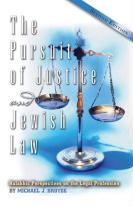
Be the first to post a review on Amazon for R. Michael J. Broyde's book The Pursuit of Justice and Jewish Law: Halakhic Perspectives on the Legal Profession: Amazon, More about the book

While you're at it, also be the first to review R. David M. Feldman's Where There's Life, There's Life: Amazon, More about the book


Tuesday, April 10, 2007

Deposing a Jewish Leader

I. The Debate

Traditionally, a synagogue would appoint a pious Torah scholar as a chazzan to lead the congregation in prayers. Throughout the ages, the question has arisen what to do if a chazzan is found to be less than pious. For example, what if a chazzan is found to have stolen an object or to have had an affair with a married woman. The answer to such questions largely depends on the type of evidence for the wrongdoing which can include rumors of varying reliability, evidence that is indicative but insufficient for a conviction in a beis din (raglayim la-davar), or valid testimony. However, even when there is testimony from valid witnesses there is still an issue of whether to deal with the sin in a public way by deposing the chazzan.

The Gemara in Mo'ed Katan (17a) states that when a Torah scholar sins, the court should not punish him in public because that would serve as a denigration of Torah. Rather, they should "hide it like the night" and punish him in private. The Rosh (ad loc.) understands this to refer to any Torah scholar but adds that if this is leading to a Chillul Hashem, then they should disregard the admonition and punish him in public. The Tur (Yoreh De'ah 334) rules like his father, the Rosh.

However, the Rambam (Mishneh Torah, Hilkhos Talmud Torah 7:1) rules that this only refers to leading Torah scholars (chakham zaken be-chokhmah ve-khen nasi o av beis din). They may not be publicly punished but an average scholar may. But the Rambam adds that we should still not rush to publicly condemn even an average scholar. The Shulchan Arukh (Yoreh De'ah 334:42) rules like the Rambam but adds the Rosh's caveat that if any of this leads to a Chillul Hashem then we should punish the scholar in public. (The Sefas Emes [Mo'ed Katan, ad loc.] found this addition from the Rosh puzzling because the Shulchan Arukh rules like the Rambam and against the Rosh.)

Yet, the Rambam seems to contradict himself. In a responsum (Pe'er Ha-Dor 85) on the issue of whether to depose a chazzan, the Rambam applies the rule of the above Gemara to every public official and not just the leading Torah scholars. The Radbaz (Responsa, vol. 4 no. 809) resolves this contradiction by positing that when the official sins in private then the admonition applies to everyone but when he sins in public then it only applies to the leading scholars. This would seem to mitigate the Shulchan Arukh's addition from the Rosh, unless we assume that he could sin in public without it causing a tremendous Chillul Hashem. However, this distinction of the Radbaz based on the Rambam's responsum does not seem to have been adopted by later authorities.

II. The Conclusions

The upshot of all this is that if the chazzan's sins are proven then he may be removed from service, and so the Shulchan Arukh (Orach Chaim 53:25) rules. The Rema adds that we do not remove a chazzan simply due to mere rumors but we do remove him if there are witnesses or something like that (ve-cha-yotzeh ba-zeh). This last phrase means we may remove him even if there is evidence that is insufficient to obtain a conviction in beis din. The Mishnah Berurah (ad loc. 78 and in Bi'ur Halakhah sv. Im) rules that even strong rumors are sufficient to depose a chazzan.

Significantly, the Radbaz (ibid.) adds the following important comment when discussing the apparent contradiction in the Rambam's writings:
ואף על פי שהרב ז"ל מהדר אזכותא דתלמיד חכם שאין מורידין אדם מגדולתו ומינויו מכל מקום מודה הוא שאם עבר עבירה בענין מינויו כגון שהיה חזן לנשים ועבר עבירה עם אחת מהן מעבירין אותו ממינויו שלא לתת מכשול לפניו עד שיתברר שעשה תשובה שלימה.
And eventhough the Rambam tries to find merit for a Torah scholar, that we do not depose him from his lofty position, he would still agree that if [the scholar] committed a sin relating to his position -- for example, if he was a chazzan for women and committed a sin with one of them -- we remove him from his position so as not to place a stumbling block before him, until it is clear that he repented completely.
This would presumably apply even more when dealing with a man in a position to force himself on others.

Additionally, R. Ya'akov Emden, in his glosses to Mo'ed Katan (17a), makes the point that certain sins are punished publicly if there can be no presumption that the scholar repented for them (I hope that I am reading this correctly). His example is heresy, about which it says "None that go unto her return again" (Prov. 2:19). This was certainly relevant to him due to his concerns regarding rabbis with hidden Sabbatean sympathies. Perhaps the same would be true about a scholar who commits a sin about which we know statistically that it is unlikely for someone to stop committing it even with extensive treatment, and certainly not without.

(I should add the obvious caveat that any real life situations must be brought before a competent rabbi or beis din.)


Sunday, April 08, 2007

More on Intermarriage

In an earlier post, I suggested that perhaps intermarried Jews today have the status of tinokos she-nishbu, Jews who have been insufficiently educated in that matter. R. Mordechai Willig suggested something similar in his recent TorahWeb devar Torah (link):
We can try to apply these concepts to contemporary times. For example, today, most of those who condone, or even promote, intermarriage or homosexuality do not knowingly reject the Torah. They were never taught properly, and might theoretically be eligible for the Korban Pesach (see Rambam, Hilchos Mamrim 3:1-3). We should attempt to influence such individuals with words of peace until they return to the strength of Torah (ibid). The Rambam’s strategy of causing the elimination of reshaim, and the Hagada’s advice to ignore a rasha and thereby set his teeth on edge (Gra), no longer apply.

According to the Chazon Ish (Yoreh Deah 2:16), strong-arm tactics have no place in our world. Employing such tactics against one who knowingly rejects Torah is counterproductive, and, therefore, prohibited when most Jews are not observant. Rather, we should attempt to bring them back to Torah with love. This kiruv imperative, however, makes the danger of our being influenced by anti-Torah beliefs and practices more potent and insidious. The need to strengthen our faith and commitment, as well as our children’s, is greater than ever.
Barukh she-kivanti le-da'ato ha-ramah.


Thursday, April 05, 2007

Blogging on Chol Hamoed

Not a concrete answer but some relevant information. Ask your rabbi for a final answer.

R. Dovid Zucker & R. Moshe Francis, Chol Hamoed (revised edition), pp. 90-91:
With the advent of modern technology, new questions have arisen with regard to writing on Chol HaMoed. One such area involves the use of a computer. Inputing data into a computer where the letter appears only on the screen is not considered a melachah according to many authorities. Saving information on a hard drive, a floppy disk or a CD is permitted according to many authorities. Some authorities prohibit the saving of information except for a festival need or to avoid a loss... E-mails, e-faxes, and text messages may be sent on Chol HaMoed provided they are not printed out.
See also R. Yekusiel Farkas, Chol Ha-Mo'ed Ke-Hilkhaso 7:98.


If He Had Brought us to Mount Sinai...

R. Jonathan Sacks, Rabbi Jonathan Sacks's Haggah, haggadah section p. 42f.:
If He had brought us to Mount Sinai and not given us the Torah

Maimonides writes (Hilkhot Yesodei ha-Torah 8:1) that the Israelites did not believe in Moses because of the miracles he performed. Miracles always leave open the possibility of scepticism: perhaps it was magic, illusion, chance or luck. Even when the Israelites 'believed in God and in Moses His servant' at the Red Sea, their belief was only temporary. What persuaded them of the truth of Moses and his prophecy was the revelation of God on Mount Sinai -- the only occasion in history in which God appeared, not to a prophet or holy person but to an entire people. Thus, had God appeared at Sinai, even without giving us the Torah, it would still have established Jewish faith in the existence of God an His involvement in history on the basis of the direct experience of an entire nation, not the testimony of a prophet.


Monday, April 02, 2007

Pesach – The Festival of Faith

Pesach – The Festival of Faith

by R. Dovid Gottlieb

The Zohar (cited by many, including the Seder Ha-Aruch v.2 p. 207) refers to matzah as “michlah d’himnusa” – the food of faith. More generally, many seforim consider the entire holiday of Pesach to be the “Chag Ha-Emunah” – the Festival of Faith.

The reason for these appellations appears clear. As the Ramban (Shemos 13:16) famously explains, the events of yetzias Mitzrayim both express and confirm the most basic foundations of our faith. The existence of God, His active involvement in the events of this world, the notion of reward and punishment – all of these yesodei emunah are demonstrated through the story of our exodus from Egypt. The overriding significance of this singular event is the reason that the opening pasuk of the aseres ha-dibros couches the existence of Hashem in terms of being the One “asher hotzei’si’cha me’eretz mitzrayim” – who took us out of Egypt and not with the more expected description, as the Creator of the world.

While no doubt true that this belief in Hakadosh baruch Hu is central to the message of Pesach, the Slonimer Rebbe, zt”l (Nesivos Shalom – Pesach #4) points out that “yeish od madregah . . . b’emunah” – there is another dimension of belief that is central to the chag of Pesach. “(she-)yehudi m’chuyyav le-ha’amin” – we are obligated to believe; “ki yisrael hem ha-am ha-nivchar” – that we are the Chosen Nation. We declare it in the mussaf davening of every chag but it actually stems from the holiday of Pesach: atah ve’chartanu mi’kol ha-amim – God chose us and transformed us from just the benei Yisroel into am Yisroel; from just the children of Yaakov into His people; from just a family into a nation.

There is one obvious implication of our chosenness which isn’t always so obvious. As my friend R. Daniel Cohen aptly described, it is that we must realize that not only do we believe in God; God believes in us – and thus chose us as His people.

If Hakadosh Baruch Hu chose us it’s because He believes in us. He believes in our capacity to partner with Him in the drama of human history. In fact, this belief is so significant that it is understood by the Midrash to be a description of God Himself.

The pasuk (Devarim 32:4) describes Hashem as perfect, just, righteous and as a “kel emunah” – a God of faith. The question should be obvious. Human beings can be described as believing or faithful, but in what sense can it be said that God believes? The Sifrei (Devarim #307, “tzur”) explains that this is in fact a fitting description because He does believe, (she’)he’emin bi’veruav – He believes in his creations. And if this is true about all of humanity it is even truer about his relationship with the “banim le’makom”, the Jewish people.

Rav Ahron Soloveichik (Logic of the Heart, Logic of the Mind, p. 149) adds one final and crucial point. If Hashem believes in us and if He trusts, then we have no choice but to believe in and trust ourselves. We are often filled with doubt – doubt about our capabilities, doubt about our worthiness, or many other kinds of doubt. But we must remember that Hashem is a “kel emunah” – He has confidence in us. And therefore we should have confidence in ourselves.

Furthermore, we should feel obligated to live up to that confidence; to do whatever we can to make sure that Hashem’s confidence is well placed. God’s trust is a mechayyev – it obligates to do whatever we can to live up to our lofty calling. To truly be His partner we have to be active participants and not passive observers. This is the lesson of Krias Yam Suf as Hashem criticizes passivity – “mah titzak eilay” (Shemos 14:15), don’t stand around crying; “va-yisa’u” – get moving, jump in. And that’s just what Nachson ben Aminadav did.

There used to be an ad campaign with the following tag line: “On the road of life there are drivers and there are passengers.” We must be God’s drivers. His belief in us demands nothing less.

This powerful insight relates has particular relevance to one of the leitmotifs the seder: raising children.

There can be no doubt that the particular mitzvah of “ve’higadeta le’vincha” which defines the seder night also represents the larger responsibility of chinuch ha-banim. And in that crucial arena of responsibility we must use Ha-Kadosh Baruch Hu’s emunah as an inspiration and a guide. As the saintly Piezetznah Rebbe, Rav Klonimus Kalman Shapiro hy”d, reiterates time and again in his classic work Chovos Ha-Talmidim, giving children a belief in themselves and in their capacity to achieve greatness is THE essence of chinuch.

Our responsibility as parents and educators is to make sure that each and every one of our children knows that the sky is the only limit on what they can accomplish. Following the lead of Avinu Ba-shamayim, we must make sure that our children know – profoundly and in their deepest kishkas – that we, their parents, believe in them.

As we gather together with family and friends to celebrate Pesach, the Chag Ha-Emunah, we must remember that faith is a two-way street. Just as we have faith in the Ribbono Shel Olam, He has faith in us. And not only must we believe in our own potential, we must make sure that our children know that they we believe in theirs.


Adapted and abridged from a drasha delivered at Congregation Shomrei Emunah in Baltimore, MD on Pesach, 5766.


Sunday, April 01, 2007

The Barebones Seder

People from families where passages from the Haggadah are skipped during the Seder need to know what is absolutely required. I've never seen it spelled out explicitly except in regard to soldiers. Here is the relevant parts from what R. Nachum Rabinovitch advised soldiers who are in an emergency situation (Melumedei Milchamah, no. 83):
On the Seder night there are two biblical commandments and four rabbinic:

A. Telling the exodus story --

1. When you can take a Haggadah with you, take it and say as much as you can.
2. In an emergency situation, say: We were slaves... and God took us out; Our ancestors were originally idolators; Pesach, matzah and maror based on what...; the blessing on the Ge'ulah...

D. Hallel -- There is no need to say it at the place of the meal, and you should say it wherever you are...


A Personal Response to Rabbi Michael Broyde

By R. Nati Helfgot: link

Please keep any comments here respectful and within the boundaries of halakhah.


Twitter Delicious Facebook Digg Favorites More