| Caution: This blog is la-halakhah ve-lo le-ma'aseh. Consult your rabbi before following any practices advocated here. Disclaimer: In reviewing books, I may choose works in which I have a financial interest. I believe that I will still be able to maintain objectivity but judge for yourselves. Important Policy: This blog is intended only for the interchange of ideas for the purpose of Torah study, promoting enlightened public policy and/or the refinement of character. Comments in that spirit are welcome but those that entail denigration of character are not welcome and if they appear will be deleted upon discovery. Since editing is rarely feasible, comments that are deemed inappropriate will be deleted entirely or, if possible, edited. Comments Moderation: For questions and suggestions about comments, please contact the blog's general editor Rabbi Ari Enkin at this e-mail address. Advertisement Policy: Please note that this blog does not necessarily endorse the services of advertisers. Please consider carefully any books and events announced on this blog and decide on your own whether they are appropriate for you. |
Tuesday, October 31, 2006
Why No Tefillin?
Here's a question for you: Why don't men wear tefillin all day long? The mitzvah is not just during morning services; it is throughout the day (cf. Tur, Orach Chaim 37). So why don't we wear them all day?
The answer to this question is historical. It used to be that men wore tefillin all day, certainly in the times of the Mishnah and Gemara. But at some point the custom was changed to wearing them only during morning services. The good news is that we know exactly when that happened.
There is textual evidence that already in Talmudic times there were many people who did not wear tefillin. Click here to read moreThe Gemara (Shabbos 130a) quotes R. Shimon ben Elazar as saying: "Every mitzvah for which the Jews submitted to death at the time of the royal decree, e.g. idolatry and circumcision, is still held firmly in their minds. However, every mitzvah for which the Jews did not submit to death at the time of the royal decree, e.g. tefillin, is still weak in their hands." In other words, granted they could not wear tefillin at a time of a royal decree not to wear it. However, even after the decree was rescinded the mitzvah was still "weak in their hands." The Gemara (Rosh Hashanah 13a) specifically condemns those who never wear tefillin.
This laxity by many on wearing tefillin continued into the Middle Ages. Tosafos (Shabbos 49a sv. ke-Elisha) write that one should not be surprised that at that time people were lax in tefillin, since they were in the times of the Talmud also. This is attested to in many other places, and in the times of the Geonim there are even implications that almost no one in the land of Israel wore tefillin. The Beis Yosef (Even Ha-Ezer 65) quotes the Kol Bo who suggests that in some communities ashes are not placed on a groom's forehead because the community members do not wear tefillin. There was even a responsum by R. Sherira Gaon, copied in many medieval works on halakhah, answering a question about whether it is yuhara (haughty) for a yeshiva student to wear tefillin when no one else does.
It seems that in order to defend this practice, some rishonim utilized the idea that one who wears tefillin needs a "guf naki - clean body". The Shibbolei Ha-Leket (Buber ed., p. 382) quotes one view that "guf naki" means that a person is clean of sins. In other words, only someone without any sins is allowed to wear tefillin. This view can be found in other rishonim that explicitly dispute it. For example, the Sefer Ha-Chinukh (no. 421) states that "guf naki" does not refer to someone who has no sins or impurity, implying that someone else had suggested that it did. The author explicitly condemns those who are strict on the holiness of this mitzvah and thereby deprive the masses of the mitzvah. Rather, "guf naki" refers to the ability to refrain from passing gas and thinking improper thoughts while wearing the tefillin.
R. Moshe of Coucy (Semag, mitzvos aseh no. 3) tells of how he would travel around thirteenth-century Europe, preaching to people that they should wear tefillin during the morning prayers. Even if they cannot control themselves all day, people can certainly maintain a guf naki for the prayer services (that is the view of Tosafos [Pesachim 113b sv. ve-ein]; Rosh [Hilkhos Tefillin, no. 28 and Beis Yosef [Orach Chaim 37]; footnote 8 in the Schlesinger edition of Semag assumes the Semag agrees). Evidently, this practice of wearing tefillin only during morning prayer services took hold and the prior practice of widespread abandonment of the mitzvah slowly turned into minimal performance of it during the morning prayers.
However, someone who cannot control himself and cannot maintain a guf naki may not wear tefillin. Despite the biblical obligation, someone in a definite situation such as that should not wear tefillin at all (Shulchan Arukh, Orach Chaim 38:1). For this reason, the Arukh Ha-Shulchan (Orach Chaim 38:6) rules that those who are not obligated in the mitzvah of tefillin -- such as women -- should never place themselves in even a doubtful position of not maintaining a guf naki. For centuries, men who were obligated to wear tefillin refrained from doing so because of a concern for guf naki and, even today, we only wear tefillin for a minimal time. And even then, if we are certain that we cannot maintain a guf naki we do not wear tefillin. Women, who are not obligated to wear tefillin, should recognize the sensitivity surrounding this mitzvah and not place themselves in the position of even possibly lacking a guf naki while wearing tefillin without any obligation to do so. (This is without considering other issues, such as deviating from the standard custom and confirming heretics.)

Monday, October 30, 2006
Va-Yekhulu
R. Hershel Schachter, Mi-Peninei Ha-Rav, p. 78:
Our master [R. Joseph B. Soloveitchik] said that one need not be careful to recite Va-Yekhulu with specifically [at least] two people, and not like is mentioned in the Magen Avraham (268:10) in the name of the Tur. {Compare with the words of the Chazon Ish (Orach Chaim 38:10)...}
Most Important Song Ever
The most inspiring song, or rather the song that most drives a person to improve, is not by Carlebach, Miami Boys Choir or Chevra. It's not even on MOChassid's new CD.
Hands down, it is "Cat's in the Cradle" by Harry Chapin (lyrics, audio excerpt, more info). Every parent should be obligated to listen to that song at last once a month.
The Talmudic Side of Seinfeld II
This post was reprinted in a revised format on Aish.com's Jewlarious.
Sunday, October 29, 2006
Atheism and Ethics
If I had taken a college course on ethics, I might know whether R. Avi Shafran's statement that Atheists have no compulsion to be ethical ("If our perception that some deeds are good and others are not is but a quirk of natural selection, none of us need feel any commitment to morality or ethics" - link) is contradicted by the writings of Immanuel Kant, John Stuart Mill, Jean-Paul Sartre and others. Maybe someone who is educated in these matters can explain this to me.
WYUR
I'll be appearing on the Yeshiva College radio station tonight around 11:20pm, on The Post Night Seder Show.
Thursday, October 26, 2006
Hebrew Pronunciation
I. Different Pronunciations
There are certain mitzvos that must be done in Hebrew, such as the reading of Parashas Zachor, and others that are preferable to be done in Hebrew. The question, then, is what pronunciation(s) can be legitimately considered Hebrew. Generally, there are two types of pronunciations today: Ashkenazic and Sephardic. However, within both types there are wide variations. Polish pronunciation is different from Russian, which is different from Litvish and German pronunciations. I know less about Sephardic pronunciations, but from what I understand, aside from the "standard" Sephardic pronunciation there are also Persian and Yemenite variations.
Some of the main differences: Ashkenazim tend not to differentiate between many of their consonants. Thus, the soft tav has an "s" sound, like a samech and sin. The ches has the same sound as a soft khaf and the ayin the same as the alef. Sephardim tend to differentiate between consonants but their vowels are similar. The segol has an "eh" sound, as does the tzeireh. The kamatz and the pasach both have an "ah" sound. (On different variations of Sephardic pronunciation, see this comment by R. Joshua Maroof.)
Click here to read moreAmong Ashkenazim, the Litvish pronounce the cholam like a tzeireh ("ay"). The Polish pronounce the kamatz like a cholam ("oh"), the cholam like it has a yud after it ("oy"), the shuruk like a chirik ("ee"). See all this in R. Yosef Eliyahu Henkin's Eidus Le-Yisrael (p. 181), regarding writing names in a get.
Modern Hebrew has the "merit" of combining some of the weakest parts of both Sephardic and Ashkenazic pronunciations. Thus, there is no distinction between consonants, like Ashkenazim, and no distinction between vowels, like Sephardim.
II. Which Pronunciation is Correct?
So which pronunciation is correct? R. Henkin (Eidus Le-Yisrael, pp. 156-157) recommends learning from Sephardim how to distinguish between consonants because Ashkenazim do not do so (although he does not seem to advocate dropping the soft tav's "s" sound). Regarding vowels, however, he says that there is no reason to believe that Sephardim are correct.
Rabbenu Bachya, in his commentary on Gen. 18:3, has a long discussion of vowels and notes how when the "nai" in God's name has a kamatz it is God's name but when it has a pasach it just means "my masters". Each vowel, Rabbenu Bachya emphasizes, is pronounced differently. Thus, many argue, the Sephardim who pronounce the kamatz like a pasach are turning God's name into a plural reference, an unintentional heresy! (See R. Ya'akov Emden, Siddur Ya'avetz; R. Yitzchak Ya'akov Weiss, Minchas Yitzchak 3:9:2; R. Moshe Shternbuch, Ta'am Va-Da'as, Gen. 18:3, Teshuvos Ve-Hanhagos, vol. 1 no. 128; R. Meshullam Rothe, Kol Mevaser 2:12; and others)
R. Ovadiah Yosef (Yabi'a Omer, vol. 6 Orach Chaim 11:4) responds that Sephardic grammarians do, in fact, distinguish between the pasach and kamatz. However, the difference between the two vowels is subtle which, he claims, argues for the authenticity of the Sephardic pronunciation.
R. Shlomo Goren (Toras Ha-Medinah, pp. 151-153) points out that regardless of whether the "nai" is pronounced with a kamatz or a pasach, it is always plural. Even when referring to God, it is plural. He cites the Rambam (Moreh Nevukhim 1:61) as explicitly stating that this name of God is intentionally in the plural. Thus, even those who fail to distinguish between the pasach and kamatz are not committing some unintentional act of heresy. He also points out that if Sephardic sages have been pronouncing it that way for centuries, it is hard to condemn it as heretical because they certainly understood the implications of that pronunciation. R. Yitzchak Herzog (Heikhal Yitzchak, Orach Chaim no. 1) also raises both of these points. (Although, according to R. Yosef, the great Torah scholars made sure to distinguish between the pronunciation of those vowels. Perhaps not all of the scholars, though.) R. Tzvi Pesach Frank (Har Tzvi, Orach Chaim 4) also points out that both pronunciations of "nai" refer to a plural.
R. Moshe Shternbuch (Teshuvos Ve-Hanhagos 1:128) is aware of this objection raised by R. Goren and R. Frank, and quotes R. Chaim Kanievsky as saying that even though "nai" with both a kamatz and pasach imply plurality, since the Torah was careful that God's name always be with a kamatz, pronouncing it with a kamatz does not imply God's plurality but pronouncing it with a pasach does. I fail to understand this response.
III. May One Change One's Pronunciation?
The idea of changing one's pronunciation is generally compared with changing the text of one's prayer, as discussed in the 19th century regarding those changing from the traditional Ashkenazic text to the chassidic "Nusach Sephard". There were those who forbade changing one's text outright, such as the Maharshdam in his Responsa, Orach Chaim no. 154 (even before the advent of the chassidim), those who only allowed individuals to change their private texts but not communities, and those who allowed even communities to change to the more preferable (or so they claimed) "Nusach Sephard".
R. Avraham Yitzchak Kook, in his approbation to Responsa Mishpetei Uzi'el, rules that since there is no way to conclusively determine which pronunciation is better, one may not change his ancestral custom in how to pronounce Hebrew in prayer, etc. R. Yechiel Ya'akov Weinberg (Seridei Esh 2:5) seems to say that an individual may change his pronunciation but not a community. R. Tzvi Pesach Frank (cited above) writes that the "spirit of the sages" is not pleased with the changing of pronunciation.
Those who object to the Sephardic pronunciation of God's name (e.g. R. Yitzchak Ya'akov Weiss and R. Moshe Shternbuch, cited above) certainly oppose changing one's pronunciation of Hebrew from Ashkenazic to Sephardic. However, they would presumably encourage Sephardim to change their pronunciations to Ashkenazic in order to avoid this perceived problem.
As noted above, R. Henkin allows the changing of pronunciation of consonants from Ashkenazic to Sephardic, but not vowels. He later (Eidus Le-Yisrael, p. 162) explains that one may only change pronunciation when the principles of grammar make it clear that one's current pronunciation is incorrect.
Unsurprisingly, R. Ovadiah Yosef (cited above, par. 5) allows and even encourages Ashkenazim to change their communal and personal pronunciations from Ashkenazic to Sephardic. He makes much of the famous example of R. Nosson Adler, the mentor of the Chasam Sofer, who changed his personal pronunciation from Ashkenazic to Sephardic in the early 1800s.
Interestingly, inconsistent pronunciation is not necessarily problematic. I once asked R. Hershel Schachter what to do if I was called to the Torah in a Syrian congregation, and he said that while it is highly unlikely that I would be given such an honor, if it happens I should recite the blessings in Sephardic pronunciation except for names (including God's name), which I should recite in Ashkenazic pronunciation (I'm pretty sure I later saw this in one of R. Schachter's books but I can't find it right now; cf. R. Henkin, Eidus Le-Yisrael, p. 157). Similarly, and R. Schachter actually quoted this to me, R. Moshe Shternbuch (Ta'am Va-Da'as, Gen. 18:3; Teshuvos Ve-Hanhagos 1:154) quotes the Chazon Ish as telling Ashkenazim who have adopted Sephardic pronuncation to still pronounce God's name with an Ashkenazic pronunciation. However, R. Shlomo Goren (Toras Ha-Medinah, pp. 146-155) objects to this practice and, while discouraging the changing of pronunciation (p. 148), encourages consistency within one pronunciation. R. Henkin also writes that one should not pray with more than one pronunciation.
There is another reason that some raise to prohibit changing one's pronunciation, and that is that this can be considered confirming the heterodox or anti-religious in their practices. R. Yitzchak Ya'akov Weiss (cited above, par. 3) raised this issue, and R. Yitzchak Herzog (Heikhal Yitzchak, Orach Chaim no. 3) also raised it regarding the community in Johannesburg. Where and when it applies is a matter of halakhic judgment.
Ida Nudel Speaks
Who doesn't remember Ida Nudel from the protests in the 1980s in support of Soviet Jews? She published a letter in this week's The Jewish Press about her experience in Israel since being allowed to leave Russia (link):
A Former Refusenik’s Disillusionment
I arrived in Israel exactly 19 years ago – on the same date, in fact, that I write these words – from the USSR, where Zionist life was thriving. I had come to the land of my dreams not as a refugee seeking a small place under the sun in whatever country was available, but as someone who knew why and for what purpose I had paved – for over 17 years and often at risk to my life – the road to Israel for myself and for many other Jews who shared my feelings and aspirations.
Click here to read moreIsrael’s mass media, Jewish Agency publications, and Voice of Israel radio all declared that every Jewish citizen of Israel lived on his or her land with dignity. All too soon, however, I discovered that most of the proclaimed advantages of the Jewish state belonged to its glorious past.
The word Zionism has acquired a negative connotation in Israel. The mass media, i.e., the country’s intellectual elite, inspire hatred between Jewish immigrants from different countries and obstruct the revival of a homogenous Jewish people after 2,000 years of dispersion.
The disdain of the weak and poor is actively and cynically cultivated by the mass media. Schools actively practice selection of children according to their families’ material means.
The national bureaucracy hinders the integration of young people into Israel’s economic life and thus pushes them to leave the country.
After 2001, when mention of national identity was removed from Israeli IDs, the word “Jewish” virtually disappeared not only from official documents but also from the pages of newspapers. Even the anti-Semitic Soviet regime was never able to deliver such a blow to the national dignity of Jews.
In the last decades of the 20th century, the interests of Jewish national revival and those of Israel’s national bureaucracy came into real conflict – one that endangers the idea of the Jewish national home. We have witnessed how a persecuted and humiliated people’s glorious dream of a resurrected Israel has been reduced, by the national bureaucracy, to a venal vision of nurturing as many millionaires as possible.
The same individuals sit in the Knesset for decades. The intellectuals are concerned only with their personal success, while the mass media have turned into a mass brainwashing machine targeting poor, semi-literate and politically naïve citizens. New millionaires are appearing at a striking rate, while the reverse process of mass impoverishment is also accelerating. The middle class is gradually vanishing from the country’s economic life.
A few days ago the world learned of this year’s winner of the Nobel Peace Prize – a Bangladeshi millionaire banker who, at his own initiative and in spite of bureaucratic obstacles, began fighting poverty and illiteracy in his country. His hard and devoted work has won him well-deserved worldwide acclaim.
This great citizen of a poor country has saved from poverty six million of his compatriots and has given them a chance for a dignified life. It looks like a fairy tale – a kind and resourceful wizard arriving to make the poor people happy.
It turns out that even a lone millionaire, providing he is a genuine patriot, can solve a national-level problem. Instead of making money on poor people’s misfortune and gaining 400% annual profit – as often is the case in Israel – he disdainfully puts the bureaucracy aside and addresses the problem himself.
The myth of unemployment being impossible to eliminate has been debunked by a one-man initiative. Can such a thing happen here in Israel, among our people who declare their mission to be one of bringing light and justice to humankind?
In light of the Bangladesh phenomenon, the economic and moral morass in Israel appears more than ever to be attributable to Israel’s national bureaucracy and political leadership.
Ida Nudel
Karme Yosef, Israel
(Editor’s Note: Ms. Nudel is a former Soviet Prisoner of Zion and a winner of the Jabotinsky Prize.)
Wednesday, October 25, 2006
The Chief Rabbi and the Atheist
Chief Rabbi Jonathan Sacks writes on what we can learn from Richard Dawkins' new book (link):
Richard Dawkins is one of the great atheists of our time, and his latest book, The God Delusion, is his angriest. Imagine, he says, a world with no 9/11, no 7/7, no Crusades, no witch-hunts, no Gunpowder Plot, no Indian Partition, no Bosnian massacres, no religious persecution of the Jews, no Northern Ireland troubles, and so on. No religion, therefore no evil in the name of God.See also R. Shalom Carmy's article "Is Religion a Primary Cause of War?" in The Torah U-Madda Journal, vol. 10 (link - PDF).
This is good, honest, challenging atheism. I only wish I had as much faith as the learned professor. It would be nice to believe that if you cured people of believing in God, you would thereby have cured them of hate, violence, anger, injustice, cruelty and the urge to control, exploit, dominate and oppress.
Nothing in history suggests such a thing. On the contrary, if people do not commit evil in the name of God they have never been short of other reasons to do so: race, the war of classes, the political system, the march of progress, the Darwinian struggle to survive...
There is, though, another thought-experiment worth performing. Imagine a world with no Book of Psalms, no Isaiah, no Ten Commandments, none of Michelangelo’s religious art or Bach’s devotional music, no Dante, no Milton, no medieval cathedrals, no prayer. Imagine one with no narrative like the Exodus to give hope to the oppressed and enslaved. And that really is the point...
Renewing Our Spirit - Online
(moving up the post because it seems I had originally omitted half the schedule)
Watch the upcoming Torah in Motion conference online: register here
Renewing Our Spirit - special e-TiM broadcast from Toronto Saturday Night November 4, 8:15-10:30pm
Panel Discussion Engagement and Disengagement: The Future of Religion in the Land of Israel
Rabbi Chaim Brovender, Dr. Adam Ferziger, Rabbi Pinchas Hayman and Rabbi Francis Nataf
Moderator: Dr. Elliott Malamet
Sunday November 5,
9:00am Rabbi Gil Student
Blogs: The New Frontier of the Jewish Community
or
Mindy Ribner
The Art of Torah Greatness: How Rav Yitzchok Kirzner zl Transformed my Life
10:00am Dr. Samuel Heilman
Sliding to the Right: The Shift in Contemporary Orthodoxy
or
Rabbi Daniel Feldman
Embarrassing Others in Public: Jewish Ethics and the Protection of Dignity
11:15am Rabbi Dr. Marvin Schick
Can Jewish Education Save North American Jewry
or
Dr. Adam Ferziger
Brother or Other: Orthodoxy and the non-Observant Jew
1:15pm - PANEL
Dr. Adam Ferziger, Dr. Samuel Heilman, Dr. Marvin Schick, Rabbi Gil Student
Moderator: Dr. Elliott Malamet
Orthodoxy Encounters Modernity:An Honest Dialogue on the Issues that Face Us
or
Malka Adatto
The Decline of the Generations: The State of the Debate
3:00pm Rabbi Pinchas Hayman
Method Or Madness: The Impact of Education on the Willingness to Think
or
Rabbi Chaim Brovender
The Bigger Picture: Using Art to Inspire Service of G-d in Religious Education
4:00pm Rabbi Daniel Feldman
Competing Needs: Prioritizing our Charitable Dollars
or
Rabbi Francis Nataf
Religious Censorship in the Information Age
or
Mindy Ribner
What is Jewish Meditation? An Experiential Workshop
register here
Coming in December:
The Legacy of the Rav Joseph B. Soloveitchik
Saturday Night December 2, 8:15-10:30pm Eastern Time
Sunday December 3, 9:30-4:30pm Eastern Time
Speakers include:
* Rabbi Shalom Carmy , Professor of Bible, YU
* Rabbi Mordechai Feuerstein , Personal shamash of the Rav in the early 1970's
* Ethan Isenberg, Creator and Director of a new documentary film on the Rav
* Rav Hershel Schachter, Roch Kollel, Yeshiva University, pre-eminent student of Rav Soloveitchik
* Dr. David Shatz, Professor of Philosophy, Yeshiva University; editor MeOtzar Harav series
Tuesday, October 24, 2006
The OU, UJC and Charity Allocations
I was alerted to this article, which reports the following. The OU had collected money specifically to help Jews in northern Israel recover from the shelling during the recent war in Lebanon. The OU then pooled the money it raised together with money raised by the UJC for similar purposes. However, the UJC also uses the money to help Israeli Arabs. When the OU learned about this, it asked that its money be segmented and only allocated to Israeli Jews. I was asked what I thought about this.
On the one hand, the Gemara (Gittin 61a) rules that we give charity to non-Jews because it is the ways of peace. Whether that means that we do it to avoid being accused of discriminating and thereby causing bad feelings, or because the ways of the Torah are peaceful and this is considered a praiseworthy act, is a matter of contemporary dispute. Regardless, in general we certainly advocate in giving charity to non-Jews (Shulchan Arukh, Yoreh De'ah 151:12, 251:1).
However, if money is donated for a specific cause then it cannot always be diverted to a different charity. Specifically, the Rema (Shulchan Arukh, Yoreh De'ah 256:4) writes that if someone donates money and specifies that it is for a specific poor person or for the poor people of a specific city, then it may not be used for someone or anything else. The Shakh (no. 10) explains that the designated group of poor people acquire this money immediately upon its being donated. Therefore, giving it to someone else is stealing the money of the designated recipients.
In the case above, it seems to me that the money was raised by the OU for Israeli Jews who live in northern Israel. For better or for worse, it seems clear to me that at least some (if not most) of those who donated the money intended it to go specifically to Jewish areas and would object if it went to areas where no Jews lived. If so, then it seems to me that the OU is correct to object to the UJC's allocation of funds. To surprise the donors like that, when the money was raised for a specific purpose and already belongs to its intended recipients, might be considered misappropriation of charitable funds and be a form of theft. KNLAD (so it seems in my humble opinion).
A Project for the Graphically Enabled
A while back, I had asked someone who is into Gedolim pictures to put together a collage of pictures of great Torah scholars who went to college. One of my children is extremely interested in this and keeps asking me when I'm going to get it. Can anyone out there put together a letter-page size image of Gedolim who went to college? It should include at least: R. Yechiel Ya'akov Weinberg, R. Joseph B. Soloveitchik, R. Yitzchak Herzog, R. Ahron Soloveichik, R. Yitzchak Hutner, R. Shlomo Wolbe and the current Novominsker Rebbe.
Monday, October 23, 2006
Best New Blog
The best new blog in a while is definitely Evanston Jew. Eloquent, thoughtful and evidently unafraid to get himself in trouble. His friends and neighbors have GOT to know who he is. But he still calls 'em like he sees 'em.
Intercessory Prayer
The Commentator continues with articles in the section "Legacies of the Rav" with the following three essays:
The Rav at Revel - The Rav at RIETS by R. Robert Blau
Memories of Kindness by Dr. Rivkah Blau
On Translating Ish ha-Halakhah with the Rav by (frequent commenter) Dr. Lawrence Kaplan
This last article, the first in a two-part series, contains comments from Rav Soloveitchik's personal study with Dr. Kaplan while reviewing the latter's translation of Ish Ha-Halakhah (Halakhic Man). Some of this is Dr. Kaplan's notes and some R. Soloveitchik's personal hand-written comments. Evidently, Dr. Kaplan has kept these unpublished for 25 years!
The following is R. Soloveitchik's expansion of the objection to asking angels to pray for us:
[T]he Rav's blanket assertion that "a person needs no advocates or special pleaders" raises the obvious objection that in fact we do ask people to pray on our behalf. In response to this objection, the Rav added the following extended supplementary comment. This is the lengthiest of the Rav's expansions, and he carefully wrote it out in longhand.
Of course Jewish prayer is community prayer. I pray for the many; the many pray for me. We find many instances in the Bible when one individual prays for another. Moses, for instance, prayed for Aaron. However, the prayer of the community is rooted in the gesture of praying together, not in that of praying for each other. People who share distress together share also in the act of praying. Moses prayed for Aaron because he experienced the suffering and travail of Aaron. He suffered no less than Aaron the pangs of frustration. Prayer is motivated by need. To pray for each other means to live through a common passional experience which urges, which impels man to pray together.
Therefore it is permissible, moreover commendable, to ask someone to pray for me, since something very important will be manifested by praying together, viz., the unity of existential destiny, the oneness of the sufferer and fellow sufferer, even though the latter physically feels no pain.
What has been forbidden is to plead with transcendental beings such as angels and seraphim to pray on one's behalf. The angels are not exposed to suffering; they feel no need which is sufficient to stimulate prayer. They cannot join the sufferer, cannot experience his tragic destiny. They, should they happen to intercede on one's behalf, would find themselves praying for, not with the individual.
Hatikvah
R. Shlomo Aviner, Am Ve-Artzo, vol. 2 pp. 251-252:
QUESTION: In the diaspora there is a custom, in order to show unity with the state of Israel, to sing "Hatikvah" (the Israeli anthem) on Israel Independence Day and Jerusalem Reunification Day, and at weddings and bar mitzvah parties, together with the anthem for that country.
However I remember when I studied in Israel that we never sang "Hatikvah" on Israel Independence Day but, rather, "Shir Ha-Ma'alos" with the tune for "Hatikvah".
Some say that it is a disgrace to the nation of Israel that there is no reference to God in its national anthem even though many other countries praise God, such as Britain's "God Save the Queen".
I heard an opinion to replace the word "chofshi" (free) [towards the end of "Hatikvah"] with the word "kodshi" (holy), thereby hinting to God without separating oneself from the general population, since no one can hear this difference while singing...
ANSWER: It is true that there is no mention of God in "Hatikvah". However, there is nothing against God either and there is national value in it. Therefore, there is certainly no prohibition against singing this anthem. We definitely have more important songs in faith in God and also in nationalism, like "Shir Ha-Ma'alos" and "Shir Ha-Emunah" that Rav Kook wrote. However, if the entire community is singing "Hatikvah" one should not separate from them but should join them, since through this they are demonstrating their connection to the land and state of Israel, which is a big obligation, even though there are better ways of doing it. Therefore, there is no need to change "chofshi" to "kodshi", since being free is also something of value. There is a mitzvah that this land [of Israel] should be under our rule and not that of another nation, as the Ramban wrote, so there is certainly a mitzvah to be free in our land...
Friday, October 20, 2006
Guide to Torah Fleshes Out Flat Characters in Stories
Robert Avrech on R. Yitzchak Etshalom's book Between the Lines of the Bible (link):
Besotted with Torah.Continued here.
That's the phrase that springs to mind when reading Rabbi Yitzchak Etshalom's "Between the Lines of the Bible: A Study From the New School of Orthodox Torah Commentary." The title is somewhat academic, and I have to admit that it does not make the book sound user-friendly. But make no mistake, this lovely and lively volume is a valuable addition to traditional Torah study and to the layman's library...
shmoozED
A new blog about Jewish education, from the people at The Lookstein Center for Jewish Education in the Diaspora: link
Thursday, October 19, 2006
Rav Soloveitchik and Heidegger
I don't claim to know all of R. Joseph B. Soloveitchik's philosophical influences. All I can say is that I noticed some commonalities between R. Soloveitchik's thought in his book The Emergence of Ethical Man and that of Martin Heidegger. Whether R. Soloveitchik acquired them in Berlin in the 1920s, from Heidegger's writing(s) or from a secondary source such as Martin Buber's writings, I can't say. But the similarities are too strong to suggest that this is just a coincidence.
1. Field of Being
Existence itself, according to Heidegger, means to stand outside oneself, to be beyond oneself. My Being is not something that takes place inside my skin (or inside immaterial substance inside that skin); my Being, rather, is spread over a field or region which is the world of its care and concern. Heidegger’s theory of man (and of Being) might be called the Field Theory of Man (or the Field Theory of Being) in analogy with Einstein's Field Theory of Matter, provided we take this purely as an analogy...Entirely the same? No. But R. Soloveitchik was reacting to concepts that Heidegger first enunciated.
(William Barrett, Irrational Man, p. 194)
In the mineral world, it is impossible to speak of an object and its environment or outside; the object is a part of its environment...[9] But we do speak of a structured organism-environment field, and although there is interaction between a living structure and its outside world, we still consider the organism to be a bounded entity, rooted in inner existence. There is a reciprocity but also a polarity of within and without...
Man and animal were granted the capacity for movement, making them more "self-contained" than the plant, which is rooted in Mother Earth... We cannot speak of them as integrated with a fixed environment. Nevertheless, even they are enmeshed within the outside world and flow into the non-self. Thus, certain viewpoints will tend to bring man closer to his environment on the model of the plant's unity with the outside world; other viewpoints, on the contrary, will strive to grant man more freedom and self-sufficiency.
[9] The field theory in physics, which dissolved allegedly concrete encapsulated objects into abstract fields of force, accomplished the feat of removing all boundary lines between objects and their environment.
(R. Soloveitchik, The Emergence of Ethical Man, pp. 14, 16-17)
2. Flow of Time
These three tenses of time--future, past, and present--Heidegger calls ekstasies, in the literal sense of the Greek ek-stasis, a standing outside and beyond oneself. Philosophers before Heidegger had constructed time as a series of "nows"--present moments--following each other like points upon a line... But in order to construct time as a sequence of "nows" we have to be able, Heidegger says, to understand what "now" means; and to do this we have to understand it as the moment dividing the past and future--that is, we have to understand past and future together in order to understand the present. Hence, every attempt to interpret time as a sequence of present moments, sliding away into the past, presupposes that man already stands beyond himself in one of the three ek-stases of time. His existence is thus a field spread out over time as it is over space...Again, not exactly the same. Especially since Heidegger emphasized the future while R. Soloveitchik gave both the past and future equal emphasis. Nevertheless, the similarities are clearly no coincidence.
(Barrett, p. 203)
History, as a human event, unfolds itself in time... Yet there is an experience of closeness in historical time. Instead of being a straight line extending in two opposite directions, time presents itself as a three-dimensional magnitude--past, present and future--that envelops the historical consciousness, that explores not only the traces of a bygone past retained in memory and a non-existent future anticipated in fantasy, but a living past and future which are projected against the backdrop of the present. The historical texture is woven of past and future; it is a focus in which the bygone and the expected converge. To live historically means to live through all the phases of history, both past and future...
(R. Soloveitchik, p. 164; cf. The Lonely Man of Faith, end of part VI; Festival of Freedom, p. 175ff.)
The Right and the Good in The Jewish Week
From this week's The Jewish Week (link):
Traffic And The Talmud
Did the Talmud anticipate city traffic? You might think that since there were no cars, no streetlights, and very few SUVs (some Roman chariots were extravagant, after all) that the Talmud may have missed this subject.
But as Daniel Feldman’s book “The Right and the Good” reminds us, the Talmud and later authorities warn us not only against violence, but also against a threatening gesture. As Rabbi Feldman writes, the Talmud is concerned by such displays — “the civic relationship between human beings is disrupted, lowered to an animalistic conflict...”
Much of our civic interaction, sadly, takes place between people looking out of car windows. Still, the tone matters. People who cut in front of another car on one block scream at those who do the same a block later. Mistakes are seen as acts of aggression and frustration leads to rage. Pedestrians are endangered, children unnerved, drivers debased.
The great chess player Aron Nimzovitch used to say, “The threat is stronger than its execution.” Sometimes the gesture, in a home or in the street, is more powerful and lasting even than a blow. So if we may reformulate the wisdom of our Rabbis in modern terms, it would go like this: Be kind, be forgiving, and drive carefully.
David Wolpe
Rav Soloveitchik vs. the Rambam
After a close reading of R. Joseph B. Soloveitchik's The Emergence of Ethical Man, I'm so surprised that if I didn't know better I'd think it was a forgery.
R. Soloveitchik explicitly disagrees with two concepts that are fundamental to Maimonidean thought. Although, to be sure, he doesn't disagree entirely. I still found it shocking:
God loves and hates; God is saddened and gladdened; God likes and dislikes. God is not only the active creator but also the passive sufferer of the cosmis drama. The Bible is very far from sharing the views which were later espoused by the medieval philosophers in their tireless crusade against any anthropomorphism. By assigning to God pure actuality to the exclusion of all responsive behavior, one detaches Him from His world and renders practical religion almost absurd. (p. 41)There's more but I've run out of time. As an side, I suspect that this book (the other new ones also, but this one moreso) renders Zvi Kolitz's book about R. Soloveitchik's existentialism obsolete.
Even the term da'at et Hashem may be translated "intimacy with God," enjoyment of the divine glory. Maimonidean intellectualization of da'at Hashem is not necessarily true. (p. 119 n. 16)
Wednesday, October 18, 2006
Moment Magazine on The Challenge of Creation
Moment Magazine reviews The Challenge of Creation: link
Gedolim and Sukkah
The Gemara (Sukkah 46b-47a) has a disagreement over whether one recites a blessing on a sukkah on Shemini Atzeres. Rav brings a proof that one does not recite the blessing from Rav Huna Bar Bizna and all the great scholars of his generation (ve-khol gedolei ha-dor), who entered a sukkah on Shemini Atzeres and did not recite a blessing. The Gemara counters that maybe they were of the view that after one recites a blessing on the sukkah on the first day, one no longer recites the blessing. The Gemara answers that they had come from the meadow (efer), i.e. they had not yet had the opportunity to enter a sukkah on the holiday and still did not recite a blessing on Shemini Atzeres even though it was their first time entering a sukkah. As Rashi explains, they had been in the field, grazing their animals, for the entire Sukkos.
This is an astonishing Gemara! The leading Torah scholars of that time did not enter a sukkah for the whole holiday, until Shemini Atzeres. How can this be???
The Tzitz Eliezer (9:32) quotes R. Chaim Berlin as suggesting a textual emendation in the Gemara, so that rather coming from efer, the meadow, they were coming from Ifra, i.e. Ifra Hurmiz the mother of Shevor Malka. They must have had some serious political-security issue to discuss with this political leader that was so urgent that it overrode the holiday obligations (see this post).
R. Ya'akov Ettlinger, in his Bikkurei Ya'akov (640:24), suggests that they had left for some hisbodedus in the meadow, introspection and meditation, and that being involved in this mitzvah exempted them from the mitzvah of sukkah. (A very surprising explanation from this German scholar.)
Both the Sefas Emes (Sukkah 47a) and Or Samei'ach (Hilkhos Sukkah 6:13) suggest that Rav Huna Bar Bizna and his colleagues sat in the sukkah on the first day (or two) of Sukkos. They explain the Gemara in different ways.
Monday, October 16, 2006
Sukkos Daytrips
I was once shocked by R. Feivel Cohen when he said that someone going on a Chol Ha-Mo'ed Sukkos daytrip where there is no sukkah is exempt from the mitzvah and may eat normally. It actually makes sense: teishvu ke-ein taduru (dwell [in the sukkah] like you live [in your house]). We leave our house to go on a trip so shouldn't we also be allowed to leave our sukkah to go on a trip? Doesn't this fall into the category of hol'khei derakhim (travelers) who are exempt from the mitzvah of sukkah (Shulchan Arukh, Orach Chaim 640:8)?
I have since seen that R. Moshe Feinstein disagreed with this ruling (Iggeros Moshe, Orach Chaim 3:93). R. Feinstein argues that the exemption for a traveler is only for someone traveling for business or some other need, and not just for fun. I heard on Yom Tov that R. Shlomo Zalman Auerbach agreed with this, but I don't understand why there should be such a distinction.
I remembered today that R. Aharon Lichtenstein once wrote on this issue (link). About R. Moshe Feinstein's distinction, he wrote:
In Iggerot Moshe OC II:93, Harav Moshe Feinstein zt"l suggests that a pleasure trip would not be included in the traveler's exemption from a sukka. This inference seems difficult to me.But while agreeing that one is exempt on a purely technical basis, R. Lichtenstein concludes:
One should be firmly and sharply opposed - both educationally and from the perspective of Jewish beliefs and values - to tiyulim or activities organized in a way that involves not observing the mitzva of sukka. The existence of formal exemptions from positive mitzvot is not the exclusive nor the only decisive way of gauging whether to perform them. We do not speak of actual evasive trickery (ha'arama) - itself a significant problem in halakha and belief - and this is not the forum to relate to it. Even not relating fully to a mitzva is problematic, even when it involves ignoring and not evading.
A Jew must be saturated with an ambition and longing for mitzvot and not, God forbid, view them as a burden he is inescapably stuck with that he tries to cast off at the first opportunity. This point is at the root of the trait of "zerizut" (acting with enthusiasm and energy), rooted in the obligation not just to serve God, but to serve him with joy and exhilaration...
Everyone Believes
On the High Holidays, we recite the piyut "Ve-Khol Ma'aminim" -- and all believe. This liturgical poem lists a number of beliefs about God and declares that everyone accepts them. How can we say that when we know that not everyone believes these things? Is it a hopeful prayer that eventually everyone will accept them? Anyone have any thoughts?
Sunday, October 15, 2006
Doing the Right Thing
The Jewish Press on R. Aaron Levine's new book Moral Issues of the Marketplace in Jewish Law.
Why Judaism Has Laws
I started reading David Hazony's new article in Azure expecting to see something new but either I don't understand it or he wrote it for a less educated audience. I expected much more from this write but it seems that it's just standard material. Well-written, though, so good reading for a beginner.
Also, I was surprised by his choice of verses to prove the following:
This is the idea that what you actually succeed in achieving with your actions is of relatively little account. What really matters is what happens inside your soul. As we have often heard it said, it’s the thought that counts.He then goes on to cite Jer. 5:28-29 and Isa. 1:11-17. I don't think either prove his point and Jer. 32:19, I believe, is the proper prooftext:
Such views are, however, largely absent from the classical texts of Jewish tradition. What we find there is much more frequently a kind of morality that is deeply interested in the consequences of our actions: In whether or not we succeed in taking care of the needy, for instance, and in how we work together to create a good society.
This is felt most clearly in the teachings of the biblical prophets...
Great in counsel and mighty in deed; whose eyes are open to all the ways of mortals, rewarding all according to their ways and according to the fruit of their doings.The Sefer Ha-Ikkarim (4:9) finds the idea of the importance of intentions in the phrase "according to their ways" and the importance of consequences in the phrase "and according to the fruit of their doings".
Thursday, October 12, 2006
So YU Guys Think They Can Dance?
I am sufficiently in touch with popular culture to understand the concept behind this video. Plus, I've been driving my family crazy with that song since Rosh Hashanah, when the chazzan for Shacharis got it stuck in my head.
And whose head and hat is that the back of? Rabbi Charlop?
The Museum Sukkah
I went today to the Long Island Children's Museum with my family and some cousins (I was the guy who davened Minchah from the "amud" outside, after the museum closed). At one point in the afternoon, we took a snack break and went outside to a sukkah that had been erected on museum property. I looked it over and was impressed. It was clearly made, or at least designed, by someone intimately familiar with the laws of a sukkah. The walls do not reach the roof -- but are about four feet high, well above the required height for walls of a sukkah. The sekhakh overhead consisted of a wooden lattice made of small pieces of wood and a bunch of leaves thrown on top. Who but someone very knowledgeable (or totally ignorant but phenomenally lucky) would make such a sukkah.
The only remaining question was who actually built the sukkah. Maybe it was designed by a local rabbi but built by museum staff who may or may not be Jewish. I suspect that it was built by the rabbi (the decorations were clearly made by a Jew -- good old construction paper chains, hanging fruit and a Hebrew sign). But even if built by the staff, and assuming that the workers were not Jewish, is the sukkah still kosher?
Daf Yomi learners who are a month behind can tell you that the answer can be found on Sukkah 8b. There, the Gemara says that "Sukkas Ganba"kh" are kosher. "Ganba"kh" stands for Goyim (non-Jews), Nashim (women), Behemos (animals) and Kusim (sectarians). They all have huts made for uses other than sukkah but, nevertheless, their huts are kosher as sukkos. This would seem to imply that regardless of who built this museum sukkah, since it was clearly designed as a sukkah it is kosher.
However, there are some posekim (e.g. Bikkurei Ya'akov 635:2; Chokhmas Shlomo 635:2) who rule that Sukkas Ganba"kh is only kosher bedi'eved, post facto but not ab initio. It is noteworthy that neither the Mishnah Berurah nor the Arukh Ha-Shulchan quote this view, and that the She'arim Metzuyanim Ba-Halakhah (Sukkah 8b) disagrees with this position. Regardless, I would argue that this view is only about who should build a sukkah. But once the sukkah is built, it is entirely kosher. This, I believe, can be seen in the words of the Bikkurei Ya'akov. If that is true, then even after combining all of the strict views and assumptions, this sukkah is still kosher.
Nevertheless, when some guy came by and, after being asked by his daughter whether the sukkah is good, responded "I don't know", I resisted the temptation to say "Sukkas Ganba"kh".
Wednesday, October 11, 2006
Rav Soloveitchik on Evolution II
I'm afraid that the excerpt in this post about R. Joseph B. Soloveitchik's attitude towards evolution is somewhat misleading. In the excerpt, R. Soloveitchik posits that the real problem of evolution is philosophical, in that it places man as part of nature rather than above nature. R. Soloveitchik here is pointing out that the classical Greek and Judeo-Christian view is that man is above nature and the scientific view is that man is part of nature. This, presumably, would make evolution problematic.
However, the excerpt is misleading because R. Soloveitchik proceeds to argue that Judaism accepts what he had called the "scientific" view -- that man is part of nature -- and not the Greek/Christian view that man is above nature. Thus, there is not even a philosophical problem with evolution.
I apologize for the imprecision. Please read the entire first chapter of The Emergence of Ethical Man to see the full picture.
A Giant In Faith And Intellect
This post by R. Natan Slifkin (slightly modified) appeared in this week's The Jewish Press under the title "A Giant In Faith And Intellect" (link).
Also in this week's The Jewish Press (p. 15), although not yet on its website, is an interview with R. Aaron Levine about his book Moral Issues of the Marketplace in Jewish Law.
Tuesday, October 10, 2006
The Talmudic Side of Seinfeld
There was a 1993 episode of Seinfeld that focused on a specific area of hygiene and entered a phrase into the common lexicon. It is now common to hear people speak of "double-dipping" and its lack of social acceptability. Here is a transcript of that brief exchange (from here):
[George, attending a wake, takes a large tortilla chip, dips it into a bowl of what appears to be sour cream, takes a bite, dips it into the bowl again, and then eats the remainder of the chip.]The point is that we should be careful about spreading our germs and considerate of fellow eaters. There is an interesting parallel in a talmudic passage, that not only makes this point but does so in a fairly humorous, and a little gross, way.
Timmy: What are you doing?
George Costanza: What?
Timmy: Did, did you just double dip that chip?
George Costanza: Excuse me?
Timmy: You double dipped a chip!
George Costanza: Double dipped? What, what, what are you talking about?
Timmy: You dipped a chip. You took a bite. And you dipped again.
George Costanza: So?
Timmy: That's like putting your whole mouth right in the dip. From now on, when you take a chip, just take one dip and end it.
Here it is in Nedarim 49b:
R. Yossi and R. Yehudah. One was eating porridge with his hands and the other [from the same bowl] with [a utensil fashioned out of] tree bark. The one eating with bark said to the one eating with his hands: "Until when will you keep feeding me your excrement?" The one eating with his hands said to the one eating with bark: "Until when will you keep feeding me your saliva?"These two rabbis were eating from the same bowl. One pointed out to his fellow that his hands were dirty, jokingly referring to them as being full of excrement (Rashi says that there was dirt under his fingernails). The other retorted that every time he put his utensil back in the bowl, i.e. double dipped, he was putting his saliva back in. I can picture this exchange happening and find it hilarious. But the Talmud's point is simple: Be hygienic and be considerate. And, clearly, take just one dip and then end it.
Monday, October 09, 2006
What I Can't Stand About Sukkos
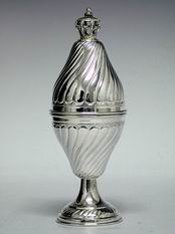
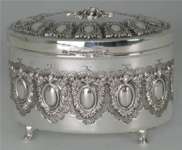
Technically, esrog boxes are a way of beautifying the mitzvah and showing respect and value to a divine commandment. However, I find them repulsive. In this age of excess, they represent a major societal ill.
They are examples of keeping-up-with-the-Joneses, mortgaging your house to pay for oversized weddings, filing for bankruptcy but still bidding on kibbudim (honors) in synagogue,... In other days, silver esrog boxes were signs of piety. Today I view them as the exact opposite. That's why my grandfather's esrog box is lying unused, somewhere in a closet in my mother's house. I won't be a party to such attitudes. I'm sticking with the good old cardboard box.Sunday, October 08, 2006
The Four Plants
I have long wished for a collection of vertlakh on the parashah that emphasize issues of modernity (i.e. Torah U-Mada or Torah Im Derekh Eretz), preferably a combination of derush and sharp lomdishe vorts. Until then...
R. Yitzchak Herzog (Judaism: Law & Ethics, pp. 23-24) quotes the famous midrash about how hadas has a good smell, lulav (date) has a good taste, esrog has both and aravah has none. Homiletically, he takes aroma to refer branching out into the many spheres of society and taste to refer to being religiously observant and remaining within the Jewish community.
His take is as follows:
[Hadas:] There are, on the other hand, Jews eminent in many spheres of life and culture, in the industrial world, in politics, in law, in letters, in science and in art. Their fame travels far beyond the community. They have fragrance. They spread a far-reaching aroma. But only too often these Jews have no Jewish taste, have no Jewish substance in them. They do little or nothing to perpetuate the religious and national traditions of their people, or to build up its future...
[Lulav:] Then we have Jews who yield substantial, solid fruit for Israel, Jews who lead honest lives, practise Judaism, and participate in every movement which aims at the restoration and regeneration of their people. But the great work which they are accomplishing quietly, unobtrusively, day by day, is unknown to the outside world. Their specifically Jewish activities find no echo outside of the community. There is no far-reaching aroma. Only those within the inner circle can taste the fruit... These Jews form the backbone of the nation...
Finally the etrog typifies the Jew who spreads far and wide a beautiful aroma; who reflect honour upon his people, but who, unlike the myrtle, is at the same time a solid fruit, a Jew in substance as well as in name, a Jew equppied with Jewish knowledge, with Jewish religious sentiment, and with a deep Jewish historic consciousness, a Jew who practises his religion and who works for his faith and race, for the realisation of his people's age-long hope and aspirations.
Friday, October 06, 2006
Thursday, October 05, 2006
If God is Good, Why is this Book so Bad?
OK, the title of this post is unfair. I'll admit that it is just a cheap play on words.
But see R. Shalom Carmy's review of R. Benjamin Blech's If God Is Good, Why Is The World So Bad? in the recent issue of Jewish Action: link (PDF)
I don't think I've ever seen a more polite negative review. And, in general, the essay is a summary of why many of the standard theodicies don't work for the average person.
Lulavim: Buyers Beware
When I looked at lulavim last night, I saw a lot with white, dried out tips of the leaves. I'm no expert but if that is what I think it is, then it is problematic. So you might want to make sure to look at that while buying a lulav, and ask your rabbi if it is a problem.
Wednesday, October 04, 2006
Suddenly Gone
In elementary school, when we used to have school on Chol Ha-Mo'ed Sukkos (pronounced: Cholamoyid Sukkis), I remember once having a big Hoshanah Rabbah round of hoshanos, in which everybody paraded around with their lulav and esrog. I think I was in sixth grade, and I hadn't brought a lulav and esrog. So I asked my friend Tani if I could borrow his, after he went around. He allowed me to but warned me to be careful because the pitom (the stem on top) might fall off if I dropped the esrog. So, of course, I accidentally dropped the esrog and the pitom fell off. I felt so bad. After all, I told the person next to me when I dropped it, an esrog whose pitom falls off isn't kosher. Granted, Hoshanah Rabbah is the last day of Sukkos, so they wouldn't need the esrog any more. But what if they wanted to eat it? It wasn't kosher any more!
As I later learned, I had been wrong on two counts:
1. When they say that an esrog isn't kosher, they mean that it isn't kosher specifically for the mitzvah of the four species on Sukkos. It is still kosher to eat.
2. An esrog whose pitom falls off is usually still kosher. According to most posekim and contrary to conventional wisdom, if the pitom falls off but there is still even a tiny bit of stem sticking out, the esrog is entirely kosher (cf. Mishnah Berurah 648:30). However, if there is a hole (even tiny) in the esrog where the pitom used to be, then it is not kosher. But otherwise, it is.
Tuesday, October 03, 2006
Reacting to the Monsey Chicken Scandal
By now, I assume that just about every reader of this blog has heard about the scandal in Monsey, in which a respected butcher was caught having sold for years non-kosher chickens labeled as kosher. The response has been an uproar, with people outraged and re-kashering their kitchens just before the holidays. I have heard some rumblings about believing observant store owners even less regarding the kosher status of food in their stores. I wonder whether this is an overreaction.
We generally believe someone who is observant regarding religious issues, because they have a chezkas kashrus, presumption of trustworthiness. This butcher not only had a presumption of trustworthiness but was specifically known as being an upstanding and trustworthy member of the community (cf. Rema, Yoreh De'ah 119:1 and commentaries), yet disproved that presumption. Does that mean that we can no longer trust people like we did before? I don't know that we ever believed that observant Jews are always trustworthy. The chezkas kashrus was that since the vast majority of known observant Jews are trustworthy on religious matters, we presume that all are until proven otherwise. All we have learned is that this particular butcher was not trustworthy. But has that really undermined everyone else's chezkas kashrus? Must we now suspect everyone in the community?
There have been occurences in history that have impacted halakhah. For example, after an incident with non-kosher cheese, the Chayei Adam (Chokhmas Adam 71:1) ruled strictly from then on. Should that be the case now, or should we just chalk this up to one bad apple?
I leave that to the proper halakhic authorities. But in my ignorance, I lean towards still trusting people as we did before.
Monday, October 02, 2006
More on Rav Soloveitchik Machzor
I used the new Rav Soloveitchik machzor throughout Yom Kippur and loved it. Congratulations and thanks to all those involved in creating it, particularly Dr. Arnold Lustiger. The commentary was beautifully written, inspiring and informative. It draws on Rav Soloveitchik's philosophical teachings as well as his lomdishe teachings, which can be seen from the books quoted. They include the recent books published in the MeOtzar HaRav Series as well as the Mesorah journal and R. Hershel Reichman's Reshimos Shiurim (there is a bibliography in the back, but I found it to be incomplete). I cannot recommend this machzor more highly! It gets the Hirhurim five stars.
Let me share with you something from the commentary. Since Yom Kippur is over, I'll skip the main point -- about repentance -- and just point out an interesting sidepoint. In two places in the commentary, Rav Soloveitchik is quoted as saying that biographies that treat their subjects as perfect are Christian (and see the definition of hagiography):
אבל אנחנו ואבותינו חטאנו -- For indeed, we and our forefathers have sinned: We confess the sins of our ancestors based on the verse in Leviticus (26:40): והתודו את עונם ואת עון אבותם, They will confess their sin and the sin of their forefathers. Whenever a Jew is duty bound to say confession, he must mention his fathers and ancestors as well. Other faiths consider sin as something that a human being can avoid. The biographies of their saints thus pursue one objective -- to demonstrate that they in fact never sinned. We reject this idea, for there is no man so wholly righteous on earth that he [always] does good and never sins (Ecclesiastes 7:20)... [pp. 161-162]Apropos this post:
וירד ה' בענן -- And Hashem descended in a cloud. Hashem often conceals Himself behind a cloud. His actions are hidden. He does not act demonstrably, nor does He seek recognition... Man must imitate this attribute of God, as part of the obligation to follow in His ways....
[T]he greatest individuals in Jewish history reflect precisely the opposite tendency, exhibiting instead a predisposition towards obscurity. One example is seen in an august institution from thousands of years ago, the 120-member אנשי כנסת הגדולה, the Men of the Great Assembly...
Beyond the אנשי כנסת הגדולה, other great rabbinic personages embodied this attribute as well. What do we really know of R' Yochanan ben Zakkai, of Abaye, Rava, the Rif, or the Ramban? Indeed, what do we know of great gedolim of more recent times? There are no autobiographies, no life stories of these great men, such as other religions have of their saints.... [pp. 820-821]
At the end of Kedushah, in the paragraph starting לדר ודר, From generation to generation, the Rav held that the chazzan should pronounce the word ושבחך, with a shuruk vocalizing the opening letter "ו" ["u"]. Even though the Rav believed that vowelizing that "ו" with a sheva (ו) ["ve"] may be more grammatically correct, R' Chaim of Volozhin reported that he heard from the Vilna Gaon that the "ו" should be vowelized with a shuruk (see his introduction to the Sefer Maaseh Rav; see also Maaseh Rav par. 48)... [p. xxxvi]Now here's a question about something that I didn't see in the book. I seem to recall that Rav Soloveitchik insisted that we change the order of the passage in the viduy regarding God forgiving our sins. It currently reads "שתסלח לנו על כל חטאתינו, ותמחל לנו על כל עונותינו, ותכפר לנו על כל פשעינו". What I remember is that the verbs and nouns are mismatched, but I don't remember how they should be properly matched. I thought it was in Nefesh Ha-Rav but I couldn't find it there. Does anyone know what I'm talking about or is this a false memory?
Sunday, October 01, 2006
Yom Kippur
Gemar chasimah tovah!
From here:
Literal Hebrew to English Translation: May you finally be sealed (in the Book of Life) for good.
Meaning: This greeting wishes others well in the new year.
Use: This greeting is used between Rosh Hashanah and Yom Kippur.
Right now, I'm struggling to forgive someone in particular for something he said, but it isn't easy. It would have helped if he had apologized when I told him that I had been offended.
UPDATE: I davened minchah in the shul where I knew he would be and wished him a gemar chasimah tovah, and he apologized. I think it's the hanhagah of Rava to do that, and it worked. I feel much better about forgiving him now.