Sunday, July 30, 2006

Nachem Nowadays

On Tisha B'Av, we add in the Shemoneh Esreh a prayer for the rebuilding of Jerusalem and the Temple which starts with the word "Nachem". After the capture and reunification of Jerusalem in 1967, the question arose whether the language of Nachem needs to be adjusted for the new reality. This was discussed by a number of posekim and Dr. Yael Levine Katz ably summarized the debate in a 2001 article in the journal Techumin. The following comes solely from her article, although it omits much material including the reactions of a number of academics whose views I do not believe belong in a serious halakhic article.

Some of the questions that arise in this discussion are:

1. When was the original prayer written? Was it written by the men of the Great Assembly, when the Temple had just been rebuilt, or by Tannaim in the first or second century CE?

2. If there are very different versions of the prayer, is combining them a change from the words of the Sages?

3. Is Jerusalem considered rebuilt if the Temple is still destroyed?


He are some of the positions of posekim:

1. R. Shlomo Goren, at the time the chief rabbi of the Israel Defense Forces, wrote an entirely new text of Nachem by combining the existing versions in the Talmud Yerushalmi, Siddur Rav Amram Gaon and Mishneh Torah into a version that removes some adjectives about Jerusalem being empty and denigrated. Interestingly, R. She'ar Yashuv Cohen, R. Goren's brother-in-law and the rabbi of Haifa, said that this text was never approved by the Chief Rabbinate and therefore should not be used. (Cf. IDF Siddur; HaTzofeh, 8 Av 5728, p. 2).

2. R. Tzvi Yehuda Kook opposed any changes to public recitation of Nachem but allowed for personal deviations. However, he was also of the view that as long as the Temple has not been rebuilt, Jerusalem is still considered destroyed and denigrated. This is even more so when there are churches and mosques throughout the city. (Cf. HaTzofeh, Shabbos supplement, 13 Tammuz 5727, p. 1; R. Shlomo Aviner, Shalheveskah -- Pirkei Kodesh U-Mikdash, p. 5)

3. R. Isser Yehuda Unterman, at the time the Chief Rabbi of Israel, also opposed any changes to the text of Nachem because the old city was still full of synagogues in various states of destruction and disrepair while churches and mosques were in abundance. (Cf. HaTzofeh, 8 Av 5729, p. 2)

4. R. Joseph B. Soloveitchik was opposed to any change in liturgy that was instituted by sages of the past. Additionally, he was of the view that Jerusalem is part of the Temple and as long as the Temple is destroyed, the city is not considered to be rebuilt. (Cf. Mesorah, vol. 7 p. 19 [PDF]; R. Hershel [Tzvi] Schachter, Nefesh Ha-Rav, p. 79)

5. R. Chaim David Halevi felt that while it was too soon to change the prayer, one would could not honestly say that the city was in a state of destruction and denigration. Therefore, he advocated adding the word "she-haysah -- that was" before words of destruction, indicating that the city had been destroyed etc. (Cf. Aseh Lecha Rav 1:14, 2:36-39, 7:35; HaTzofeh, 9 Av 5753, p. 4)

6. R. Ovadiah Yosef opposed any change in the text. He states that since the text of the prayer was established by the men of the Great Assembly, we lack the power to change it. Additionally, not only is the physical state of the city on a low level, but the religious level of the people of Israel in general is severely lacking. (Cf. Yechaveh Da'as 1:43)

7. R. Shlomo Min HaHar, at the time the rabbi of Bayit Vegan in Jerusalem, opposed any change in the text because the spiritual state of the people of Israel had yet reached the level for which we pray.

8. R. Shaul Yisraeli, at the time a lecturer in Yeshiva Mercaz HaRav, opposed any public change in the text but allowed individuals to recite whichever version appeals to them.


Thursday, July 27, 2006

In Dire Straits

R. Mordechai Willig, in this week's TorahWeb essay, states -- as I've written here before -- that it is traditional for Jews to react to a tragedy with introspection and search for the sins that led to the unfortunate situation. Citing the opposition to the Rambam that past authorities claimed was the cause for the burning of the Talmud in 1242 and the lack of synagogue decorum that the Tosafos Yom Tov suggested was the cause of the Takh Ve-Tat pogroms the Tosafos Yom Tov's attempt to reform synagogue decorum in the wake of the Takh Ve-Tat pogroms, R. Willig suggests that these two issues -- "Greater respect for opposing philosophies and the sanctity of the shul" -- are still areas in which we have room for improvement.

He further adds that "[s]pecial emphasis must be placed on interpersonal relationships" and "[o]ur war effort must include greater devotion to Torah study as well."
The first Mikdash was destroyed because we forsook Hashem’s Torah, the ultimate truth (Yirmiyahu 9:12, haftorah of Tisha B’av). The second Mikdash was destroyed because of baseless hatred, the opposite of peace. Only by correcting both of these errors can we merit the rebuilding of the Mikdash.


Greek Philosophy and Ancient Jews II

R. Isadore Twersky, "Some Non-Halakic Aspects of the Mishneh Torah" in R. Alexander Altmann ed., Jewish Medieval and Renaissance Studies, pp. 114-115:
In common with many medieval writers, Jewish, Christian, and Muslim, Maimonides is of the opinion that Jews in antiquity once cultivated the science of physics and metaphysics, which they later neglected for a medley of reasons, historical and theological.[96] He does not, however, repeat the widespread view, as does Halevi, that all sciences originated in Judaism and were borrowed or plagiarized by the ancient philosophers. Halevi, echoing a Philonic view, states: "...The roots and principles of all sciences were handed down from us first to the Chaldeans, then to the Persians and Medes, then to Greece, and finally to the Romans."[97] That Maimonides does not subscribe to this view of the Jewish origin of all wisdom has been inferred--a kind of argument ex silencio--from his formulation in the Guide, where he merely establishes the antiquity of philosophy per se. It seems to me that this is clearly noted by Maimonides in the introduction to his Commentary on the Mishnah where, in buttressing an argument, he says that this matter is known to us not only from the prophets but from the wise men of the ancient nations "even though they did not see the prophets or hear their words."[98] Maimonides does not care to trace all philosophic wisdom back to an ancient Jewish matrix. His sole concern is to establish hokmah as an original part of the Oral Law, from which it follows that study of the latter in its encyclopedic totality--that is, gemara--includes philosophy. This is the position--a harmonistic position unifying the practical, theoretical and theological parts of the Law--which Maimonides codified in the Mishnah Torah.

[96] Moreh Nebukim, I, 71. See Wolfson, Philo, I, 163.
[97] Kuzari, II, 66.
[98] Kapah, p. 42. See Teshubah, V, 5.


The End of Edah III

On second thought, it's the Nine Days so I'm sending that post back in time and out of sight: link


The End of Edah III

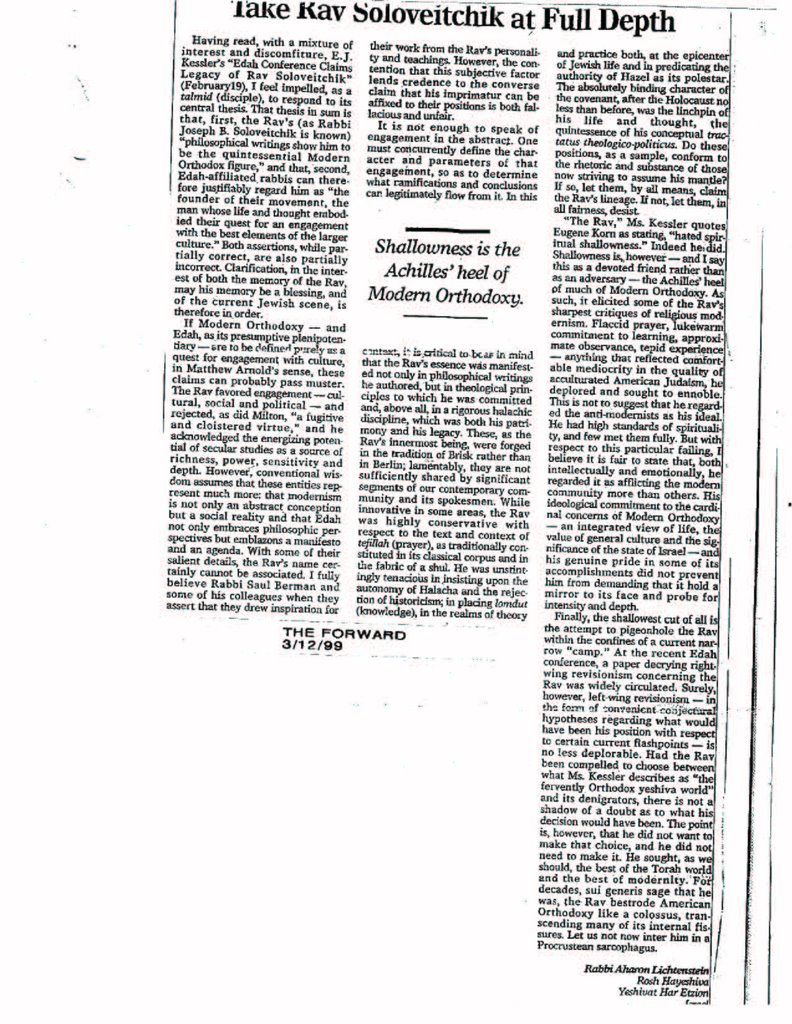
R. Eliyahu Ferrell was kind enough to send me a copy of R. Aharon Lichtenstein's letter to The Forward about Edah, published March 22, 1999 (I actually have not yet read this):


(click on the image to enlarge it)

UPDATE: PDF


Slifkin Launches Book, Discusses Ban

In this week's Jewish Press.


Women Non-Rabbis

Menachem Butler blogs about a new article by R. Michael J. Broyde, in which he argues that many women teachers should be legally allowed to claim a parsonage tax exemption. R. Broyde's argument centers around the interpretation of that passage in the tax code, in which ordination has been deemed irrelevant and function defines one's status. Thus, R. Broyde argues, women who teach Jewish studies and lead prayer services in classrooms should qualify for parsonage just as much as a cantor.

This is NOT an argument for women rabbis but, quite the opposite, a removal of one of the arguments for women rabbis. The US tax code does not require one to be a rabbi in order to receive parsonage.

(See also this post about the ordination of women)


Wednesday, July 26, 2006

Greek Philosophy and Ancient Jews

Many medieval Jewish philosophers claimed that the Greeks received the tenets of philosophy from the Jews. Some even attributed this to a meeting between Aristotle and Jeremiah (see this post). The following are R. Yitzchak Herzog's thoughts on the viability of such a suggestion.

R. Yitzchak Herzog, Judaism: Law and Ethics, pp. 197-198:
Nor would Greek philosophy exercise a very powerful attraction over their [Palestinian Jewish] minds. The Aristotelian system, despite its pronounced monotheism, would rather horrify them by its conception of God's relation to the world, and by its doctrine of the eternity of the Universe. Nor would the mental heirs of the prophets fail to perceive the gulf which, notwithstanding striking affinities, separated the Jewish system from Platonic transcendentalism and Stoic Pantheism.

The search for a first principle which formed the impelling motive of Greek philosophy, would appear meaningless to men whose ancestors had long ago found God. The Palestinian teachers, moreover, like the prophets of old, so vividly realised the presence of God, that to speculate about Him would amount with them to an attempt to move away from Him... While recognising the infinite distance separating the creature from the Creator, Israel's sages taught at the same time with the fiery enthusiasm of immovable conviction that it was man's supreme function on earth to enter into close relations with his Maker by means of a life realising itself in the practice of righteousness and justice, of charity and benevolence, of purity and holiness.

The spirituality of the God-idea evolved by Greek metaphysics had nothing new to offer to those who carried forward the labours of the prophets. At a time when the Hellenic race had not yet emerged from the savage state, the Sinaitic revelation had declared that no possible amterial representation could in the remotest degree serve as symbolic of the Supreme Being... [W]hile in the language of the Greek metaphysics, the conception of God becomes so rarefied as almost to dwindle out of sight, in the vivid and forcible word-pictures of the Torah and the prophets, the God-idea is brought into the boldest relief.

From Greek ethics, the Palestinian teachers would also have little to learn...


The End of Edah II

Some letters to the editor in response to R. Saul Berman's article, including a letter by occasional commenter to this blog R. Eliyahu Wolf Ferrell, and R. Berman's reply to the letters: link


Tuesday, July 25, 2006

Confronting the Challenges

Coming up in Los Angeles...

CONFRONTING THE CHALLENGES
A Torah and Science Panel Discussion

Featuring:
Rabbi Natan Slifkin
Famed author of several controversial books on Biblical Zoological, Torah and Science.

Rabbi Chaim Eisen
Gifted educator, author, and one of the most brilliant and creative minds in Jewish thought.

Join us for an exciting three part series with two of the most brilliant and insightful minds in Torah and Science:

Monday July 31 at Beth Jacob - 7:30pm
Defining the roles and relationships of Torah and Science:
Does Intelligent Design Belong in the Classroom? Is Evolution Heresy?

Tuesday August 1 at Beth Jacob - 7:30pm
Seeking Scientific Truth in the Torah - or Not: Do We Believe the Torah or What Science Says About the Creation Account?

Saturday Night, Private Home TBA - 9:30pm
The Talmudists, the Halachists, and the Scientists: Is Jewish Law Based upon the Spurious Science or did Chazal know Quantum Mechanics

(For what little my opinion is worth, I met R. Chaim Eisen for the first time last year and, if not for work and family obligations, would consider flying to LA just to attend these session.)


R. Aryeh Kaplan on Creation

R. Aryeh Kaplan, Immortality, Resurrection and the Age of the Universe: A Kabbalistic View, p. 11:
It would appear, then, that the seven days of creation described in the Torah actually occurred in thought rather than deed. Of course, God's thoughts are not the same as ours, and it is possible to say that creation in thought actually refers to the creation of the spiritual counterparts of the physical world. This approach is found in a number of Hasidic sources.[23]

Thus, it may be that the seven days of creation took place over 15 billion years ago, before the Big Bang. This represented the creation of the spiritual infrastructure of the universe, which the Talmud refers to as "creation in thought." The universe then developed according to God's plan, guided by the spiritual infrastructure He had created. Finally, less than six thousand years ago, God created Adam as the first of a new type of being. Although human beings may have existed before Adam, he was the first to acquire a special spiritual sensitivity and be able to commune with God.

[23] See No'am Elimelekh, Hayyei Sarah.
(See also here)


Out-of-Print Slifkin Books


I've been contacted by many people asking how to buy the two banned books by Rabbi Slifkin that are out-of-print, Mysterious Creatures and The Camel, the Hare, & the Hyrax.

I saw them available on the website of Levine Judaica and have confirmed that the store still has copies in stock, at regular prices! This link to a search should work.

Levine Judaica has been serving Manhattan's Judaica needs for over 100 years, now with its fifth generation descendant working in the store.

UPDATE: Levine Judaica ran out of copies. Try:
Nehora.com
Hecht's
Rosenblum's
Judaica Place
Eichler's - Flatbush
Eichler's - Boro Park


Just Who In The World Do We Think We Are? III

The full text of R. Chaim Ozer Grodzinski's responsum mentioned in this post can be found here (PDF).


Monday, July 24, 2006

Disposable Diapers on Shabbos

To my knowledge, there are three or fours trends in disposable diapers that are relevant to their use on Shabbos.

1. I do not know whether disposable diapers ever required the use of safety pins. Regardless, the majority of posekim rule that there is no problem in using safety pins on Shabbos if one does it normally (i.e. piercing once in and then a second time out) and intends to leave the safety pin in for less than 24 hours.

2. The initial use of adhesive on disposable diapers was as follows: The diapers would have adhesive tabs that would allow one to close the diapers through the use of the tab. The adhesive tabs were covered with plastic in the factory and the user would remove the plastic and stick the tab to the other side of the diaper.

The potential problem, then, is the sticking and unsticking. Is that allowed on Shabbos? Generally speaking, most poskim allow sticking and unsticking of that nature if it is of a temporary (i.e. less than 24 hour) nature, based on the Magen Avraham's position (340:18) that sticking and unsticking of glue is only prohibited if it is/was intended to last (le-hiskayem). Thus, the sticking of the tab to the diaper is permissible since it is only intended to last for a few hours. However, the unsticking -- the removing of the plastic from the adhesive tabs -- is potentially more problematic. The plastic was put on in the factory and certainly remained there for days if not weeks. Therefore, removing the plastic might be prohibited.

Many posekim prohibited this (e.g. Tzitz Eliezer 16:6), while some permitted this since the factory workers/machine did not necessarily want the plastic to remain on for a long time; it just happens to be that way. The manufacturers would be perfectly happy to have the diapers sold and the plastic removed immediately. Therefore, according to this second view, the plastic is considered to be stuck on temporarily (Yechaveh Da'as 6:24).

What many people used to do is to remove the plastic from the adhesives before Shabbos and replace them, so that they will be on for less than 24 hours, i.e. temporarily, and permissible to remove on Shabbos.

3. This type of diaper was replaced with re-stickable adhesives that are made to be stuck, unstuck and restuck again. This is significant because sticking and unsticking the adhesive becomes the normal way of using the adhesive, much like opening and closing a door is not considered building and destroying. According to most posekim, using these diapers is much less problematic and require no pre-Shabbos preparation (e.g. Shevet Ha-Levi 5:31, 40). Other posekim, however, still require unsticking the adhesive once after its long stick from the factory.

Also, the Minchas Yitzchak (8:31) was very much against the use on Shabbos of any kind of adhesive in disposable diapers.

4. Nowadays, some manufacturers have entirely replaced the adhesive with velcro. This has no problem at all.


UPDATE: I forgot to mention a very unusual footnote by R. Yosef Kafach in his edition of Mishneh Torah, Hilkhos Shabbos 10:11. In an unnumbered footnote, R. Kafach uncharacteristically argues that the phrase the Rambam (and Shulchan Arukh) uses for glue, "kolan shel soferim", implies glue that starts out liquid and then dries and connects two items. Thus, he concludes, the adhesive on diapers does not fall under this definition and is entirely permissible.


(As always, ask your rabbi about these things.)


Talking in Shul

Very interesting suggestion to supporting Israel by stopping talking in shul: link

Not quite my style but it might work for others.


Sunday, July 23, 2006

Just Who In The World Do We Think We Are? II

(continued from here)

III. Ideology and Halakhah

The second answer to our initial question is both more obvious and more difficult. As uncomfortable as it may be to admit it, while the entire Orthodox community agrees on a broad array of theological and practical subjects, there are still ideological issues of dispute between the different sub-communities within Orthodox Judaism. And when it comes to such issues, we need to seek guidance from the authorities within our own communities. Thus, for example, a soldier in a Hesder unit in the Israeli army will not be going to Rav Chaim Kanievsky to ask about whether to follow orders to evacuate a Jewish settlement. He will go to a rabbinic authority within his community who shares his values regarding the state of Israel and army service, such as Rav Avraham Shapira, Rav Aharon Lichtenstein or Rav Shlomo Aviner. A Satmar father with questions about the education of his daughter will not go to a moderate Charedi authority like Rav Yisroel Belsky or Rav David Cohen. He will go to the many talented Satmar dayanim. And a student finishing his third year of post-high school yeshiva, who has to decide whether to enter college in the upcoming year or delay it further, will go to an authority who shares his appreciation of secular studies and accepts the validity of attending college. Ideology sometimes impacts halakhah and, when that happens, we are wise to seek guidance from the leaders of our community who share our values.

Click here to read moreLet’s be honest: the issues underlying this ban are ideological and have a lot to do with the acceptance of science and secular studies. If you would not go to Rav Elyashiv for guidance about your secular education then you probably should not be going to him about these books. This is not to say that the authorities within your own community will automatically say that the books are permissible. They may not. But at least they will be making that decision based on the values that your rebbeim taught you and that have formed your outlook on Judaism and the world.

But is this intellectually honest? Shouldn’t you be going to the most qualified rabbi available and not just one whose views appeal to you? Rav Aharon Lichtenstein addressed this in a presentation to the Orthodox Forum that has since been published in the second volume of his Leaves of Faith. His answer is that this is perfectly legitimate. As a member of an ideological community, regardless of physical location, your rebbeim are the leaders of that community and every student should seek guidance from his own mentors. Sometimes these mentors are not even alive but one is certainly still allowed to follow the example and approach set by one’s rebbe when he was alive. Rav Lichtenstein deduces from a teshuvah of the Rashba that this even applies very long after an authority’s death, so the views of Rav Soloveitchik, the Seridei Esh, Rav Kook, Rav Herzog, Rav Hutner — and I can go on for a long time with more names — are still very relevant. And certainly the views of today’s leaders of our community are relevant.

In summary: this issue is dependent on ideological issues and I do not consider myself part of the ideological community of those who banned the books. The rabbinic authorities of my ideological community, and I suspect of the ideological community of everyone sitting here, see this mater quite differently from those who signed the ban. They might even go so far as to say that there is a great need for a book like this, much like Rav Aryeh Kaplan’s books have received great acclaim in some communities.

IV. Local Concerns

The third answer to the question we raised at the beginning is a matter that I think has become increasingly unpopular over the past few decades but deserves to be strengthened. That is the prerogative of the mara d’asra, the local rabbinic authority. In times past, when communities were clearly local and had organized structures, the community rabbi was the single halakhic authority over the area. When people had halakhic questions, he was the one deciding. He ruled whether chickens were kosher, what vegetables they were not allowed to eat because of bugs, and so on. Halakhic declarations published in newspapers or on billboards were irrelevant because it was the local rabbi who was the final authority in that community. And with good reason. He understood the needs of the community; he knew in what areas they needed to be extra strict and in what areas they needed leniency. He was also aware of the local market and the impact of various rulings on the community. This is no longer the case in most communities today, although there are a number of exceptions. Generally, halakhah today comes from global organizations like the OU, from newspapers and the internet, from distant roshei yeshiva and rebbes, and of course from the guy in the back of the shul who knows the inside scoop on everything. I believe this is to be lamented, but I could be wrong. It is possible that this is just an organic change of our communal structures due to global sociological changes, and that there are hidden benefits that outweigh the negatives I see. Regardless, this is just about plain halakhah, if there is such a thing. Regarding issues that impact faith, the negatives are overwhelming.

Let me give an example that I think will clarify my point. In 1876-77, Rav Shimshon Raphael Hirsch sought to demand that the Orthodox residents of Frankfurt secede from the general Jewish community and create a separate Orthodox Jewish community. One of these Orthodox residents was a huge talmid chakham who disagreed with Rav Hirsch’s position, and he found support from one of the leading rabbinic authorities in Germany at that time, Rav Seligmann Baer Bamberger, the Wurzburger Rav, who ruled that the Orthodox in Frankfurt need not secede from the general Jewish community. This led to an open debate in the media between Rav Hirsch and Rav Bamberger on the halakhic issues involved. I won’t go into the details here but those interested can find the relevant material translated into English in volume 6 of the Collected Writings of Rav Hirsch. Almost 40 years later, those Orthodox in Frankfurt who had not seceded sent a question to Rav Chaim Ozer Grodzinski, the great posek in Vilna, asking whether the times have changed and they are now obligated to secede. Rav Chaim Ozer’s response can be found in the second volume of his collected letters and is very relevant to our topic. Let me read an excerpt for you:
Honestly, the foundation of the answer to this fundamental question is not, in my opinion, like all other rulings of ritual law, or even of the most serious questions of abandoned women, whose source is open in the Talmud and later authorities, and the respondent need only attend to explaining the views of the early and late authorities and decide between them according to the rules of decision-making in order to find the answer to his complex question.

Not so, the answer to this question. Its specific foundation is in the complete recognition and clear foresight, the knowledge of what is the proper path to mend the fence and close the breech in order to strengthen the religion. There is no doubt in my eyes that the righteous rabbis, Rav Hirsch and Rav Bamberger, did not disagree on rulings and laws. Rather, their foresights were different, each one according to his path in holiness and for the sake of Heaven. And in that this foresight shines brightest to a scholar who understands his place, who lives in that region and community, who knows the characteristics and details of the people of his congregation, who is connected to them with all the lines of connection, who attends to their needs, he has a distinguishing eye to attend with extreme care to the questions of religion, and can see what will arise in the next generation.

It seems that this is the reason that this serious question was not asked [at the time] to the great Gedolim — the Malbim, Rav Yisrael Salanter, Rav Yehoshua Leib Diskin and R. Yitzchak Elchanan Spektor. This question could not have been answered based on sources in the Talmud and later authorities, but only on upright thought and proper foresight. And due to their distance they could not get involved with this and could not find sufficiently strong foresight to decide…
Rav Chaim Ozer, the Posek Ha-Dor of his generation, tells us something very important in this letter. Questions of religious danger are of local concern. Only someone who knows a community extremely well, who can anticipate their reactions and look a few steps and a few years ahead, only someone like that should be ruling on issues of faith in a community. Thus, to answer our original question, even if hypothetically speaking these books were heretical, only a local authority should be deciding whether banning the books is the appropriate step for any given community. And if the books aren’t heretical, then only a local authority should be deciding whether they are dangerous. Regarding Rabbi Slifkin’s books, I think both he and I will agree that there are communities for which the books are dangerous and there are communities for which the ban on the books is dangerous. As Rav Chaim Ozer made so clear, this is a matter that must be left for each community’s leaders.

V. Conclusion

To sum up, I offered three reasons for why we I am here despite the ban: 1) there are authorities who disagree with the ban; 2) the authorities who issued the ban do not lead my ideological community; and 3) this is a local matter that cannot be decided from afar. I hope this is why those of you in the audience are here also, although I suspect some are here just for the fight. Regardless, I’ve been saying since the beginning that everyone should be discussing this with his rabbi or rosh yeshiva and not rely on halakhic rulings he reads in the newspaper or on the internet, or hears from some young nobody at a book launch. I thank you all for coming and hope that this latest book will serve as a source for greater Yiras Shamayim and Emunah Tehorah, fear of the Lord and pure faith.


Saturday, July 22, 2006

Yeshiva Soldiers II

Regarding yeshiva exemptions from the army, the following verse from this week's parashah struck me (Num. 32:6):
האחיכם יבאו למלחמה ואתם תשבו פה

Shall your brothers go to the war, and you shall sit here?
But I guess the same applies to us cowards in the diaspora as well.


Friday, July 21, 2006

Yeshiva Soldiers

One of R. Meir Goldwicht's classic stories is when he was in combat in Lebanon and they had a brief respite from battle on a Friday night. Rather than rest, he and some fellow soldiers made kiddush and spent the time singing zemiros and saying divrei Torah. This story inevitably leads to R. Goldwicht's starting the tune for "Achas Sha'alti" that they sang that night.

It seems to me that a believing Jew would prefer to have soldiers like that, strong in their faith and their practice (not that any soldier, regardless of belief or practice, does not deserve our profound gratitude). That is why this picture, which has been up on Drudge for hours, seems to me so meaningful.


I don't know who that soldier is, nor whether his prayers will be answered. But that sight inspires me to prayer and my thoughts will be with him and his courageous colleagues. May Hashem watch over all of them.

(See also the picture in this post)


Thursday, July 20, 2006

Jewish Law and Torture II

Following up on this post, I saw that R. Chaim Shmuelevitz (in Sichos Mussar but more fully in Peninim Mi-Shulchan Gavohah from a taped lecture) points out that of the three advisors who were, according to the midrash, in the discussion with Pharoah on how to subjugate the Jews, Bilam did the worst and in this week's parashah was killed in battle (Num. 31:8) while Iyov did less (he just was silent) and had tremendous suffering. The lesson is that any life, even full of suffering, is better than death. Not quite equivalent of torture vs. killing, but indicative that causing someone to die is worse than causing someone to suffer.

R. Michael J. Broyde was kind enough to send me his full article on torture in Jewish law, available for download here (PDF).


Wednesday, July 19, 2006

New York Water

It looks like the good Lord wants to remove the question from Jews over whether New York water requires filtering (see these posts: I, II, III, IV, V). From the NY Times:
New Yorkers are endowed with certain inalienable rights, among them bragging about the city’s water — so pure it doesn’t need to be filtered, so delicious it is better than bottled.

So it may surprise, perhaps even insult, proud residents to hear that federal officials are worried that the fabled water — coming from the largest unfiltered system in the country — is getting muddier and may have to be completely filtered, at a cost of billions of dollars, if it cannot be kept clean...

Turbidity — the condition that makes water cloudy and interferes with chlorination to eliminate contaminants — appears to be getting worse because of changing weather patterns and increasing runoff from land development upstate.

If the city cannot find a permanent solution to the silt, it may not be able to avoid building a huge filtration plant that could cost about $8 billion.


Just Who In The World Do We Think We Are?

Below is the first installment of my remarks at the launch of R. Natan Slifkin's new book, The Challenge of Creation. Yes, I know it went long. When I speak from notes I speak very quickly. This was the first time I ever spoke from a written text and I went way too slowly and couldn't skip.


I. The Question

Recently, one of the editors of the journal Yeshurun was kind enough to give me a copy of the latest issue and I found in it, among many other interesting things, some decades-old teshuvos on some of the most complex halakhic topics by a well-known rabbi. That posek, that authority, is named Rav Yosef Shalom Elyashiv. The knowledge and ability Rav Elyashiv displayed in those teshuvos decades ago demonstrates a level of Torah expertise that I will never reach in my life. Never. This clear reality, this simple and unquestionable fact, raises an obvious question: What in the world am I doing here tonight? Almost two years ago, Rav Elyashiv signed a ban against three of Rabbi Slifkin’s books, including The Science of Torah, and the book we are launching tonight, while having very substantial changes and expansions, is still a revision of The Science of Torah. So why am I here in defiance of Rav Elyashiv’s ruling? Aryeh sha’ag mi lo yira — a lion has roared, who will not fear? Who in the world do we think we are?

Click here to read moreII. Chakham She-Hitir

I think there are three main answers to this question which, while overlapping, make separate points. The first is very simple: I am not qualified to disagree with Rav Elyashiv nor am I remotely worthy of having my name mentioned in the same sentence as his. But others are. Every posek routinely finds his rulings being disputed by his colleagues and Rav Elyashiv is no exception to this phenomenon. One can simply open the Sefer Piskei Teshuvos to find examples where great posekim of recent times have disagreed with Rav Elyashiv: Can sechach mats be made in such a way as to be kosher for a sukkah covering? Rav Elyashiv holds no while others hold yes. Can a get be issued via a teleconference with the husband? Rav Elyashiv holds no while other hold yes. If other posekim, who routinely rule on matters of life and death, of lineage and divorce, of personal and communal issues, disagree with this ban, then of course the ban is not universally binding. What I’ve said up to now should not be in any way controversial. If there are giants of Torah, experts in halakhah, who disagree with this ban, then it is not universally binding. What to do then, we’ll discuss shortly, but first it should be clear that posekim have the right to disagree and, if they do, people have the right, and sometimes the obligation, to follow this dissenting view.

The question we then have to address is whether in our case there are any dissenting views. To do this, we need to divide this issue into two parts — 1) do these books that were banned contain heresy, as the text of the ban states, and 2) even if they do not contain heresy, are they theologically dangerous? There are some who will dismiss this concept of a theological danger but I don’t think we should minimize it, so lt us leave this second isue of potential danger for later and address right now whether the books contain heresy.

When the ban on the books came out, a prominent rabbi told me that he doesn’t think the ban is prohibited and I wasn’t sure what he meant by that. What prohibition did he think might apply to the ban, that he declared did not? What was his hava amina? I should have asked him but guessing is more fun. This is what I think he meant. The Gemara in Niddah (20b) states that “chakham she-assar, ein chakham acher rashai le-hatiro”: when a rabbi issues a strict ruling — let’s say that Mrs. Schwartz brings a recently slaughtered chicken to Rabbi Cohen and Rabbi Cohen rules that the chicken is not kosher — another rabbi cannot then rule permissively — Rabbi Levy, who bumps into Mrs. Schwartz later that day, cannot look at the chicken and rule that it is kosher. Once a rabbi issues a strict ruling no one else can rule to the contrary. The rishonim disagree over the reason for this rule: according to Rashi it is out of respect for the first rabbi. Once he rules one way, it is a slap in his face for a colleague of his to rule to the contrary. According to the Ra’avad, however, it is for a different reason entirely: shavya nafsheih chatikhah de-issura — he has made this item under question into a prohibited object. The Nimukei Yosef explains this second view as follows: when a questioner asks a rabbi for his ruling, he is essentially accepting the rabbi’s ruling as authoritative and the rabbi’s conclusion has the status of a neder, a vow. When the rabbi rules strictly, it is as if the questioner takes a vow prohibiting the object. Therefore, if the rabbi rules the chicken to be non-kosher, Mrs. Schwartz has essentially taken a vow to consider the chicken non-kosher. So this rule, that once a rabbi rules that a chicken is non-kosher another rabbi cannot rule that it is kosher, is either out of respect for the first rabbi or because the questioner has a vow-equivalent to follow the first rabbi.

The Shiltei Gibborim applies this reasoning to another dispute: does the rule work the other way, if a rabbi rules leniently is another rabbi prohibited from ruling strictly? Some rishonim rule that this is the case while others dispute that such a rule exists. The Shiltei Gibborim explains that those who hold that the rule of chakham she-assar is out of respect for the first rabbi would also reverse the rule and say that a rabbi cannot overrule a colleague who decides leniently because that is also a slight to the first rabbi’s respect. However, those who explain it based on shavya chatikhah de-issura would say that a neder permitting an object doesn’t exist. Therefore, according to this view, even if Rabbi Cohen permits a chicken, Rabbi Levy can still rule that it is nonkosher. Regardless of the lomdus behind the rulings, and it gets complex when you start taking into account the various nuances of different views, the Rema in Shulchan Arukh (Yoreh De’ah 242:31) ruled like the first view, that once a rabbi rules leniently on a very specific case, another rabbi cannot rule strictly on that same case. Chakham she-hitir, ein chakham acher rashai le-ossro.

In our case, each copy of the banned books was printed with haskamos, rabbinic approbations, declaring the books to be not only permissible but praiseworthy. The books are essentially chickens on which Rabbi Cohen has ruled that each one is kosher. And I apologize for calling Rabbi Slifkin a chicken because his stance in this whole matter has surely shown that he is nothing of the kind. Anyway, once Rabbi Cohen has ruled that the books are kosher, can Rabbi Levy now come along and rule that they are not kosher? Is this not the case we just discussed? I think there are two reasons why it is not. First, while the Rema ruled like the first view, that another rabbi cannot rule strictly after a rabbi rules leniently, the Shakh ruled like the second view. According to the Shakh, a rabbi is allowed to disagree with a lenient colleague. Therefore, even though these books were initially ruled upon as being kosher, another rabbi is not prohibited from coming along and ruling that they are not kosher. Furthermore, the Shakh is of the view that there is an exception to this entire rule for someone who is qualitatively greater than the first rabbi. Thus, if one rabbi rules a chicken or a book to be kosher and an older and wiser rabbi rules that it is not kosker, he is allowed to do so. So applying this to our case, there are two reasons why the ban is not prohibited: either we don’t hold of the rule that after one rabbi is lenient another cannot be strict, so the rabbis who issued the ban were entirely within their rights to disagree; or this rule does not apply when the second rabbi is older and wiser, which can plausibly be said about Rav Elyashiv.

But my point here is that there is a chakham she-hitir, there are chakhamim she-hitiru. You can even ask them whether they ruled that the books are permissible and they will answer yes. And there are many others who agree with them. Are there other authorities who disagree? Yes, and they are allowed to do so. But there are different views on this subject. The answer to the question we asked a few minutes ago, whether these books contain heresy, is that it is at most a machlokes, a matter of debate. Even if some great Torah scholars consider the views in this book to be heretical, there are giants of Torah who have disagreed. Rav Elyashiv’s own rebbe, Rav Yitzchak Herzog, is among such great rabbis. I won’t go into this is in more detail because we would end up being here all night but I’ve spent a good deal of time on this on my blog. That being the case, one answer to why we are here tonight is that we are relying on different halakhic authorities. We are following the chakhamim she-hitiru, the rabbis who ruled permissively, and all those who explicitly or implicitly agree with them. I personally had my own posek approve this new publication and he pulled in another posek, all in addition to Rabbi Slifkin’s own rabbinic authorities. Significantly, many of these rabbis have specific expertise in the issues of Torah and science, have a full grasp of the science involved, and are aware of some of the relevant but obscure Torah discussions. The importance of this expertise in rendering an informed judgment should not be minimized.

(continued here)


The Most Important Event in Jewish Publishing Since the Invention of the Printing Press


Last night we had the launch of Rabbi Natan Slifkin's new book The Challenge of Creation. Turnout was great. Excitement was high. And the book just looks fantastic.

A few blogs have already covered the event:

Wolfish Musings
Jew School (what, you don't come over and say hello?)
Canonist
Serandez
Lammpost

Below are some pictures. Remember, Rabbi Slifkin will be speaking tonight at the Young Israel of Teaneck at 8:45pm. Be there, or else. As promised, I will be posting the text of my speech. Just not right now.


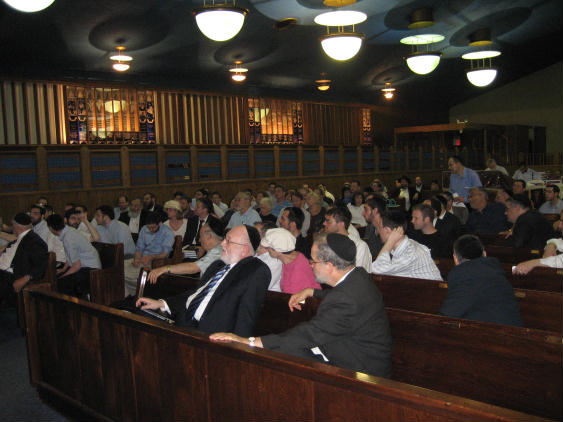
Some of the crowd, with R. Weinreb and R. Yoel Schonfeld up front, and R. Fabian Schonfeld over in the corner of the picture


The Zoo Rabbi and Rebbitzen


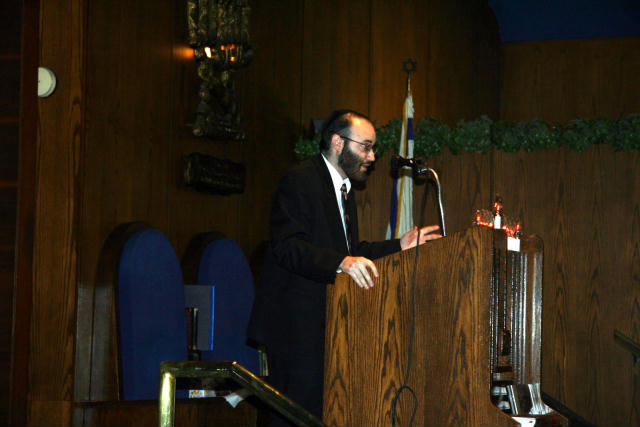
Rabbi Tzvi Hersh Weinreb


Me


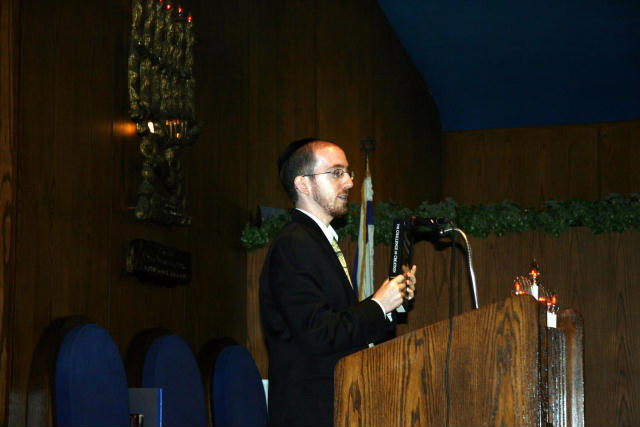
Rabbi Natan Slifkin, holding up a copy of the new book


Tuesday, July 18, 2006

War in Lebanon

In his Toras Ha-Medinah (pp. 395-401), R. Shlomo Goren addresses halakhic objections to the Operation Peace in Galilee. When terrorists in Lebanon were shelling villages in northern Galilee, Israel sent troops into Lebanon to stop the attacks. As a result, the attacks stopped for two decades but over 200 soldiers were killed and many more were injured. Was it justified to sacrifice that many lives in order to save the lives of villagers in northern Galilee who might or might not have been killed? Should not the imperative of "piku'ach nefesh" obligated us to minimize death and not send in soldiers?

R. Goren addresses this at length. He quotes the famous view of the Minchas Chinukh (nos. 425, 604) that piku'ach nefesh does not apply during war. If it did, it would be impossible to ever wage war. Rather, the Torah sometimes obligates us to set aside the concerns of piku'ach nefesh and fight a war. Thus, the entire above argument does not apply to soldiers.

However, R. Goren adopts a different approach to the permissibility of war. Rather than arguing like the Minchas Chinukh that piku'ach nefesh does not apply during war, he suggests that piku'ach nefesh does apply. However, the piku'ach nefesh of the nation takes precedence over the piku'ach nefesh of each individual. So while each individual is placing himself at risk, that is in order to save the community as a whole. (Interestingly, R. Menachem Genack offers the same explanation in the name of R. Joseph B. Soloveitchik in his Gan Shoshanim, ch. 45 pp. 88-89. I know, there are contradictory reports in the name of R. Soloveitchik.) Furthermore, he quotes the Chazon Ish (Eruvin 114:1) as being of the view that once we go to war, then any fighting is considered piku'ach nefesh of the entire community. Therefore, even if an argument could be made that Israel should not have entered Lebanon, once they entered the piku'ach nefesh of the community takes precedence over that of the individual.

R. Goren then offers another argument that I find difficult to understand. He quotes a Tosefta in Eruvin (3:5, quoted in the Gemara 45a) that, even though when bandits try to steal money on Shabbos one may not fight them with weapons because it is not a case of piku'ach nefesh. However, at border towns, one can assume that they are really trying to invade the country and one may always fight them on Shabbos. The relevance of this passage to the case at hand is unclear. Yes, the terrorists were attacking border towns. However, the Tosefta is only saying that one should always assume that attacks on border towns are invasions. But in our case, we already knew that! If he was trying to say that not defending the border towns would allow the terrorists to penetrate further, then that is certainly a good argument but one that is militaristic and not necessarily halakhic.

Regardless, our thoughts and prayers are with the Israeli soldiers who are currently working tirelessly for piku'ach nefesh of the community as a whole.


We Stand With Israel

From the RCA:
Tuesday, July 18, 2006

The Rabbinical Council of America, in partnership with the Conference of Presidents of Major Jewish Organizations, has today setup a simple, but it is to be hoped very effective, mechanism that will allow many men, women, and even children, to communicate to Israeli and U.S. leaders, their support, solidarity, and identification with the current actions of the State of Israel in defending itself against the terrorist entity Hezbollah.

Members of the community and public are encouraged to write emails to WeStandWithIsrael@rabbis.org. These emails will be immediately and automatically forwarded to the White House, the office of the Prime Minister of Israel, The Israel Defense Forces, and the UN Secretary General.

Supporters of the people of Israel are urged to facilitate awareness of this mechanism, by which the “silent majority” are empowered to easily and effectively translate their sentiments and concerns into effective action, at a critical moment in Israel’s history.

The availability and power of Internet communication can thus be effectively leveraged into concrete support and encouragement to the people of Israel, many of whom are under terrorist threat and rocket attack.

As explained by Rabbi Basil Herring, Executive Vice President of the Rabbinical Council of America, “All Israelis and Americans need to know right now that we stand shoulder to shoulder with the people of Israel in this difficult hour. With this email campaign all of us can quickly and effectively convey in our individual voices that Israel’s cause is our cause; that Israel is fighting to defend the way of life that we all cherish, Jewish and non-Jewish alike.”

The Rabbinical Council of America urges all media outlets sharing these concerns to foster distribution of the following public service announcement, at their earliest opportunity, in print, and online:
Show Your Solidarity with Israel - Right Now!

Show our brothers and sisters in Israel that we stand with them in this hour of peril, while also sending a message to Washington and the UN that Israel’s actions of self defense are fully justified. It will take practically none of your time and it will cost you nothing. All you need to do is send an email to WeStandWithIsrael@rabbis.org, and it will be immediately and automatically forwarded, with thousands of others, to Prime Minister Olmert, The Israel Defense Forces, The White House, and the UN Secretary General. Your message can be as short or as long as you choose, and it will surely make a difference.

Sponsored by the Rabbinical Council of America, in coordination with the Conference of Presidents of Major Jewish Organizations. We encourage all other Jewish organizations and their members to take similar steps in support of Israel.

Am Yisrael Chai!


Monday, July 17, 2006

The Jewish Publishing Event of the Century

Just a reminder that the official launch of Rabbi Natan Slifkin's new book, The Challenge of Creation, will take place on Tuesday July 18th at 8pm at the Young Israel of Kew Gardens Hills (see here). Books will be available for purchase and signing by the author.

I will be speaking on the topic of "Just Who In The World Do We Think We Are?"


Additionally, Rabbi Slifkin will be speaking the next night, Wednesday July 19th at 8:45pm, at the Young Israel of Teaneck on the subject of "The Dynamics of a Controversy: Insights into a Recent Book-Banning". Please tell your friends.

There are no entrance fees to either event.


Jews and Christian Zionists

There has been a lot of talk recently about how much help we should be accepting from Christian Zionists and whether we can trust them. Interestingly, this issue is over 150 years old. In the 1820s-1840s, the same questions arose in Israel and there was a difference of opinion between the Sephardim and Ashkenazim in Jerusalem. From Arie Morgenstern, Hastening Redemption: Messianism and the Resettlement of the Land of Israel, pp. 166-167:
How did the Jews of the Land of Israel receive the missionaries? Were they willing to talk with them, to receive the Scriptures they published and printed, to look at their publicity materials, and to accept their economic and medical support and their intervention with the authorities in defense of Jewish interests? Did they engage with them in theological discussions over matters of faith?

As we have seen, the leaders of the Perushim [Ashkenazic students of the Vilna Gaon] maintained an understanding of redemption that differed from the traditional one, and their view of the missionaries' activities could likewise be expected to differ. The Sefardic sages, almost to a man, saw only the negative side of the missionary activity. This was their first encounter with missionaries, and their response, in my judgment, was decisively shaped by their historical memory of their experiences with the Christianity of the Iberian Peninsula. They feared that the missionaries' economic resources might enable them to sway the Sefardic poor, and they accordingly imposd a strict ban on any contact with the missionary Wolff.

The leaders of the Jerusalem Perushim took a different tack. As foreign citizens, they stood to gain more from the missionaries than could the Sefardim, who were Ottoman subjects. From their first encounter with the missionaries in the 1820s, the Perushim recognized the potential usefulness of maintaining contact with them. The state of war at that time between Turkey and Russia complicated their lives, and they hoped the missionaries would intercede to help them secure the protection of the British consul in Beirut.

During the 1820s and 1830s, missionary activity in the Land of Israel concentrated on distributing sacred texts and tracts, providing material and medical support, and offering substantive defense against governmental scheming. The Ashkenazim were in such dire straits at that time that rejecting those forms of assistance would have been suicidal. Few voices of protest were raised against their willingness to receive the missionaries' help; that may have been because of the missionaries' failure during that time to achieve any of their religious goals...

But while the economic assistance provided by the missionaries helped secure the position of the Ashkenazim in the Land of Israel, the leadership of the Perushim saw more to it than that alone. In their view, the involvement of Christian missionaries in efforts on behalf of the Jewish community represented the fulfillment of the prophetic promise that gentiles would help promote the return to Zion: "And strangers will build your walls" (Isa. 60:10). Consistent with that understanding, the leaders of the Perushim saw the church's emissaries not as missionaries but as representatives of "the princes sitting at the head of the Kingdom of England, noblemen, etc."


Mazel Tov Hirhurim!

Hirhurim just received its 1,000,000th pageview since the hit counter was put into effect (June 2, 2004). This is a testimony to the boredom of Jewish web surfers.

Thanks to all the readers who have made this milestone possible.


Sunday, July 16, 2006

R. Aharon Lichtenstein on Sages and Science

R. Aharon Lichtenstein, Leaves of Faith, vol. 2 pp. 295-296:
Moreover, I freely acknowledge that one's faith in the concept [of Da'as Torah] is periodically put to a severe test. As but one instance, the doyen of current rashei yeshiva, R. Schach, proves the value of Torah as the self-sufficient repository of all knowledge by asking, rhetorically: "Whence did Hazal know that the earth was forty-two times larger than the moon, and that the sun was approximately one-hundred-and-seventy times larger than the earth (as explained in the Rambam, Hilkhot Yesodei Hatorah 3:8), if not from the power of the Torah?"[24] In raising this question, he is wholly oblivious not only of the rudiments of astronomy but also of the fact that the selfsame Rambam explicitly states, with respect to these very issues, that they are beyond the pale of Hazal's authority:
Do not ask of me to show that everything they have said concerning astronomical matters conforms to the way things really are. For at that time mathermatics were imperfect. They did not speak about this as transmitters of dicta of the prophets, but rather because in those times they were men of knowledge in these fields or because they had heard these dicta from the men of knowledge who lived in those times.[25]
To my mind, the strain is palpable.

[24] Rav E.M. Schach, quoted in Toda'ah 48:2 (Nissan 5752).
[25] Guide of the Perplexed, trans. S. Pines, III:14; p. 459. The question raised by the passage is self-evident; but the Rambam's position, in any event, is clear.
(See here for this quote in a larger context)


Saturday, July 15, 2006

The Jewish Publishing Event of the Decade

Just a reminder that the official launch of Rabbi Natan Slifkin's new book, The Challenge of Creation, will take place on Tuesday July 18th at 8pm at the Young Israel of Kew Gardens Hills (see here). Books will be available for purchase and signing by the author.

Additionally, Rabbi Slifkin will be speaking the next night, Wednesday July 19th at 8:45pm, at the Young Israel of Teaneck on the subject of "The Dynamics of a Controversy: Insights into a Recent Book-Banning". Please tell your friends.

There are no entrance fees to either event.


Friday, July 14, 2006

Kuntres Be-Inyanei Pesak Halakhah

If you haven't seen it yet, Menachem Butler has uploaded R. Hershel Schachter's latest article in the YU Torah journal Beis Yitzchak. You can download the Hebrew article here (PDF). It is on R. Joseph B. Soloveitchik's attitudes towards halakhic rulings, in particular about whom one can trust to properly relay past rulings. And R. Schachter repeats the story about R. Soloveitchik's opposition to, but slight tolerance of, metzitzah be-feh.


Thursday, July 13, 2006

Jewish Law and Torture

R. Michael J. Broyde on torture in halakhah (link):
However, this is very different from a serious conversation about torture in the Jewish tradition during wartime, which poses several harder and more complex questions: In what situations may torture be used in the course of war to extract vital information that cannot otherwise be obtained? Might brutality be a legitimate way to punish those who have engaged in warfare against the community, so as to persuade others to cease their actions? And most importantly, how much of Jewish law and ethics are suspended during wartime?...

In sum, according to Jewish law and ethics, torture in the context of war is no more problematic than death itself, and is permitted by the general license to wage war. There is no logical reason that halacha would categorically prohibit duly authorized wartime torture as a method for acquiring information otherwise not available, in order to save lives in the future. Of course, not all conduct permitted as a matter of Jewish law is wise or prudent; the consideration of which policies work in what settings is fundamentally not a question of Jewish law or ethics, but one for military and political leadership.

We all pray for a time when the world will be a peace — but until that time arrives, Jewish law directs the Jewish state and the American nation to do what it takes (no more, but no less, either) to survive and prosper ethically in the crazy world in which we live.


The End of Edah


Wednesday, July 12, 2006

Israel's Next War Has Begun

For Shivah Asar Be-Tammuz, a brief departure into the safety of our brothers in Israel.

Yossi Klein HaLevi in The New Republic on the current events in Israel:
The next Middle East war--Israel against genocidal Islamism--has begun. The first stage of the war started two weeks ago, with the Israeli incursion into Gaza in response to the kidnapping of an Israeli soldier and the ongoing shelling of Israeli towns and kibbutzim; now, with Hezbollah's latest attack, the war has spread to southern Lebanon. Ultimately, though, Israel's antagonists won't be Hamas and Hezbollah but their patrons, Iran and Syria. The war will go on for months, perhaps several years. There may be lulls in the fighting, perhaps even temporary agreements and prisoner exchanges. But those periods of calm will be mere respites.

The goals of the war should be the destruction of the Hamas regime and the dismantling of the Hezbollah infrastructure in southern Lebanon. Israel cannot coexist with Iranian proxies pressing in on its borders. In particular, allowing Hamas to remain in power--and to run the Palestinian educational system--will mean the end of hopes for Arab-Israeli reconciliation not only in this generation but in the next one too.

For the Israeli right, this is the moment of "We told you so." The fact that the kidnappings and missile attacks have come from southern Lebanon and Gaza--precisely the areas from which Israel has unilaterally withdrawn--is proof, for right-wingers, of the bankruptcy of unilateralism. Yet the right has always misunderstood the meaning of unilateral withdrawal. Those of us who have supported unilateralism didn't expect a quiet border in return for our withdrawal but simply the creation of a border from which we could more vigorously defend ourselves, with greater domestic consensus and international understanding. The anticipated outcome, then, wasn't an illusory peace but a more effective way to fight the war. The question wasn't whether Hamas or Hezbollah would forswear aggression but whether Israel would act with appropriate vigor to their continued aggression.

So it wasn't the rocket attacks that were a blow to the unilateralist camp, but rather Israel's tepid responses to those attacks. If unilateralists made a mistake, it was in believing our political leaders--including Ariel Sharon and Ehud Olmert--when they promised a policy of zero tolerance against any attacks emanating from Gaza after Israel's withdrawal. That policy was not implemented--until two weeks ago. Now, belatedly, the Olmert government is trying to regain something of its lost credibility, and that is the real meaning of this initial phase of the war, both in Gaza and in Lebanon....
Continued here.


More on the Clearance Sale

Today is the last day of Lambda's Clearance Sale. Yesterday, I bought a full set of Nehama Leibowitz's studies at over 30% off. And I saw that they are selling R. Aaron Levine's Moral Issues of the Marketplace in Jewish Law for $21, even less than the SOY Seforim Sale had it!

UPDATE: The books were 40% off. I compared the price I paid with the list price of Nehama Leibowitz's book, forgetting that I also paid for another book.


Tuesday, July 11, 2006

It is Manna

The King James Version translates the Jews' reaction to seeing manna as follows (Exodus 16:15):
And when the children of Israel saw it, they said one to another, It is manna: for they wist not what it was.
This is probably the worst possible translation of "ויראו בני-ישראל, ויאמרו איש אל-אחיו מן הוא--כי לא ידעו, מה-הוא"

The 1917 JPS translation has it as:
And when the children of Israel saw it, they said one to another: 'What is it?'--for they knew not what it was.
The interpretorial question is what "מן" means in the phrase "מן הוא".

Rashi says that "מן" means food, and so the Artscroll Stone Tanach translates it as "It is food". The Bekhor Shor suggests that the word derives from ancient Egyptian and means "what", in the sense of "What is it?", as the JPS translation renders it. The Rashbam and Chizkuni interpret similarly.

Interestingly, Ibn Ezra quotes that interpretation in the name of a R. Shlomo but that it comes from Arabic rather than Egyptian. The Ibn Ezra then disputes this interpretation based on his knowledge of Arabic.

The Bekhor Shor's interpretation received support, to a degree, from archaeological finds. Cassuto points out that ancient Canaanite language uses "מן" to mean "what", as evidenced in Ugaritic poetry and the El Amarna Letters. While Bekhor Shor claims that the word comes from Egyptian, the archaeological evidence suggests that it comes from ancient semitic languages. Either way, the meaning is the same and indicates that the JPS translation has a very solid basis.


Bnei Banim

Looking for the first three volumes of R. Yehuda Henkin's Responsa Bnei Banim (the fourth is available for purchase online at the Yashar website)? Check out the Lambda Clearance Sale, where the books are currently available. 3709 13th Avenue in Brooklyn, NY, today and tomorrow from 11am through 8pm.


Monday, July 10, 2006

Lambda Clearance Sale


Lambda Publications is currently having a clearance sale at its Brooklyn office, 3709 13th Avenue, from 11am through 8pm. Included in the sale are books from Yashar, Urim, and much more. The sale started today and continues through Wednesday. The discounts are very, very deep!


The Maharal and the Golem

Tradition Online has posted R. Shnayer Leiman's classic article "The Adventure of the Maharal of Prague in London: R. Yudl Rosenberg and the Golem of Prague" (link). The key paragraph is on pages 32-33:
Did the Maharal create a Golem? If our only evidence for the Maharal’s Golem came from the writings of R. Yudl, we would perforce conclude that the Maharal’s Golem is imaginary. In fact, the tradition that the Maharal created a Golem antedates R. Yudl. Already in 1837 (before R. Yudl was born), legends about the Maharal and the Golem appeared in print. The early printed accounts indicate that these legends had an oral history before being recorded. They probably go back at least to the second half of the eighteenth century. Unlike R. Yudl’s version, these accounts never speak about blood libel, and they know nothing about a Cardinal Johann Sylvester. Nonetheless, the gap between the death of the Maharal in 1609 and the first printed account in 1837 is striking. There is certainly no evidence contemporary with the Maharal that he—the Maharal—created a Golem. Rationalists dismiss the late accounts out of hand; mystics hold on to them dearly, though they often seem unaware of just how late and thin these traditions really are.


Sunday, July 09, 2006

R. Joseph B. Soloveitchik on Miracles and Nature

A few months ago, I exchanged some e-mails with another blogger who is ardently anti-Slifkin. Following that, and with my permission, he posted our exchange on his blog and then the two of us put up a few posts regarding R. Joseph B. Soloveitchik's approach to miracles (my posts on the subject: I, II; his posts on the subject: I, II, III). In short, this blogger (nicknamed Freelance Kiruv Maniac, but I know his real name) argues on my interpretation of chapter 10 in R. Soloveitchik's recently posthumously published book, The Emergence of Ethical Man. While I believed that my reading is correct, I nevertheless turned to an expert to obtain clarification — Dr. Lawrence Kaplan, student of R. Soloveitchik, translator of Halakhic Man, professor of Jewish Law and Philosophy at McGill University, and frequent commenter to this blog. While I asked Dr. Kaplan for a few brief words, he graciously gave me a long analysis. What follows is his short essay on the subject.

R. Joseph B. Soloveitchik on Miracles and Nature

Lawrence Kaplan

The purpose of this essay is to elucidate the teaching of R. Joseph B. Soloveitchik [Henceforth: the Rav] on miracles and nature, as presented in his recently published work The Emergence of Ethical Man [Henceforth: EEM]. In order to do so, I will have to adjudicate between two competing interpretations, that presented by Rabbis Natan Slifkin and Gil Student and that presented by the anonymous blogger, Freelance Kiruv Maniac [Henceforth: FKM]. In general, my reading will support the interpretation offered by Rabbis Slifkin and Student; but in light of my examination of the entire chapter in EEM in which the Rav’s teaching concerning miracles and nature appears, I hope to arrive at a more precise and complete understanding of that teaching.

Click here to read moreIn his recent post, “R. Joseph B. Soloveitchik on Miracles and Nature-The Complete Story (Or, More Selective Quoting by R' Student)” FKM argues that R. Student distorts the Rav’s teachings in EEM with regard to miracles.

This issue was originally raised when R. Slifkin minimized a supernatural understanding of miracles, i.e., viewing miracles as physical events that violate the natural order and defy scientific explanation. In support of his position, as R. Student noted, R. Slifkin in his much-revised version of Science of Torah, quotes the following passage from EEM (p. 187):
What is a miracle in Judaism? The word “miracle” in Hebrew does not possess the connotation of the supernatural. It has never been placed on a transcendental level. “Miracle” (pele, nes) describes only an outstanding event which causes amazement. A turning point in history is always a miracle, for it commands attention as an event which intervened fatefully in the formation of that group or that individual.
Addressing Rabbi Student and criticizing R. Slifkin’s understanding, FKM responded to that quote as follows:
Rav Soloveitchik is being ultra precise, Kedarko BaKodesh. According [to this excerpt] he is not characterizing the miracles of Yetzias Mizrayim for which the Torah and the Rambam repeatedly use the term MOFES. He limited his discussion to the terms of “nes and pele”. Mofes, on the other hand, connotes the clear and unmistakable interference with the natural order in order to illustrate a power superior to nature. The verses in the Torah that convey G-d’s purpose of the 10 Makos makes this abundantly clear. Mofes is the term used over and over. Do I need to spell them out? Rav Soloveitchik is not demoting those mofsim/miracles to be within the natural order. This demotion would directly contradict numerous Rishonim and Achronim and negate the entire theological message of the 10 Makos. You and Rabbi Slifkin would like him to take that step. According to your quote below, he is not.
In response to FKM, R. Student posted a longer excerpt from this section of EEM to back up both his and R. Slifkin’s understanding of the Rav:
The supernatural miracle is not very welcome in the covenant society. We prefer the regular flow of life. The Halakhah is completely integrated with the natural process. It never takes cognizance of any causalistic anomalies. Yet the central theme of the exodus tale is the miracle.

What is a miracle in Judaism? The word “miracle” in Hebrew does not possess the connotation of the supernatural. It has never been placed on a transcendental level. “Miracle” (pele, nes) describes only an outstanding event which causes amazement. A turning point in history is always a miracle, for it commands attention as an event which intervened fatefully in the formation of that group or that individual. As we read the story of the exodus from Egypt, we are impressed by the distinct tendency of the Bible to relate the events in natural terms. The frogs came out of the river when the Nile rose; the wind brought the locusts and split the sea. All archaeologists agree that the plagues as depicted by the Bible are very closely related to the geographical and climatic conditions that prevail in Egypt. Behind the passages in the Bible we may discern a distinct intention to describe the plagues as naturally as possible. The Bible never emphasizes the unnaturalness of the events; only its intensity and force are emphasized. The reason for that is obvious. A philosophy which considers the world-drama as a fixed, mechanical process governed by an unintelligent, indifferent principle, may regard the miracle as a supernatural transcendental phenomenon which does not fit into the causalistic, meaningless monotony. Israel, however, who looked upon the universal occurrence as the continuous realization of a divine ethical will embedded into dead and live matter, could never classify the miracle as something unique and incomprehensible. Both natural monotony and the surprising element in nature express Gods' word. Both are regular, lawful phenomena; both can be traced to an identical source...

In what, then, does the uniqueness of the miracle assert itself? In the correspondence of the natural and historical orders. The miracle does not destroy the objective scientific nexus in itself; it only combines natural dynamics and historical purposefulness. Had the plague of the firstborn, for instance, occurred a year before or after the exodus, it would not have been termed “with a strong hand” (be-yad hazakah). Why? God would have been instrumental in a natural children's plague. Yet God acts just as the world ruler.[1] On the night of Passover He appeared as the God of the cosmos acting along historical patterns. The intervention of nature in the historical process is a miracle. Whether God planned that history adjust itself to natural catastrophes or, vice versa, He commands nature to cooperate with the historical forces, is irrelevant. Miracle is simply a natural event which causes a historical metamorphosis. Whenever history is transfigured under the impact of cosmic dynamics, we encounter a miracle.
As FKM admits in his most recent post, in responding to that quote “I was caught off guard. At first glance, Rabbi Soloveitchik is saying exactly what they [Rabbis Slifkin and Student] wanted him to say about the Ten Plagues. They are simply historically timed natural catastrophes. It seemed like I had to go on the defensive.” FKM responded as follows:
Rabbi Soloveitchik merely points out that G-D uses the stuff of the natural world to carry out His historical design. He can easily accept the idea that G-d uses the natural world in ways that cannot be explained by scientific analysis. “The intervention of nature in the historical process is a miracle.”

Having the forces of nature intervene purposefully towards some specific historically meaningful goal is completely inexplicable to the scientist. (I think the Greeks called this phenomena “fate”.) How could nature be “aware” of human history to actively engage in correspondence with it? This “awareness” and deliberate purposeful intervention of blind natural forces is clearly beyond the realm of the “scientifically possible”.

If Rabbi Slifkin will now concede to this idea, then he is either retracting or contradicting himself.
First, we should note that FKM in this response has tacitly abandoned his earlier distinction between nes and pele on the one hand and mofes on the other. Even according to FKM’s response, the Rav has “demo[ted] those mofsim/miracles [associated with the plagues] to be within
the natural order,” a demotion that, according to FKM, “would directly contradict numerous Rishonim and Achronim and negate the entire theological message of the 10 Makos.”

Further, I would argue that this second response is flawed in its own terms. If the miracle “does not destroy the objective scientific nexus in itself,” all that the scientist qua scientist is required to do is to show how the miracle arises out of that nexus. That historically this miracle contributed to the exodus of the Israelites from Egypt is, again, for the scientist qua scientist not “scientifically inexplicable,” but scientifically irrelevant. It is a striking coincidence — no more, no less.

I would finally note FKM’s rhetoric in this response. “At first glance, Rabbi Soloveitchik is saying exactly what they [Rabbis Slifkin and Student] wanted him to say about the Ten Plagues.” Not “what they believed him to be saying,” but “what they wanted him to say.” Rabbis Slifkin and Student, of course, have an agenda, as opposed to FKM who, equally of course, is perfectly objective!

In any event, in his most recent post FKM states that this second response, made “without the benefit of looking at the book itself to read the excerpt in context,” was a “needless retreat.” For, he says, “after paying a small fortune to get my hands on the entire book … I saw that my initial rebuttal to the smaller quote was perfectly accurate. I found it bizarre that R' Student should think RYBS agrees with [R.] Slifkin at all, for on the VERY NEXT LINE, Rav Soloveitchik then [something is missing from FKM’s text: LK].” FKM then cites “the full story from pp. 188-190,” with the addition of “inserted emphasis and additional bracketed comments.” I will now present FKM’s entire quotation of the Rav’s text together with FKM’s inserted emphases and bracketed comments. I apologize in advance for the length of the excerpt, but it is important to read both what the Rav has to say and to see how FKM understands him. Indeed, as I will show, FKM ought to have quoted MORE of what the Rav has to say. For, as we shall see, he cuts off the quote at a critical point. Kol ha-posel be-mumo posel.
We see that the Torah incessantly stresses the miraculous when reflecting on or recalling the redemption from Egypt:

“The great trials which your eyes have seen, the signs and those great miracles [MOFSIM]” (Deut. 29:2)

“And the Lord brought us out of Egypt with a mighty hand and with an outstretched arm, and with great terribleness, and with signs and with wonders [MOFSIM]” (Deut. 26:8)

When the antithesis reached its climax and the historicity of the covenant came to critical point, God wanted to demonstrate the unalterable necessity inherent in the charismatic historical occurrence. It cannot and will not be curtailed by any natural forces. If the need arises, the covenant will become a factum, even if other factors will have to be altered because of that. Miracle expresses the idea that whenever the covenant comes to a crisis in its eternal struggle with the forces of indifference, the historical motives will overcome the opposition of a cruel reality. Historical values will emerge victorious from the clash with actual forces, which during the interim, seemed to run contrary to the vision of realization.

[FKM: He refers to a clash of forces with the covenant ALTERING the natural reality repeatedly here. This is apparently a description of how we, as limited human beings, perceive a miracle-termed specifically as a Mofes as mentioned above. Without spelling it out explicitly here, Rav Soloveitchik sharply contrasts the DIVINE NARRATIVE of the Makos as they are happening from GOD'S PERSPECTIVE on the one hand, with the manner in which God commands them to be REMEMBERED AND RETOLD BY PEOPLE on the other. The reason for this turnabout is given immediately by Rav Soloveitchik:]

This faith is rooted in our identification of both realms-the historical and the universal. Human intelligence has separated them from each other. Yet in the divine infinite consciousness, the cosmic law is at the same time a moral law and morality is natural. “I form light and create darkness: I make peace, and create evil” (Isa. 45:7). Light and darkness-two natural phenomena, and peace and evil-two ethical concepts, are correlated. Moreover, they merge together into one divine creation. God reveals Himself through the cosmos in the natural law and through the ethical universe. The unity of God warrants the unity of both orders: the natural and the moral.

This is a common place in the prophetic world formula and needs no further elucidation. However, as we explained in detail in the second part of this essay, man has introduced a cleavage between the natural and the ethical orders...

[FKM: So it is abundantly clear that Rav Soloveitchik understands the unity between charismatic historical and natural forces (mentioned in R' Student's limited quote) is harmonized only within the divine consciousness and prophecy alone. But to the ordinary human observer like the scientist, there is only conflict and a clash of forces with the historical ones defeating the natural ones. This is the message of the miracles of the Exodus to the world at large.]
In response to FKM, first let me point out that his citing and highlighting the quote from the Rav “We see that the Torah incessantly stresses the miraculous when reflecting on or recalling the redemption from Egypt,” as well as his highlighting the word “mofsim,” beg the question with a vengeance. For the question precisely is what, for the Rav, the Torah means by mofsim, by the miraculous. Let us examine how FKM interprets the Rav.

According to FKM’s understanding of this passage, at first glance Rabbi Soloveitchik appears to contradict himself. On the one hand on pp. 187-188 he states that “the miracle does not destroy the objective scientific nexus in itself,” while immediately further on he says that the covenant “will not be curtailed by any natural forces,” and that “if the need arises, the covenant will become a factum, even if other factors will have to be altered because of that.” FKM understands this to “refer to a clash of forces with the covenant ALTERING the natural reality.” FKM harmonizes this apparent contradiction by claiming that “Rav Soloveitchik understands the unity between charismatic historical and natural forces (mentioned in R' Student's limited quote) as harmonized only within the divine consciousness and prophecy alone. But to the ordinary human observer like the scientist, there is only conflict and a clash of forces with the historical ones defeating the natural ones. This is the message of the miracles of the Exodus to the world at large.”

This harmonization cannot be accepted. If, as Rabbi Soloveitchik says, “behind the passages in the Bible we may discern a distinct intention to describe the plagues as naturally as possible,” if “the Bible never emphasizes the unnaturalness of the events; only its intensity and force are emphasized,” if a “miracle is simply a natural event which causes a historical metamorphosis,” and if, finally “the uniqueness of the miracle assert itself … in the correspondence of the natural and historical orders… [and] the miracle does not destroy the objective scientific nexus in itself,” then how is all of this not accessible to “the ordinary human observer like the scientist.” For whom is the Bible writing if not for that human observer?

In general, it is very difficult to see how it is possible that the miracles associated with the exodus “do… not destroy the objective scientific nexus” from the perspective of “the divine infinite consciousness,” but do destroy that nexus from the perspective of the human observer. Furthermore, as readers of Kol Dodi Dofek and other essays of the Rav know full well, the Rav did not like –to say the least -- to speak about events taking place from the perspective of “the divine infinite consciousness,” which are barred to human understanding. That, in my view, is precisely why the Rav in the passage quoted by FKM after saying that “in the divine infinite consciousness, the cosmic law is at the same time a moral law and morality is natural,” goes on to say that these two realms “merge together into one divine creation. God reveals Himself [to man: LK] through the cosmos in the natural law and through the ethical universe.”

In truth, however, I believe that FKM misunderstands of the passage on pp. 188-190. Although FKM may have paid a small fortune to get his hands on the entire book, it appears he did not even read the entire chapter of which these excerpts form a part. Unfortunately the passage on pp. 188-190, as FKM himself notes, is not as clear as one might wish—we have to remember Rabbi Soloveitchik did not prepare this text for publication —, but in light of the entire chapter, I believe that it has to be understood as follows.

Let us look closely at the following key sentences. “When the antithesis reached its climax and the historicity of the covenant came to critical point, God wanted to demonstrate the unalterable necessity inherent in the charismatic historical occurrence. It cannot and will not be curtailed by any natural forces.” What “antithesis” and what “natural forces” is the Rav referring to? To understand this we must go back earlier in the chapter.

According to the Rav, between the initiation of the covenant and its fulfillment there is always an interim period characterized by the “apparent deterioration of the covenant.” This deterioration is caused by an antithesis that “is inherent in the covenant itself.” The Rav describes this antithesis in various ways. It is a clash “between a historical-natural reality [antithesis] and a covenantal-charismatic mission,” or again between “the charismatic-historical and the natural-orgiastic [antithesis],” or, most important, “between the natural human order [antithesis] and the charismatic-historical order.” Note in all instances the Rav refers to the antithesis as stemming from the natural order. But it is absolutely clear that for him this natural order, antithetic to the covenant, does NOT refer to that natural order which is in the hands of heaven: the light and the darkness, the wind and the rain, the sea and the dry land, etc., but, as the Rav explicitly states, to the natural historic human order which is in the hands of man. It is this natural historic human order which is opposed to the covenant. This opposition manifests itself on two levels: an individual level, where selfish, orgiastic, hedonistic, natural man resists the ethical, charismatic, and historic demands of the covenant; and on a historical-communal level, where, either within or without the incipient covenantal community, groups arise and make use of “concrete historical forces” to undermine or oppress the covenantal people. The prime example of the latter, as the Rav states, was the enslavement of Jacob’s family in Egypt which “marked the full reversal of the covenant.”

If we now return to the Rav’s statement, “When the antithesis reached its climax and the historicity of the covenant came to critical point, God wanted to demonstrate the unalterable necessity inherent in the charismatic historical occurrence. It cannot and will not be curtailed by any natural forces,” it becomes clear — though one wishes the Rav had made it more explicit — that the antithetic “natural forces” which opposed and threaten to curtail the covenant were NOT the natural forces involved with the plagues, but rather the “natural forces” of the human historical order, both the inner resistance of the Israelites themselves — indeed, the Rav claims that even “Moses as a natural man offer[ed] resistance” initially to the covenantal demands — and especially the threat to the covenant posed by the Egyptian bondage. Indeed, I believe that in his comment “When the antithesis reached its climax and the historicity of the covenant came to critical point,” the Rav had in mind the Rambam in Hilkhot Avodah Zarah 1:3, where the Egyptian enslavement almost cut off the great principles implanted in the people by Abraham.

That this interpretation is correct is confirmed by the Rav’s statement, “Historical values will emerge victorious from the clash with actual forces, which during the interim, seemed to run contrary to the vision of realization.” FKM emphasizes the phrase “victorious from the clash with actual forces,” but he overlooks the significance of the continuation of the sentence, “which during the interim, seemed to run contrary to the vision of realization.” If this reference is to the actual cosmic natural forces involved in the plagues, what does the Rav mean by his claim that these actual forces ran contrary to the vision of realization during the interim. It is clear that the actual forces referred to are the actual forces of the HUMAN natural order, both personal and communal, which, as we have seen, were, for the Rav, during this interim period opposed to the realization of the covenant.[2] This is also supported by the Rav’s references to “the forces of indifference” and “the opposition of a cruel reality.” I think by now it should be clear that these forces were forces of human indifference and the opposition came from a cruel human reality.

This interpretation, ironically enough, is further confirmed by the end of the excerpt from the Rav cited by FKM, though FKM – mistakenly—believes that it supports his interpretation. Let us look at this passage again.
This faith is rooted in our identification of both realms-the historical and the universal. Human intelligence has separated them from each other. Yet in the divine infinite consciousness, the cosmic law is at the same time a moral law and morality is natural. … Moreover, they [the two realms] merge together into one divine creation. God reveals Himself through the cosmos in the natural law and through the ethical universe. The unity of God warrants the unity of both orders: the natural and the moral.

This is a common-place in the prophetic world formula and needs no further elucidation. However, as we explained in detail in the second part of this essay, man has introduced a cleavage between the natural and the ethical orders....
What does the Rav mean by saying that “The unity of God warrants the unity of both orders: the natural and the moral. This is commonplace in the prophetic world formula and needs no further elucidation. However, as we explained in detail in the second part of this essay, man has introduced a cleavage between the natural and the ethical orders...”

FKM writes: “So it is abundantly clear that Rav Soloveitchik understands the unity between charismatic historical and natural forces … is harmonized only within the divine consciousness and prophecy alone. But to the ordinary human observer like the scientist, there is only conflict and a clash of forces, with the historical ones defeating the natural ones. This is the message of the miracles of the Exodus to the world at large.”

So, for FKM, while the natural forces involved in the miracles of the Exodus are “harmonized only within the divine consciousness,” the ordinary human observer, like the scientist, who observes these miracles sees only “a conflict and a clash of forces, with the historical ones defeating the natural ones.”

It must be said that it is difficult to see how man’s supposed inability to see that in the divine consciousness there is no clash between the natural forces involved in the miracles of the Exodus and the charismatic-historical forces can result from the fact that “man has introduced a cleavage between the natural and the ethical orders...” But, in truth, FKM cut off this quote at a crucial point. The full text reads: “However, as we explained in detail in the second part of this essay, man has introduced a cleavage between the natural and the ethical orders. The ethical personality with its drive towards a sympathetic coexistence suddenly encountered the esthetic–orgiastic personality, with all its demonism. The genuine existence clashed with a pseudo-existence, and man surrendered to the demonic forces.”

From this quote in its ENTIRETY it is clear as day that when the Rav says that “man has introduced a cleavage between the natural and the ethical orders” he is referring primarily to a cleavage between the HUMAN natural and the ethical orders, to a cleavage within man and following from that to a cleavage between man and the natural world surrounding him and under his control. As the Rav explains in the second part of the book, originally natural man, man as part of nature, gave rise to man as a human personality. This human personality was supposed to have been an ethical one, which would live in harmony both with natural man and, again following from that, with the surrounding natural world. But the human personality, instead of evolving into the ethical personality, became the demonic-esthetic–orgiastic personality. And it is this demonic-esthetic–orgiastic personality which “has introduced a cleavage between the natural and the ethical orders,” living in harmony neither with the natural man within nor with the natural world without. It should therefore also be undeniably clear that this cleavage introduced by man between the natural and the ethical orders has absolutely nothing to do with the natural forces involved in the miracles of the exodus and how they were perceived by the human observer.

Indeed, the real point of the Rav is exactly opposite to that suggested by FKM. The cosmic-natural order in the hands of God operates in harmony with the ethical-charismatic-historical order. And the message of the miracles of the exodus was precisely to demonstrate this harmony by showing how these miracles were simply “natural event[s] which cause[d] a historical metamorphosis. Whenever history is transfigured under the impact of cosmic dynamics, we encounter a miracle.” The natural quality of the miracles of the exodus was the greatest example of the harmony of these two orders. These miracles furthered the aims of the covenantal society without for one moment ceasing to be natural. And, as the Rav goes on to say later in the chapter, far from the natural quality of these miracles being barred from man’s perception, this natural quality was intended to serve as a model for man. Just as God harmonizes the natural and the ethical orders, so man should imitate God by harmonizing them within his own life, that is, by first expelling the esthetic-orgiastic personality from within himself, and then by harmonizing within himself and within his society natural man with man the ethical personality. And this is precisely the aim of the covenantal society whose establishment the natural miracles of the exodus facilitated. We see how the Rav’s teaching on these matters forms a perfect unity.

A fair reading of the ENTIRE passage of the Rav dealing with the miracles of the exodus within the context of the chapter in which it is to be found and in the context of the book as a whole supports, then, the reading offered by Rabbis Student and Slifkin, which is, when all is said and done, the plain reading of the passage, namely, that the miracles of the exodus were natural events which did not break in any way with the objective scientific nexus, and were miraculous only in the sense that, to repeat, they gave rise to “a historical metamorphosis” and led to the realization of the covenantal vision. Indeed, as the Rav states on the very last page of EEM, “The man of the miracle appears: the harmonious personality that reconciles the natural with the historical order (Moses through the plagues and exodus from Egypt)” (p. 204, emphasis added). Note how the miracle reconciles the two orders. Harmony is the final word.

In conclusion: I do not delude myself into believing that FKM will now acknowledge his error. I must say that I never cease to be impressed by how FKM, with amazing ingenuity and “maniacal” energy, defends the—what at least seems to me to be—indefensible. But if he wishes now to criticize me, along with Rabbis Student and Slifkin, for “distorting” the Rav’s teaching and to defend his own interpretation, he will need to do so in light of the ENTIRETY of the passage dealing with miracles, as seen within the chapter and book as a whole.

For myself, I have tried to the best of my ability to understand the Rav’s teaching concerning miracles and nature. As I understand it, it is both a profound and an inspiring teaching. But why should that surprise anyone?

[1] Something seems wrong with the text here. I wonder whether the “just as” from this sentence belongs to the previous one, that is, the previous sentence should read “God would have been just as instrumental in a natural children's plague.” Perhaps Dr. Michael Berger who edited EEM or Rabbi Reuven Ziegler, director of the MeOtzar HoRav archives, could enlighten us on this point.
[2] Again, something seems wrong with the text. At the beginning of this paragraph the Rav speaks about “natural forces,” but a little later on he speaks of “actual forces.” I wonder whether in the Rav’s manuscript the text in both places either read “natural forces,” or “actual forces.” And again, perhaps Dr. Berger or Rabbi Ziegler could enlighten us about this.

[The preceding was written by Dr. Lawrence Kaplan. See above for more information on him.]


Twitter Delicious Facebook Digg Favorites More