Wednesday, November 30, 2005

What Kind of a Name is Student?

What kind of a name is Student? I get asked that all the time. That's what it was in Poland. It's listed in the Yad Vashem archives and on the Jewish Records Indexing website. It was not changed when my family came to America, and my great-uncle's family in Israel (he went to Palestine before the Holocaust) has the name also.

I remember once reading a column by Miss Manners in which she stated that it is improper to make a joke about someone's name. While the name may seem new to you, it has belonged to that person for his whole life. Any joke you may come up with on the spot he has probably heard at least a dozen times. Kal va-homer for someone named Student who used to work as an actuarial student!


Tuesday, November 29, 2005

Confronting Confrontation

In a 1986 lecture, recently placed online, Dr. Michael Wyschogrod critiqued R. Joseph B. Soloveitchik's classic essay on interfaith dialogue, Confrontation. R. Soloveitchik writes that Jews may dialogue with Christians on secular matters but not on theological issues. Dr. Wyschogrod disagrees with R. Soloveitchik because the latter's distinction is ultimately impossible.
But if, in fact, there is no distinction, for the man of faith, between the secular and the sacred order, then how can we prescribe cooperation about secular but not about sacred matters? If Orthodox Jewish representatives sit down with church representatives to discuss nuclear war, poverty, abortion, or any other "secular" issue, can the Orthodox Jew keep his faith out of the discussion? He can, I suppose, enumerate his position on those questions and refuse to discuss his reasons for holding those positions. But is that feasible? People have a right to know why I hold the position I do and I can only tell them by explaining my faith, my obedience to the written and oral Torah and the methods of exegesis I use to interpret these authoritative texts. It is simply not possible to split a Jew into two, demanding of him to keep what is most important about his very identity out of the dialogue. All Jewish values are ultimately rooted in revelation and to pretend otherwise is to play a charade which will convince no one.
To a believing Jew, nothing is secular. All values are ultimately based on theological concerns. Therefore, Dr. Wyschogrod argues, R. Soloveitchik's distinction is meaningless.

Dr. David Novak continued this critique in his 1989 book Jewish-Christian Dialogue: A Jewish Justification (pp. 6-9). Novak writes:
If this is the case, then Jews are precluded from bringing into any discussions of public morality with non-Jews their theologically informed views of the nature of the human person and society. All these views involve theology.
I find this critique to be absolutely correct. In fact, so obviously right that it must be wrong. In response to Dr. Eugene Korn's critique of Confrontation, Dr. David Berger wrote the following:
Great thinkers do not write transparent nonsense. They do sometimes engage in rhetorical hyperbole, and the more obvious it is that the literal understanding of a hyperbolic assertion cannot be intended, the more an author has the right to rely on the reader to understand this.
I think this approach applies equally to Dr. Wyschogrod's and Dr. Novak's criticism of Confrontation. Their critique is that R. Soloveitchik made an obviously meaningless distinction that, in practice, precludes all interfaith dialogue. Considering that this essay is one of the most important writings of a brilliant thinker, and the simple fact that R. Soloveitchik guided the RCA in interfaith dialogue for decades after writing Confrontation, we can only conclude that this critique is simply based on a misunderstanding of R. Soloveitchik's intent.

So what did R. Soloveitchik mean? Confrontation was delivered at the 1964 mid-winter conference of the RCA. Consider the following letter from R. Soloveitchik dated November 1964, originally printed in the RCA Record and recently reprinted in Community, Covenant and Commitment: Selected Letters and Communications (pp. 259-260):
In the areas of universal concern, we welcome an exchange of ideas and impressions. Communication among the various communities will greatly contribute towards mutual understanding and will enhance and deepen our knowledge of those universal aspects of man which are relevant to all of us.

In the area of faith, religious law, doctrine and ritual, Jews have throughout the ages been a cmomunity gudied exclusively by distinctive concerns, ideals and commitments. Our love of and dedication to God are personal and bespeak an intimate relationship which must not be debated with others whose relationship to God has been molded by different historical events and in different terms. Discussion will in no way enhance or hallow these emotions.

We are, therefore, opposed to any public debate, dialogue or symposium concerning the doctrinal, dogmatic or ritual aspects of our faith vis-a-vis "similar" aspects of another faith community...

We would deem it improper to enter into dialogues on such topics as:
1. Judaic monotheism and the Christian idea of Trinity.
2. The Messianic idea in Judaism and Christianity.
3. The Jewish attitude on Jesus.
4. The concept of the Covenant in Judaism and Christianity.
5. The Eucharist mass and Jewish prayer service.
6. The Holy Ghost and prophetic inspiration.
7. Isaiah and Christianity.
8. The Priest and the Rabbi.
9. Sacrifice and the Eucharist.
10. The Church and the Synagogue -- their sanctity and metaphysical nature, etc.
UPDATE: In other words, the problem is direct discussion of theological matters, not dialogue about issues that emanate from values with theological bases. The distinction is not complicated at all. We can talk about HOW to help relieve the burden of poverty without discussing the theological underpinnings of WHY we want to do so. There is no "how" in regard to talking about pure theology, such as the topics listed above.


Holiday Tree

The US has lately had some controversy over municipal trees being called "Holiday Trees" instead of "Christmas Trees." Christians have objected to the name of their holiday being obscured in such an ambiguous term. In particular, Boston has been the site of a controversy this year over the naming of the tree. The man who donated the tree even said that had he known it would not be called a "Christmas Tree," he would not have given it to the city.

A representative of House Speaker J. Dennis Hastert said, "To rename a Christmas tree as a holiday tree is as offensive as renaming a Jewish menorah a candlestick" (link).

I'll go one step further. While Christians consider the renaming of the holiday symbol an affront to their religion, I find it offensive to my Judaism. The implication is that the tree is a symbol of the various holidays celebrated in America, most notably Hanukkah that generally falls out around the same time as the Christian holiday (particularly this year). The tree is not. It has nothing to do with Judaism, Hanukkah or any of our holidays. Regardless of its historical origin, the tree has come to be a symbol of one of the most important Christian holidays. Using an ambiguous term that implies it has significance to Judaism is, in my opinion, extremely offensive to Jews (and presumably members of other religions) and is simply inaccurate.


Monday, November 28, 2005

Eruvin in Brooklyn

This is the first in a series of posts that will deal with the issues surrounding eruvin in Brooklyn. Let me be clear: I am not sufficiently competent to decide on this issue nor do I have any interest in doing so. I am going to try to map out the issues as best as I can, and I hope that readers will find it interesting and helpful. I have no doubt that this will draw certain partisans who will offer long and knowledgable comments. However, I cannot promise to answer every comment fully simply because I will undoubtedly lack the time to do so.

I. Public Domain

The most important question about Brooklyn revolves around a fundamental point that is extremely complex. Recall that an eruv is a rabbinic enactment that only works on an area in which one is biblically permitted to carry on Shabbos. If the area is a public domain on a biblical level, then an eruv simply will not work. The issue therefore revolves around whether Brooklyn is a public domain on a biblical level or not. In most areas of law, we are not overly concerned whether something is rabbinically or biblically permitted. However, here, this is our primary concern.

It is important to note that the general rule that we are lenient regarding eruvin does not apply to the first step of determining whether an area is biblical public domain. If carrying is only prohibited on a rabbinic level, then we can say that we are consistently lenient since we are only dealing with a rabbinic prohibition. However, here we are still trying to determine whether or not we are dealing with a rabbinic prohibition, so it is premature to be consistently lenient.

II. Straight Through

The first issue we will discuss is the existence of a street that goes all the way through a city, from one end to another. A good example of this is in Teaneck, where I grew up. Teaneck has Route 4 going right through the town, fairly straight all the way through.
(From Google Maps)

What seems to be the first source of this rule is Rashi on Eruvin 6a sv r"h (here, towards the bottom). Rashi writes that a public domain is sixteen amos wide, is a city with 600,000 people, does not have a wall or or its public domain (i.e. thoroughfare) goes all the way through it, arranged even from one side to the other. According to this last qualification, a street that goes all the way through a city and has its two openings on each side of the city parallel to each other, i.e. the street goes straight through and does not curve, is a qualification for being a public domain. However, note that I bolded the word "or". In the Vilna edition of the Talmud, this word is in parentheses.

Subsequent rishonim quote this criterion of having a street that goes straight through the city, and so do the Shulhan Arukh, Magen Avraham, and later authorities.

In Teaneck, Route 4 is considered a problem and, due to its presence, there are two eruvin in Teaneck, one on either side of the highway. There is no single eruv that encompasses the highway. (While Teaneck does not have 600,000 people, set that aside for our purposes.)

In Brooklyn, it is unclear whether there is a street that qualifies for this criterion. In the map below, the pink shows Flatbush Ave. that comes directly from the Manhattan Bridge and continues to Prospect Park. After the park, Flatbush Ave. breaks off into Ocean Ave. and Flatbush Ave. Ocean Ave. continues essentially straight with the previous Flatbush Ave. and goes all the way to the end of Brooklyn, without piercing through the end. Flatbush Ave. continues all the way past the end of the island and over Marine Parkway Bridge.
(From Google Maps)

The Flatbush Ave.-Ocean Ave. street seems to be fairly straight but does not pierce through the border of Brooklyn on one side. But does it need to? Or is it sufficient that the street goes from one end of Brooklyn to the other?

The Flatbush Ave.-Flatbush Ave. street goes all the way from one end of Brooklyn to the other but it is not straight. But does it need to be straight?

III. Interpretations

On this last question, R. Moshe Feinstein (Iggeros Moshe, Orah Hayim 1:140, 5:28) disputes that there is any requirement for a street to be straight, as long as it goes all the way through a city. Most of the rishonim who repeated this requirement meant that the street itself is consistently wide enough throughout the length of the city, even if it is crooked. Rashi, however, meant something different. When Rashi stated the requirement that a street be straight, was speaking specifically of a city that is fully surrounded by walls. That is where the "or", cited above, becomes important. Rashi first speaks of a city without walls and does not mention this requirement and then, after the "or", discusses a city with walls and states that it requires a street that goes straight through the whole city.

R. Menasheh Klein has a book with his responsa permitting eruvin in Brooklyn titled "Om Ani Homah." In chapter 42 of that book, he quotes a long list of rishonim who state that the street must be straight in order for it to render the city a biblical public domain. R. Menahem Kasher (No'am 6, pp. 204-206) also cites these rishonim as implying a criterion for a public domain of a straight street that runs directly through the city. R. Mordechai Willig (Beis Yitzhak journal 25 [1993], pp. 63-68) also explains the rishonim as not distinguishing between walled and unwalled cities regarding straight streets. Interestingly, R. Yosef Bechhofer, in his book The Contemporary Eruv (p. 37), cites R. Yehoshua Siegel, the Sherpser Rav, as utilizing this as a reason for permitting an eruv in the Lower East Side.

R. Moshe Weissman wrote a book defending those who disagree with eruvin in Brooklyn titled "Yetzi'os Ha-Shabbos" (with an approbation from R. Moshe Feinstein stating that he actually read the whole book). In his first two chapters, he addresses this topic and pursues the distinction that R. Moshe Feinstein offered--that Rashi was only stating that walled cities require straight streets but unwalled cities are made public domains by even crooked streets. R. Weissman applies this to all of the rishonim that R. Klein cites and even makes a somewhat convincing case that aharonim, such as the Hayei Adam, had this distinction in mind.


IV. Conclusion

Thus, according to R. Aharon Kotler (from memory, I think his responsum is in Mishnas Rabbi Aharon, responsum 6), R. Moshe Feinstein and R. Moshe Weissman, Flatbush Ave.-Flatbush Ave. is sufficient to fulfill the criterion of a street that renders the city a public domain. However, according to R. Menahem Kasher, R. Menasheh Klein and R. Mordechai Willig (on R. Willig's position, see also R. Chaim Jachter's Gray Matter p. 174 n. 5), since the street is not straight throughout Brooklyn it does not fulfill the criterion.


Clean Language

The Gemara in Pesahim (3a) asks why the Torah, in describing the animals Noah was to bring onto the ark, refers to non-kosher animals as "einenah tehorah" (that are not pure) rather than the more simple "temei'ah" (impure). The Gemara answers that it was in order not to record a negative term. Better to add extra words than to include a negative term.

However, this is difficult because there are many clearly negative terms in the Torah. The word "temei'ah" is, in fact, used in the Torah! The Ba'al Ha-Ma'or explains that when the Torah is teaching a specific point then it is appropriate to use the negative term. However, in other contexts -- such as telling Noah what animals to bring onto the ark -- there is no specific need for a negative term and therefore it is inappropriate.

The book Ha-Ga'on by R. Dov Eliach (vol. 3, pp. 922-923) records a story in which one of the Gra's students was talking to the Gra and used a derogatory term for Hassidim. The Gra reacted negatively and the student pointed out that the Gra himself had used much harsher terms. The Gra answered that when explaining his opposition to Hassidim, the context called for using strong and negative terms. But in other contexts, it is inappropriate to use negative terms.


Sunday, November 27, 2005

Getting Rid of the Religious Parties

R. Yehudah Levi on religious political parties in Israel, from his Facing Current Challenges: Essays on Judaism (pp. 364-366):
[N]ot only is party activity not very helpful, it is actually detrimental precisely in the area in which it is needed most urgently--public relations and education. By their very nature and through no bad intentions, the religious parties may cause a chilul HaShem in a number of ways...

1. We mentioned earlier that presenting Torah in the framework of a party is in itself doubly problematic, indeed a double chilul HaShem. It symbolizes acceptance, on the part of Torah, of the sovereignty of the state; and it causes a disgrace to the Torah by presenting it as the concern of a small faction...

2. The smallness of the religious parties in the Knesset gives a false picture of the size of the Torah-observant community in Israel, as people tend to forget that many Torah Jews vote for other parties...

3. Whatever a politician says is obviously geared toward enhancing his party's prestige. This is readily understandable; that is hsi job. But this sensible approach robs the pronouncements of the religious politician of nearly all moral and religious value...

4. The realities of politics demand constant compromises... [W]hen the "representative of Torah" compromises on personal integrity and matters of interpersonal relationships, regarding which there are Torah guidelines, it is a humiliation and a disgrace of the Torah...

5. ...The activities of the present religious parties give a definite impression that their main thrust is in the field of mitzvoth between man and God... [A]n image has been created that which identifies Judaism primarily with matters between man and God... The result is that the broad public gets a completely distorted picture of the essence of Judaism, in which the beauty, integrity, and sweetness of the Torah are seriously marred, leaving little in Torah to attract the estranged.

6. The character of a political representative of the Torah community is liable to become blemished. He is asked to negotiate to gain benefits or advantages for the cause of religion, and at the same time he is expected not to turn into a hrose trader. He is forced to resort to flattery, so as to advance himself and obtain a position of pwer, and at the same time he is expected not to become tainted...

There are those who fear that abolishing the religious parties would lead to the end of any political influence for the religious community. On this matter, Rav Yitzchak Hutner told me:
Look at the United States. The Jews there have a disporportionately large political influence. Each of the two major political parties competes for their votes; neither of them can do without the support of the Jews. Now imagine there would be a political party "Jews for America" in the United States. It would have absolutely no influence. The same is true here in Israel. If the observant Jews were to join the major parties and work within them, they would have immense influence. Now, separated and concentrated in their own parties, they are quite easily neutralized.


Saturday, November 26, 2005

The Jewish Corner of the Blogosphere

Another article about Jewish blogs that doesn't mention Hirhurim.


God on the Internet

First Things has an interesting article titled "God on the Internet" in which it pretends that only Christians have discovered the internet. The sole mention of Jews is in regard to Jdate.com. I understand the focus on Catholics, but a mention of other religions might have been appropriate given the title and purported topic, no?

Some interesting observations in the article:

"There are other troubling features of the web. It lends itself easily to politicization..."

"Another reason for the tyranny of the banal is the web’s general disposition toward consumerism."

"Beliefnet is, quite successfully, helping people meet what they perceive as their spiritual needs... Which should worry us all—for perceived needs aren’t always the same thing as genuine needs, and answers to bad questions can turn into very, very bad answers."

"On the Internet, those dissatisfied with what they find in their religious brick-and-mortar communities can simply retreat into a virtual world in which they are surrounded entirely by like-minded people."


Thursday, November 24, 2005

Kuntres She-Lo Ya'alu Ke-Homah VII

Do Not Ascend Like A Wall

by Rabbi Shlomo Aviner

Rabbi of Beit El and Rosh Yeshiva of Ateret Cohanim, Yerushalayim

translated by Rabbi Mordechai Friedfertig

printed with permission

(continued from here)

12. The wall is a homiletic (aggadic) and not a legal (halachic) issue

1. Our Rabbi Ha-Rav Tzvi Yehudah wrote: "Is it not revealed and clear that the Ramban knew the holy words of our Sages in Ketubot 111a but here in his clarification of the law in Sefer Ha-Mitzvot, he is not in the position of a mystic but as a master of the revealed law, and here he does not bring into account these holy words of the midrash of our Sages."[181]

2. And the Rambam: "The Nation was made to swear in the way of a parable and said 'I made you swear..."[182]

3. And similarly Avnei Nezer: "And it is extremely difficult to rely on the clarification since it is dependent on the homiletic words in the Talmud and Midrash Shir Ha-Shirim on the verse 'I made you swear.'"[183]

4. And similarly Pnei Yehoshua: "They are conflicting midrashim."[184]

5. Ha-Rav Kasher proves from this that this issue is not mentioned in the Rambam and Shulchan Aruch which implies that it is not practical law.[185]

"The Rif, the Rambam, the Rosh, the Tur and the Shulchan Aruch do not bring this issue of the Oaths as law.[186] And similarly even the Early Authorities (Rishonim) on Ketubot - the Ramban, the Ritba and the Meiri at the end of Ketubot do not say anything of the law of these Oaths, it appears that they hold that this is an issue of pure homiletics."[187] And he also adds that in all of the statements of the Chafetz Chaim regarding the awakening to build the Land of Israel - "It is proper to purchase land and ascend to the Land,"[188] "I did not see even one time that he mentioned the issue of the Three Oaths, since in our days they made great noise about this until it has the law of "Be killed and do not transgress" over the prohibition of the Oath, but the Chafetz Chaim and many others as well do not mention the issue of the Three Oaths at all, since it was obvious in their eyes that here there is not even the slightest trace of prohibition at all, so that there was not even a need to write the reason."[189]

6. Ha-Rav Yisraeli wrote that since in these Oaths there is no establishment of a prohibition, it makes sense why the halachic authorities did not bring these Oaths as law.[190]

7. And similarly the words of the Admor of Izbitza brought above,[191] that when there is forcefulness there are no Oaths, thus of necessity he holds that there is no issue of law here.

8. "And similarly there was also the straightforward understanding of Ha-Gaon Rabbi Meir Simchah...who returned many times to the expression of the 'fear of the Oaths,' whose meaning is clear that here there is no issue of authenticity of this law, rather cowardice on account of this issue of the Oaths, there is absolutely no contradiction between the clarification of the halachah and the Torah mitzvah," thus wrote our Rabbi Ha-Rav Tzvi Yehudah.[192]


13. The Oaths are Divine decrees and not a prohibition

1. Thus explained the Maharal who wrote: "That Hashem, may He be Blessed, decreed this matter on Israel to be in Exile...as a result He decreed that they should not rebel against the Nations to leave from under their control...He decreed that they should not ascend like a wall which is 'ingathering' and it will nullify the scattering."[193] The Maharal does not use the expression of "He made you swear" rather "He decreed" since thus was the order of reality established, and he also explicitly wrote "The Three Oaths which are The Three Decrees."[194]

2. Ha-Rav Kasher also explained the Maharal's words that Hashem prevents us from ascending like a wall, and when it is possible to ascend like a wall, it is a sign that the decree has been nullified.[195]

3. And similarly Ha-Rav Yisraeli, that thus Hashem decreed upon us a decree of exile that we will not succeed in ascending like a wall, "If so, in fact it is stated that the commandment to conquer [the Land] exists, but we are not able to fulfill it on account of compulsion."[196]

4. And our Rabbi Ha-Rav Tzvi Yehudah similarly wrote regarding the issue of the settlement, inheritance and conquest of the Land: "If during the duration of the generations of Exile we were found in situations of compulsion, on account of all of our reality of Exile, the spiritual and physical, and on account of the non-Jewish authorities who established its decree in our Land, since because of them any essence of the possibility to fulfill this severe mitzvah in its fullness was taken from us, this obviously does not infringe on the essential obligation of the mitzvah and all of the make-up of its matter, just as any mitzvah is not marred on account of a compulsive situation in which a person finds himself and impedes him from fulfilling."[197]

5. And this is also implied from Shut Ha-Rivash, and these are his words: "There is no doubt that ascending to the Land of Israel is a mitzvah...and what the prophet had said to those in Exile 'Build houses...,'[198] this is because of the Exile which was decreed upon them, and the One who exiled them did not allow them to return until they ascended in the days of Koresh, and now too one of the Three Oath which The Holy One, Blessed be He, made Israel swear not to ascend like a wall."[199] If so, the wall is only an obstacle to ascending to the Land of Israel on account of the Kingdoms, under the direction of the Master of the Worlds, and when the obstacle is removed such as by Koresh, the mitzvah returns and is renewed. And in the continuation of his words: "The settling of the Land of Israel is not a commandment limited to a certain time but a commandment which exists for the generations."

6. This is also implied from the Responsa of the Rashbash: "In truth, this commandment is not a commandment which includes the entirety of Israel in the Exile which now exists, but it is a general hindrance,[200] as our Sages stated in the Talmud in Ketubot, that it stems from the Oaths which The Holy One, Blessed be He, made Israel swear not to rush the End, and not to ascend like a wall."

And the wall is the hindrance to the entirety of Israel ascending, like he relates in the continuation of his words that there are also hindrances for individuals such as finding a wife, learning torah and making a livelihood.[201]

7. And the Pe'at Ha-Shulchan[202] similarly ruled in the footsteps of the Rashbash, that this is on account of the compulsion, as is explained from the comparison of the hindrance of ascending to the Land with the hindrance of offering sacrifices.

8. And our Rabbi Ha-Rav Tzvi Yehudah similarly wrote: "The One who causes all occurrences, Blessed is He, caused by this the wall to fall, which had separated...with the barrier of the Exile and the rulers of the Nations."[203] "The Nations caused the fall, with the command of the Divine Providence, with formal announcements and with acts of conquests, of the wall that by the power of their authorities separated between us and our Land."[204] "The Balfour Declaration... behold from within it and in its wake and on its basis came the full completion of the expression of the nullification of The Holy One, Blessed be He, of His Oath 'Do not ascend like a wall' of the Land of Israel, in His actual removal of the wall by way of the revelation of the recognition of the rulers of the Nations..."[205] "It fell by the word of Hashem to nullify this Oath, by way of the public proclamation of the Kings of the lands."[206]

"And this voice of the Living God and King of the Worlds, which then caused the wall to fall which separated between us and our Land, when He called to us: 'Ascend!' He was the One who called to us, by His now preparing the suitable circumstances for thus, - 'Inherit!',[207] and the same voice of His Torah and all of its commandments, which was heard by all of those whose forefathers' feet stood on Mt. Sinai, He was the One who returned and obligated all of us in the fulfillment of the Divine commandment which we were commanded for the generations to inherit the Land which He gave to our forefathers."[208]


An article of our Rabbi Ha-Rav Tzvi Yehudah Ha-Cohain Kook, which he published in the Israeli newspaper "Ha-Tzofeh" (18 Elul 5733 [Sept. 15, 1973]) and appears in "Le-Netivot Yisrael vol. 2" (pg. 217):

Clarifications of the Issue of the Claim of the Three Oaths
Response to those who ask and inquire

Yes, you are correct, there is a need to clarify the issues in their complete and true form. In Massechet Ketubot 111a, the Three Oaths: Do not ascend like a wall (i.e. Do not return to the Land of Israel en masse), do not rebel against the Nations of the World, do not distance the End [of Days]. And yes, according to the stages of the issues, firstly "Do not force the End" is not a principle in the Talmud, but "'Do not distance the End,' - with their sin," and in Rashi's commentary in "another explanation" that they should not force, and Rashi explains they should not offer too many supplications for this, and not that they should not increase and magnify the building of the settlement of the Land of Israel and the revival of the Torah in the Land of Israel.

And regarding the issue of the rebellion against the Nations of the World, when we were compelled to remove the authority of the British from here this was not rebellion against them, since they were not the legal authorities in our Land, rather they had a temporary mandate in order to prepare the authority of the Nation of Israel in its Land according to the decision of the League of Nations, as the word of Hashem in the Tanach, and when they betrayed their mission the time arrived to remove themselves from here. And regarding the last issue of ascending like a wall, about which we were warned, surely this wall is only the authority of the Nations over our Land and the place of our Temple, and any time in which this wall exists by the Divine command of Exile, but when in the continuing results of the Revealed End (Sanhedrin 98) it becomes nullified and this wall falls, and "the mouth which forbids is the mouth which permits," and the Master of the Universe who erected this wall, as "a separation of iron which divided between Israel and their Father in Heaven" (Pesachim 85b and Sotah 38b), is the One who nullified and caused this wall to fall, then when there is no wall there is no obstacle and the issue of ascending like a wall, is like the law of one who vows not to enter a house, and when the house fell he does not need to be released from his vow.

And regarding all of this, despite all that the author of the "Megillat Esther" is, with all of his importance and holiness, he can not be compared to the Ramban, who is called "The father of Israel," and there are various laws in the Shulchan Aruch from him, while there is not even one law from the Megillat Esther - it is revealed and clear that the Ramban knew the holy words of our Sages in Ketubot 111a but here in his clarification of the law in Sefer Ha-Mitzvot, he is not in the position of a mystic but as a master of the revealed law, and here he does not bring into account these holy words of the midrash of our Sages. And similarly, this is the straightforward understanding of the Ha-Gaon Rabbi Meir Simchah ztz"l, which in the letter of support for "Keren Ha-Yesod" ("The Foundation Fund" established in 1920 to raise money and invest in the Jewish Homeland) he twice repeated the expression of the "fear of the Oaths," whose meaning is clear that here there is no issue of authenticity of this law, rather cowardice on account of this issue of the Oaths, there is absolutely no contradiction between the clarification of the halachah and the Torah mitzvah.
Notes to be posted at the end of the series.


Ramban and Aggadah

R. Daniel Eidensohn, author of the recently published Da'as Torah, posted the following excerpt to Avodah of an article by Dr. Marvin Fox, "Nahmanides on the Study of Aggadot" in The Journal of Jewish Studies 40:1 (1989), pp. 98-100 link, I'm adding paragraph breaks based on conjecture):
Septimus makes the argument even stronger by virtue of the fact that he cites in his notes numerous sources which sustain the point that has just been made. His views are summarized with caution and clarity, when he says, "I would venture to say that anyone who reads Nahmanides' commentary will find ample evidence that he did not accept the absolute authority of all aggadah." What makes this entire discussion puzzling is the fact that anyone who would take the trouble even to read casually in Nahmanides' work, particularly, as Septimus points out, his commentary on the Torah, would see immediately how strange it is to assert as a truth beyond all question that his actual view was that we are obligated to believe all aggadot. There is hardly a page in that commentary where Ramban does not reject openly a midrash or a talmudic aggadah.

This approach to aggadah does not imply, as some of the commentators on this subject supposed, irreverence or impiety. Neither does it imply a lack of appreciation for the importance and value of aggadah. It simply indicates an understanding that, in contrast with our relation to halakhah, we have here the option, nay, the need, to be selective. We have a revealing parallel in the way that Ramban relates to the commentaries of his two great predecessors, Rashi and Ibn-Ezra, and to the works of Maimonides. He is unsparing in criticism when it is called for in his judgement, even to the point of seemingly unrestrained acerbity. Yet it is immediately evident that he has the highest regard for these earlier commentators, learns a great deal from them, often expresses agreement and appreciation, while allowing himself the right to react to their work with careful selectivity. When he thinks they are relatively superficial or when he thinks they are wrong, he says so without hesitation. This does not diminish his respect for them or his recognition of their importance or that of other scholars and commentators who preceded him. No one who has studied the works of Nahmanides can doubt for one moment that he held Maimonides in very high regard. Yet, in one of the most extreme cases of opposition to the views of Maimonides, he attacks his teaching with remarkable lack of restraint, concluding his attack with the statement that the account which is given by Maimonides "contradicts Scripture so that it is forbidden even to hear these words, to say nothing of believing them." Even so, there is no possible question about the deep regard in which Ramban held Rambam. Yet Ramban is totally confident that he knows how to be selective and which criteria to apply in particular cases.

This same attitude is evident throughout his treatment of aggadot. Respect and appreciation do not imply that one is obligated to abandon all independent judgement. The interpreters who find it difficult to believe that Nahmanides could have meant what he said in his report of the disputation have not paid close enough attention to his statement in its context. Ramban is saying that we do not have to believe in the truth or correctness of any given midrash. This does not mean that he approaches the whole of rabbinic aggadah with an initial attitude of disbelief, irreverence or outright rejection, but that we are permitted, even mandated, to exercise our intelligence and our learning in order to determine when to accept and when to reject a particular midrash.

Those who are shocked by Nahmanides' stance have paid insufficient attention to the nature and status of aggadic literature within the complex of the Judaic canon. They are equally lacking in an understanding of the style and mentality of one of the greatest Jews of the Middle Ages. What is particularly revealing is the extent to which these interpreters are dominated by their preconceptions of the nature of Jewish orthodoxy. Since, as is clear from their writings, they identify orthodoxy with literalist fundamentalism, they reach the understandable conclusion that Ramban could not both be a voice of orthodoxy and question the authority of "canonized" aggadic texts. Had they taken the trouble to look at the sources with an unprejudiced eye, they could easily enough have discovered that very early authorities had already expressed doubts and antagonisms toward aggadah in general. In the view of R. Zeira, the very unstructured character of aggadah makes it dangerous. He asserts that one cannot readily extract sound doctrine from it since it tends to turn things upside down. He thus advises his son to have nothing to do with the study of aggadah, but to devote himself exclusively to halakhah. In another well-known passage it is stated that a divine curse and other dire consequences await those who occupy themselves with aggadah. These statements do not represent, by any means, the only opinion expressed on this subject in the rabbinic sources, but it is certainly not a view which is unique or totally idiosyncratic. Why then should Ramban be considered to have uttered heretical statements when he simply propounded the far milder position that we are not obligated to believe every aggadah?


Wednesday, November 23, 2005

Work It Out

It's the day before Thanksgiving and things are slow... As I took out my lunch and patted my ever-increasing stomach, I remembered reading this article on Aish.com a few years ago. At the time, I nearly choked when I read this sentence:
I know a number of rabbis who have memberships at the gym and work out on a regular basis.
I know many, many rabbis. But I don't know a single rabbi with a gym membership, much less one who actually uses that membership. Granted, people don't generally advertise such things. But honestly, come on! Look around you, for crying out loud.

When I read it, I thought that maybe Aish HaTorah in Jerusalem has some sort of gym facility that the rabbis there use, presumably for kiruv purposes.


That's it. Nothing profound in this post.


A Tzaddik's Blessing

I'm not the only one! For years, I've thought that I must be crazy for many reasons, one being that I just don't get why people travel all over the world and spend a good deal of time and money on obtaining the blessing of a particular righteous rabbi. "Rabbi X is in town? Great, I'll go spend three hours waiting on line so that I can get his 10-second blessing. He's a big rabbi, right? Because I've never actually heard of him."

R. Berel Wein writes the following:
A second lesson inherent in the story of Sodom is that even the most righteous person in the world – our father Avraham – cannot save other people simply with his blessings and entreaties. People, communities, nations, have to save themselves. Avraham can guide and teach, serve as an example and role model, influence and lead, but in the last analysis only Sodom can save Sodom, only Lot can save Lot. There is a great reliance in the religious and general world upon others to somehow pull us through. People are willing to invest a great deal of time, effort and money to obtain the blessings of a righteous person to solve their problems. The same effort invested in their own personal attempts to improve themselves in their daily behavior would perhaps produce greater and more beneficial results than blessings from others, no matter how great those others are.


RIETS at a Crossroad

Interesting article in The Commentator about the future of the semikhah program at YU's Rabbi Isaac Elchanan Theological Seminary.


Sharing Spaces

Moment Magazine has an article about synagogues and churches that share spaces (only a small excerpt is available online). Interestingly, the author asked R. Hershel Schachter his view on the matter, although from his answer it seems that he might have been asked a slightly different question. He stated his opposition, based on halakhah, to a Jew entering a church. R. Yitz Greenberg was also asked, and he gave some non-answer about how halakhic changes take time.

The following letter from R. Joseph B. Soloveitchik is relevant. He was asked about the architecture of a proposed interfaith chapel and was specifically told that the existence of such a chapel is not under question but only details about it. R. Soloveitchik answered those questions but also felt obligated to state his view of interfaith chapels. Community, Covenant and Commitment (pp. 8-9):
I strongly object to the use of an interfaith chapel. The Halakhah is unequivocally opposed to it and this prohibition is even more strict than that concerning human images... The idea of a common house of prayer is absolutely irreconcilable with the Judaic philosophy of worship. This attitude stems neither from intolerance or narrow-mindedness, nor from a feeling of superiority or dogmatic charism, but from a depp philosophical insight into the essence of worship... The holiness of the synagogue, like the sanctity of the home, finds expression in our respect for tis privacy and exclusiveness. To be dedicated to a plurality of cultic modes is a pure paradox.


Thanksgiving

Thanksgiving will be celebrated in the Student home with a regular Thursday night dinner of blintzes and, if babysitting can be arranged, a trip by the parents to somewhere to see something that may or may not have to do with Harry Potter.

But to those interested in re-enacting the Pilgrims' legendary feast and football game, see these articles:
Is Thanksgiving Kosher? by R. Michael J. Broyde
Is Turkey Kosher? by R. Dr. Ari Zivotofsky
Is Football Kosher? by R. Herschel Walker

UPDATE: For those keeping track, due to a change in plans there was no Harry Potter sighting and instead the family went ice skating. And instead of blintzes, we decided to eat what the Pilgrims ate -- Chinese take-out.


Tuesday, November 22, 2005

Pre-Publication Discounts

An interesting halakhic problem for a publisher is offering a pre-publication discount -- giving a lower price if someone pays in advance. In essence, you are charging less for the benefit of having extra time with the money, which is a form of prohibited interest. However, there are two details that can change this.

1. According to R. Moshe Feinstein (Iggeros Moshe, Yoreh De'ah 2:63), the prohibition against charging interest does not apply to corporations. Therefore, if the publisher is a corporation, there is nothing to talk about. However, many authorities disagree with this position.

2. If only the orders are taken in advance but not the money, then there is no money changing hands until the book is ready to ship, which is permissible.

3. R. Yisroel Reisman (The Laws of Ribbis, pp. 159-160) recommends extending the pre-publication discount until the book is already in stock at the publisher (even if not at bookstores). Once the book is in stock, there is no prohibition of offering a discount. And, therefore, there is no prohibition offering a discount well in advance that will last until a time when the book is in stock.


Monday, November 21, 2005

Tucking in Tzitzis

Another triumph of textualism -- well, maybe the triumph has not yet occurred but it is gaining momentum -- is in regard to how one deals with the tzitzis strings from one's tallis katan undergarment. The vast majority of halakhic authorities rule that it is proper to wear one's tzitzis strings out and visible, although allowing that it is technically permissible to tuck them in (see Shulhan Arukh, Orah Hayim 8:11 and commentaries).

However, the custom in Europe prior to the Holocaust was generally to tuck the tzitzis in. Particularly in Eastern European yeshivos, where one would have expected the most fervor in adhering to the strict letter of the law, the practice was to tuck the tzitzis in. R. Yehiel Mikhel Epstein, the rabbi of Novardok, attests to this practice in his Arukh Ha-Shulhan (Orah Hayim 8:17, 23:2), even while decrying it. The oral history from that period also attests to it. R. Nosson Kamenesky writes in his Making of a Godol (pp. 528-529, 579-580) about how visitors to the Mirrer yeshiva were suprised that the students there would not take their tzitzis out while reciting the Shema, and how that was also the practice in Slabodka. Note how they were not even surprised that the students would normally tuck their tzitzis in, only about how they kept it that way even while reciting the Shema. On Shabbos, I asked someone who learned in Hayim Berlin during the 1940s what the practice was and he said that about half of the yeshiva wore their tzitzis out, but many of them tucked them into their pockets or wrapped them around their belts (the latter was the practice of R. Hayim Soloveitchik; see Nefesh Ha-Rav, p. 105). He could not remember what R. Yitzhak Hutner did.

The reason for this practice seems to have been due to the mussar concept of dressing stylishly and respectably. Wearing one's tzitzis hanging out looks "shlumpy" and is contrary to the mussar philosophy. Since it is technically permissible, it was adopted. (My wife told me that one thing she found striking about me while we were dating was that I tucked my tzitzis in my pockets, which she thought looked dignified.*)

However, despite the seemingly impeccable pedigree of the practice, it has largely fallen out of force in the yeshivah world. This, I presume, is due to the force of textualism. The standard halakhic texts -- in particular, the Mishnah Berurah (8:26) -- oppose the practice of tucking in one's tzitzis and the oral tradition from the European yeshivos seems insufficient to counter that force. Perhaps it is the death of true mussar that has facilitated the death of this practice as well.

On the sources regarding this practice, see the article by Jason Weiner in the Spring 2005 issue of the Journal of Halacha and Contemporary Society.

* For the record, I now tuck in my tzitzis entirely.


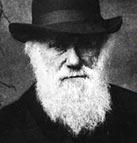
Name the Man

Along the lines of this old post, here's another game of name the mystery man in the picture.


(Note: This is just a fun post. Don't take things so seriously.)


Facilitated Communication

What ever happened to Facilitated Communication, the prophecies and divine revelations that autistic people could supposedly reveal and that had approbations of highly respected Torah scholars? It used to be all the rage but I don't hear about it anymore.

See here for a review from Yated Neeman on the subject.

A little Googling got me to a statement from the American Psychological Association:
Peer reviewed, scientifically based studies have found that the typed language output (represented through computers, letter boards, etc.) attributed to the clients was directed or systematically determined by the paraprofessional/professional therapists who provided facilitated assistance... Furthermore, it has not been scientifically demonstrated that the therapists are aware of their controlling influence.

Facilitated communication is a process by which a facilitator supports the hand or arm of a communicatively impaired individual while using a keyboard or typing device. It has been claimed that this process enables persons with autism or mental retardation to communicate. Studies have repeatedly demonstrated that facilitated communication is not a scientifically valid technique for individuals with autism or mental retardation. In particular, information obtained via facilitated communication should not be used to confirm or deny allegations of abuse or to make diagnostic or treatment decisions.
Have there been any retractions from the Gedolim who supported Facilitated Communication? I think Rav Shteinman and R. Elya Weintraub publicly supported it. Am I mistaken on this? It's been quite a few years so I don't remember exactly. If they still support Facilitated Communication, why am I not hearing about this anymore? Am I just out of touch?

UPDATE: A reader directed me to this article by Dr. Avraham Steinberg. Of particular interest is his interaction with R. Shlomo Zalman Auerbach on this subject. A Gadol who asks a scientist to conduct tests to verify a claim. Gevalt! Oy meh hayah lanu!


Sunday, November 20, 2005

Repentant Rabbis

Can a ba'al teshuvah, someone who grew up non-observant, become a pulpit rabbi?

In the old days, the rabbi's job was simply to answer halakhic questions and another functionary -- a maggid or a mokhi'ah -- would speak to the public, inspire them and lead them to greater levels of observance. Today, however, this is the rabbi's job. Is everyone qualified to do this?

The Rambam (Mishneh Torah, Hilkhos Teshuvah 4:2) writes:
It must be appointed in each and every Jewish community one who is wise, great, learned, God-fearing from his youth and who is loved by everyone to rebuke everybody and make them repent.
Note the requirement that he be "God-fearing from his youth." This would seem to exclude a ba'al teshuvah from becoming a pulpit rabbi.

However, there is a difficulty with the Rambam's position. The midrashic tradition has it that the prophet Yoel (Joel) was the son of Shmuel (Samuel). According to 1 Samuel 8:1-3, Yoel sinned. Now one could suggest that since the Gemara (Shabbos 56a) states that Shmuel's sons did not sin, they were entirely free from any sin. On this, see R. Avigdor Nevenzahl's collection of essays on Genesis (last essay) and R. Ya'akov Medan's book David u-Bassheva. If Yoel did, in fact, commit some sort of sin, even one of lesser severity than that mentioned in the text, then how could he become a prophet who rebuked the people? After all, he was not "God-fearing from his youth"?

R. Yitzhak Sorotzkin addresses this in his Rinas Yitzhak to Joel 1:1. He suggests that perhaps prophets are different and do not need to be God-fearing from youth. However, his second suggestion is relevant to our original question. The Gemara (Yoma 86b) states that one who repents from fear has his intentional sins turned into accidental sins and one who repents from love has his intentional sins turned into merits. Thus, suggests R. Sorotzkin, Yoel repented from his misdeeds through love and, therefore, his past sins were erased and he was as if he had been God-fearing throughout his life.

Based on this, we can suggest that someone who become observant out of a love for Torah, rather than fear of divine punishment, has his past sins erased and, like Yoel, is considered as if he has been God-fearing throughout his life. Therefore, he is qualified to become a pulpit rabbi.

However, someone who remains an unrepentant sinner, such as a practicing homosexual, cannot serve as a pulpit rabbi.


Taxes

R. Hershel Schachter on taxes (link).


Become a Hasid

This website has a link to a webpage that offers you the opportunity to become a Hasid by filling out this web form. Translation from Yiddish:
With your electronic signature, you become a Hasid of the holy rebbe, may he live long.
Name:
E-mail address:
It's that easy!


Friday, November 18, 2005

Searching for God and Double Standards

TorahWeb is running a nationally broadcasted event this Saturday night at the Young Israel of Midwood, 1694 Ocean Ave., Brooklyn, NY.

8:00 PM - Rav Mayer Twersky - Searching for God
8:45 PM - Rav Hershel Schachter - Double Standards in Our Lives

Click here to find a broadcast site near you.


Thursday, November 17, 2005

Pass the Hallah Already

There is a whole debate about the proper way to cut hallah bread when cutting it for a group of people sitting at the table. May one cut pieces for everyone at first, or must one cut only for oneself, eat a little, and then cut for everyone else? And then there are variations in between. A neighbor of royal Bobov ancestry told me that his father has a letter from the previous Bobover rebbe saying that, based on kabbalistic sources, one may initially cut an extra piece for one's wife. Others cut a bunch of pieces and then the leader takes the last piece, implying that he had to cut all those pieces just to get to the one that he wants. And so on, with many variations. Personally, I don't get the whole debate.

The Gemara (Berakhos 47a) states that when one person is reciting the ha-motzi blessing on the bread for everyone at the table, the others may not eat until the one who recites the blessing takes his piece of bread. The implication is either that the others may not take bread before the leader takes his piece or that they may not eat until he eats first.

Tosafos quote the Sar (R. Shimshon) from Coucy who ruled the first way, that people should not take their pieces of bread before the leader. But if he hands the pieces out, they may eat first. However, the Rambam and others rule the second way, that they may not eat first.

The Shulhan Arukh (167:15) quotes the words of the Gemara without explanation, while the Rema adds that the leader may give out pieces of bread but others may not eat their pieces until the leader eats first. This is clearly following the view of the Rambam and not the Sar from Coucy.

The Magen Avraham (34) raises a question on the Rema's ruling: The Talmud Yerushalmi states that Rav would eat and pass out the pieces of hallah at the same time. While it is clear that Rav was acting above and beyond the law by doing both at the same time, he seems to have been of the view that the leader must eat first before distributing the pieces. The Magen Avraham leaves this question open but an answer can be found in the Bi'ur Ha-Gra (to se'if 17). The Gra explains this passage as meaning that Rav knew that if he handed out the pieces, no one would be able to eat them until he ate first (as above). In other words, Rav's actions were not because he could not hand out the pieces before eating but because the people could not eat until he ate first.

The Taz (15) also raises a question on the Rema's ruling. The Taz explains that only according to the Sar from Coucy may one hand out pieces of bread since, according to his view, the people may eat as soon as they receive it. However, according to the Rambam -- and this is how we rule in practice -- people may not eat until the leader eats first. Therefore, distributing the pieces of bread is a needless wait before the eating may begin. In practice, we are very strict about any waiting time between the blessing and eating -- even waits that are related to the meal and, therefore, technically permissible (see Rema, Orah Hayim 167:6). Therefore, passing out bread that no one can immediately eat is a needless wait and should be forbidden. This Taz is the starting point for anyone who wants to argue that one may not even cut bread for others, the argument being that cutting extra bread should be equivalent to handing it out.

However, the Taz, who is arguing based on the Rambam, seems to be against that very Rambam. The following is the Rambam's language in Hilkhos Berakhos (7:5):
The leader (ha-botzei'a) gives a piece to everyone and the other takes it in his hand. The leader does not put it in the eater's hand unless he is a mourner (avel). And the leader stretches out his hand first and eats. And those sitting down [to eat] may not taste until the one who recited the blessing eats first.
It seems clear that, according to the Rambam, the leader places pieces in front of each person and then takes his own piece and eats it first. The only other way I can see reading this Rambam is according to the version which the Rema himself quotes and dismisses in Darkhei Moshe, that the word avel (mourner) should read okhel (eating). In which case the Rambam states that the leader may not distribute bread unless he is already eating. Otherwise, though, the Rambam -- who is supposed to be the source of this whole stringency -- seems to explicitly allow not only cutting pieces of hallah for everyone but also giving it out.

The Bah, the Taz's father-in-law, recommends not giving out pieces to everyone because people will likely eat before the leader, which we rule is improper. That is my practice. But the Taz disagrees with his father-in-law by saying that it is prohibited to do so rather than just inadvisable. The Taz, and not the Bah, is what can lead to the stringencies regarding cutting pieces.

I asked my rabbi about this and he has no problem with not only cutting but also giving out pieces before the leader eats. Ask your rabbi.


Can Elephants Jump?

Can elephants jump? According to Tosafos, living in medieval France where there were no elephants, yes. According to everything we now know about elephants, no. See here (PDF) for R. Natan Slifkin's new essay on the subject.


Wednesday, November 16, 2005

The Angels' Visit

R. David Silverberg discusses whether the angels came to visit Avraham on Pesah or Sukkos: I, II, III, IV


Anivus

Grammatical question: Is there such a word as "anivus" or is it a yeshivishism for "anavah"? Discuss amongst yourselves.


Multidenominational Xmas Responsa

I find this very humorous. Moment Magazine asked rabbis of different denominations whether Jewish children should be allowed to sing Christmas carols. Here is my summary of the responses, by denomination (the editor explains her policy of denominational inclusion here):
Lubavitch: Here's a nice and totally unrelated story. No.
Modern Orthodox (ignore for the moment whom they chose to represent MO): No, out of respect for Christians.
Conservative: No, let's look at the history of the practice.
Reform: Only if it's for fun.
Reconstructionist: Why not?
Jewish Renewal: It's great. Here's a nice story.
Humanistic Judaism: It's part of our culture.


Minhas Shai: New Edition

Someone had e-mailed me within the past few weeks about where he can buy a stand-alone edition of the classic Minhas Shai. I was informed yesterday of a new edition of the work published in Jerusalem by the World Union of Jewish Studies and edited by Zevi Bezer and Yosef Ofer.


Two New Blogs

Two new blogs that look promising:

Emet/Truth by our frequent commenter* Rael Levinsohn

Maven Yavin, a collaborative blog by four established, thoughtful bloggers


* Note that if you were to write a commentary on this blog, then you would be a commentator. But if all you do is write comments, then you are a commenter. Not that there's anything wrong with that.


The Netziv on Blogging

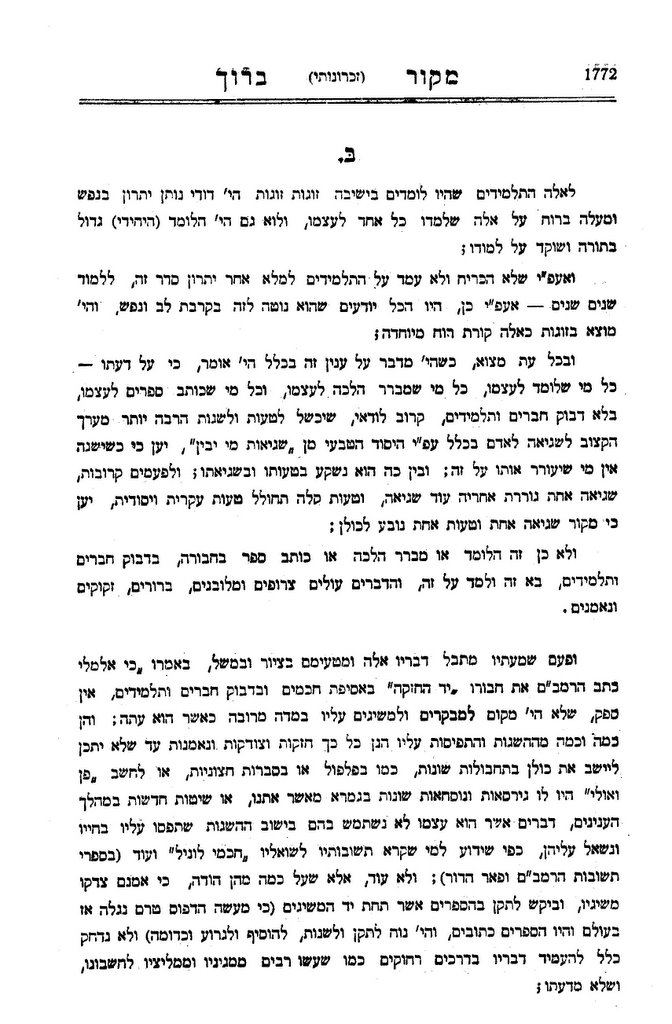
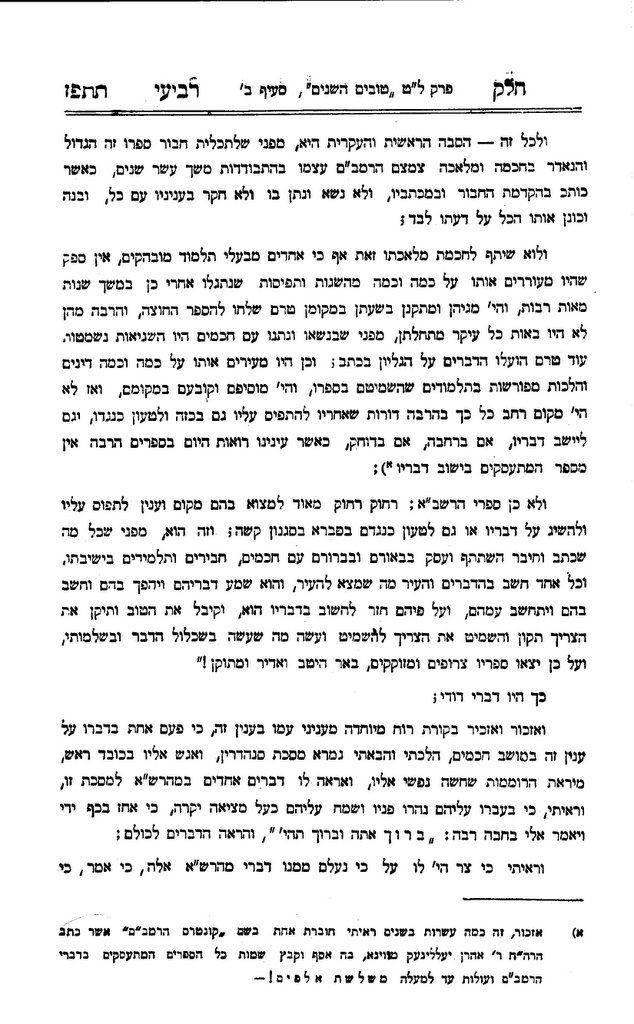
OK, the Netziv (R. Naftali Tzvi Yehudah Berlin) never actually wrote about blogging. But his nephew, R. Barukh Epstein (author of Torah Temimah), wrote about his uncle's championing collaborative communal learning. Granted, this was in regard to learning in partners of two but I think it is clear that it is also relevant to blogging.

The following excerpt from R. Epstein's memoirs, Mekor Barukh, was sent to me by a reader for another reason. This was translated in the controversial partial translation My Uncle, the Netziv that, interestingly enough, was translated by R. Moshe Dombey, of Targum Press.

Here is my loose translation of the relevant passage:
At every available time, he would talk about this matter in general and would say that in his view, anyone who learns on his own, anyone who clarifies a halakhah on his own or writes a book on his own, without the assistance of friends and students, almost certainly makes many more mistakes than a person normally would according to the principle of nature "Who can discern his errors?" (Psalms 19:13), since when he errs no one informs him of it. Therefore, he remains in his mistake and, frequently, one mistake leads to another and a simple error causes a fundamental error, all from the source of one single [original] mistake.


Tuesday, November 15, 2005

Kuntres She-Lo Ya'alu Ke-Homah VI

Do Not Ascend Like A Wall

by Rabbi Shlomo Aviner

Rabbi of Beit El and Rosh Yeshiva of Ateret Cohanim, Yerushalayim

translated by Rabbi Mordechai Friedfertig

printed with permission

(continued from here)

10. The teacher of the Oaths, Rabbi Zeira, retracted them

Thus it is related in the Midrash:[159] "'If it is a wall,' if Israel would have ascended like a wall from Babylonia, the Temple would not have been destroyed during that period for a second time. Rabbi Zeira went to the marketplace to buy something. He said to the one who was weighing: That was weighed very fairly. He responded: Do not depart from here Babylonian because your ancestors destroyed the Temple. At that moment Rabbi Zeira said, are not my ancestors the same as the ancestors of this one?! Rabbi Zeira entered the house of study and heard the voice of Rabbi Sheila who was sitting and teaching: 'If it is a wall,' if Israel would have ascended like a wall from the Exile, the Temple would not have been destroyed a second time. He said: The unlearned person taught me well."

From here, we see that Rabbi Zeira retracted from that which he said "Do not ascend like a wall." Thus wrote Ha-Rav Shraga Feivel Frank,[160] and so too Ha-Rav Mordechai Attiah,[161] and he adds that this is the reason that Rabbi Zeira, when he ascend to the Land of Israel, fasted for one hundred days in order to forget his Torah learning of Babylonia,[162] which is something which we do not find among even one of the talmudic rabbis who ascended to the Land of Israel. "Rather it is possible to say in a hinted way, since Rabbi Zeira in Ketubot taught the issue of the Three Oaths, and he knew through a Divine Spirit that a subsequent generation would come and place all of its sluggishness on this statement, he therefore fasted for one hundred days in order for him to forget this statement."[163]


11. The halachic authorities disagree with the author of the Megillat Esther not to ascend like a wall

1. Our Rabbi Ha-Rav Tzvi Yehudah wrote: "Obviously, the author of the 'Megillat Esther' with all of his importance and holiness, can not be compared to the Ramban, who is called 'the father of Israel,' and there are various laws in the Shulchan Aruch from him, while there is not even one law from the Megillat Esther."[164]

And the Ramban clearly stated that we are commanded to conquer the Land, and he emphasized and stressed again that this commandment exists in all generations.[165]

2. And in the book Kuntres Mitzvat Yeshivat Eretz Yisrael of Ha-Rav Blumberg of Dinenburg, he rejected each and every statement of the Megillat Esther without leaving a survivor or refuge among them, and Ha-Rav Shmuel Mohliver, Ha-Rav Chaim Berlin and Ha-Rav Meir Shapira attached approbations to it. And similarly in the book Em Ha-Banim Semeichah of Ha-Rav Yissachar Shlomo Teichtal.[166] And similarly in the book Geulat Yisrael[167] of Ha-Rav Avraham Yellin who wrote that all of the Early Authorities (Rishonim) disagreed with him, and others.[168]

3. And Maharam Chagiz ruled in practice that all these are "objectionable words." And these are his words: "And there are those who also grasp objectionable words in their saying Three Oaths The Holy One, Blessed be He, made Israel swear."[169]

4. Ha-Rav Sharaga Feivel Frank wrote that those who suspend themselves on the Three Oaths and toil to purify the immutable impurity of the Nations by one hundred and fifty reasons, this is chutzpah (impudence) against our forefather Avraham, and against the Sages of Israel and in particular the Gra who ruled in practice regarding the mitzvah of ascending and inquiring about Zion.[170]

5. And similarly the question: "If the possibility exists in the physical reality to bring all of Israel at one time to the Land of Israel...," the Gra responded: "If the possibility exists to bring six hundred thousand to the Land of Israel at one time, we need to do so immediately, since this number of six hundred thousand has immense power and is complete."[171]

6. And so too the Admor of Chortekov: "If the Children of Israel would have settled approximately a half of a million in the Land of Holiness, it would have drawn the Redemption near."[172]

7. And Rabbi Yehoshua of Kotna ruled similarly based on the Ramban that even now there is a mitzvah "to conquer the Land of Israel so that it will be under our control."[173]

And the Meiri[174] wrote similarly that the conquering of the Land is an obligatory war like the opinion of the Ramban.

And similarly according to the Rambam there is a commandment of conquering the Land of Israel.[175]

And even Rashi mentioned the issue of the possibility of Redemption with a [strong] arm in the Second Temple Period.[176]

8. Rabbi Yaacov Emden considered the conquering of the Land of Israel: "Knowledge of the waging of war,[177] manufacturing weapons and lookouts, burnt powder and burnt reed and that which accompanies them (i.e. materials for gun powder), numerous, great and wide-ranging ruses, they are found in the wisdom of calculated thoughts and are of great benefit more than those in which the enemy remembered the eternal sword considering that perhaps we will also be aided by these to ascend and conquer our Land from the control of our enemies."[178]

9. The Admor of Gur, the Chidushei Ha-Rim, stated in the year 5623 (1863), at the time of the national revolt in Poland: "I am concerned lest there will be a prosecutor in Heaven against the Nation of Israel. We see how a nation like the Poles sacrifice its life for its liberation and liberating its land from foreigners, and us, what are we doing."[179]

10. Rabbi Pinchas Eliyahu of Vilna wrote: "But we are guilty concerning the prolongation of the Exile in our dwelling on a foreign land...for how long will we not do for this that which is in our ability to do...and our eyes which see the Nations in which people will go out in the name of their country and wage war each one for the sake of his land...and we are idle and slothful...how long will we not arise to wage war as well for the sake of our Holy Land."[180]
Notes to be posted at the end of the series.


Yankel Radio

I've got Mordechai Schiller to thank for introducing me to Five Towns Radio (FTR) and Nachum Segal's online radio. I've been listening to both, or more accurately using them as background noise in my quiet office, for some time.

I recently read about a relatively new technology called Jack Radio (article, click through the ad). It is a fully automated radio station that randomly selects songs from a large library of top 40 songs from the last forty years. The style of songs is totally random.
"If [consecutive songs] sound like they should go together, then we've done something wrong," says Robert Lewis, program director at KBPA/Bob-FM, a Jack clone. The unlikely pairings are called "train wrecks" in Jack's lingo because that's what it sometimes sounds like to listeners. The mixed hits go against the grain and can invite a wider demographic (25-to-54-year-old white listeners) to tune in. "Even if you don't like a song, the next song you'll probably love," says Perry.
That's what I think of every time I listen to these Jewish stations. You can go from a song with a dance beat to a Carlebach tune to a boys choir in minutes. I assume that it is because of the limited quantity of selection but large variety of style within the Jewish music scene.

While both FTR and Nachum Segal are online streams of Jewish music and there is a good deal of overlap in the music they play, there are some differences that I've noticed.

1. FTR is more yeshivish. Nachum Segal plays some Israeli music and has on his rotation a song that uses the lyrics to the prayer for the welfare of the state of Israel (not that there's anything wrong with that). FTR sticks to more black hat music -- the kind that gets onto the cover of Country Yossi Magazine.

2. Nachum Segal includes songs from the 1970s through today. You'll hear quite a few "classics" from Miami Boys Choir, Mordechai Ben David and Avraham Fried that will either warm your heart or make you nauseous. FTR is contemporary (which might also make me you nauseous).

3. Nachum Segal sometimes plays cantorial music (hazzanus). No kidding. Also, some really old-sounding big band songs that seem like they're from Modzitz songs from fifty years ago.

4. FTR has this weird thing where the talk is much louder than the songs. That makes me jump every time they transition to talk.

5. FTR has a much poorer internet connection and I frequently have problems connecting. I rarely if ever have a problem with Nachum Segal.

UPDATE: FTR has informed me that they are currently in the process of upgrading their servers to handle the increased traffic they have been experiencing, and that is probably what has been causing the connectivity issues.

With both stations, the Jack-like format makes it so that even if I can't stand the song playing now, the next one might be my favorite. So I keep listening. The only drawback is when someone walks into my office and I'm embarrassed by the song playing. That's why I have to be quick in my ability to Alt-Tab to the volume control and click "mute all." But my clear favorite is FTR, although because of connectivity issues I listen to Nachum Segal more often.


Internet Commerce on Shabbos

The current RJJ Journal (Fall 2005), has an article by its editor, R. Alfred Cohen, on the issue of internet commerce. The article itself is preliminary and does not claim to be conclusive. However, there area a few things I would have liked to have seen in such an article:

1. A differentiation between a website that performs a service and one that simply allows consumers to buy something. For a service-providing website, there is a question of sekhar Shabbos, receiving money for work performed on Shabbos. For an internet store, I would assume that the work is performed during the week when the item is shipped.

2. Given the global nature of the internet, and the differences between the times of Shabbos' beginning and end according to the views of Rabbenu Tam and the Ge'onim, there is essentially no time in the week that is Shabbos everywhere in the world. Someone, somewhere will be allowed to use your website any time during the week. Holidays, however, might cause a problem.

3. As correctly noted in the article, money transfers are currently done through credit cards, which themselves are done through banks' clearing houses that are closed during the weekend. Therefore, there is not truly any money changing hands on Shabbos. However, my understanding from my days in banking is that the ATM network does move money on weekends and that technology already exists (I've seen it) to tap into the ATM network through the web. I don't believe it has been implemented on a large scale for technical reasons, but it is certainly a theoretical possibility. If that is the case, I'm still not sure that someone purchasing something from you and depositing money in your account is problematic.

R. Shlomo HaKohen of Vilna has an important responsum (Binyan Shlomo, 17) in which he argues that a kinyan with no ma'aseh (act) is permissible on Shabbos. If someone comes to your house and places a gift in your premises, you may acquire the object through a kinyan hatzer because there is no formal act of acquisition. If someone deposits money in your account on Shabbos, you have not violated the rabbinic enactment against making an acquisition. Does this mitigate the problem of internet commerce on Shabbos? Maybe, but that's beyond my expertise.

4. There is an issue of zilzul Shabbos (denigration of Shabbos) if a store is open on Shabbos. I find it hard to believe that it also applies to an internet store, in which there is no foot traffic and everything is done in the privacy of one's home.

These are just some thoughts. The question is so complex that it will only be decided by the greatest of halakhic minds who will, undoubtedly, disagree. So if this is relevant to you, ask your rabbi and he will probably ask his advisor.


Monday, November 14, 2005

Those Obnoxious Orthodox Rabbis II

Following up on this post, I received notification via e-mail that the Detroit Jewish News is profoundly apologetic for its "terrible decision-making" and begs the forgiveness of those who were offended. I don't think that there is much more we can ask for.

Thank you for understanding our pain and ensuring that it does not happen again.


Fortieth Anniversary of Nostra Aetate

The fortieth anniversary of Nostra Aetate, the papal declaration that radically changed the Catholic Church's attitude towards Jews, passed by two weeks ago with essentially no notice in the Orthodox Jewish community. The controversy in the Orthodox community that surrounded its original issuance and the developments since then have been ignored, as have the impact of the statement. Neither the OU nor the RCA have anything on their websites about it.

R. Yitzchok Adlerstein has broken the silence by posting a thoughtful piece on the subject on Cross Currents.

Worthy of note is the ongoing debate over the last two years about R. Joseph B. Soloveitchik's heritage on this issue, as posted to the Boston College website.

Here is a link to the Vatican's statement about the Nostra Aetate anniversary: link
Here is the ADL's collection of articles on the anniversary: link
The Reform movement's CCAR's suggestions from programs to commemorate the anniversary: link
Dr. Eugene Borowitz's address at the Catholic University's program in March celebrating the anniversary: link

UPDATE: This post is probably relevant to the topic.


Sunday, November 13, 2005

Canaanites in Israel

A classic piece of evidence for the post-Mosaic writing of the Torah is in last week's Torah portion. Gen. 12:6 "והכנעני אז בארץ And the Canaanites were then in the land."

Cassutto points out that there are three ways to understand this statement:

1. The Canaanites were still in the land at that time, but not at the time of the writing of the text. This is how modern critics understand the text.

2. The Canaanites were already in the land at that time, i.e. they had conquered it from those who had previously settled in it. This is how Rashi understood the text.

3. The Canaanites were, at that specific time, in the land. The land was not barren -- Canaanites were there -- so Avraham could not immediately become the ruler of the land. This is how Cassuto understood the passage, as well as Benno Jacob. I believe that the Pesikta Zutrasi (cited in Torah Shelemah, ad loc. no. 109) also understood the phrase in a similar way.

Frankly, while this passage could be read within the context of a late authorship of the Torah, I see no compulsion to do so. This is not a verse that should scare traditional believers in the Torah.


Two Awards

Apropos of nothing:

1. You can call me an award-winning blogger. It seems I won the neighborhood award for the last sukkah standing.

2. A neighbor wins the award for the fastest kiddush for a new baby. His daughter was born on Friday and the kiddush was on Shabbos. But for a faithful reader, I'll walk the 25 blocks (each way). At least on a nice day like yesterday.


Saturday, November 12, 2005

Sarah, Wombs, Hazal and Science II

Following up on this post, I was that R. Yitzhak Sorotzkin (Rinas Yitzhak, Gen. 16:4) quotes the Panim Yafos as saying that when Rashi (Gen. 15:5) states
"He said to him, 'Leave your astrological calculations that you have seen in the constelations that you are not destined to have a son. It is Avram who will have no son, but Avraham will have a son. Similarly, it is Sarai who will not give birth, but Sarah will give birth.'" he means that Sarai/Sarah was miraculously healed. In our context, that would mean that her physiology was changed via miracle to include a womb.


Friday, November 11, 2005

The Cultural Divide

Joe Schick has two insightful posts about the cultural divide between left-wing Haredim and right-wing Modern Orthodox Jews. It is largely based on from where they are coming and the attitudes they have internalized and with which they are familiar. Living in both circles, I greatly appreciated his observations. The divide is not that huge, but it is something that I see emerging every once in a while with my friends.

Links: I, II

Note that because he used the Slifkin Affair as an example, the comments there have devolved into yet another debate on the subject. Don't let that distract you from the cultural observations.


Regaining My Faith

Right before Yom Kippur, the principal of my daughter's Bais Yaakov sent home a letter to parents about the slipping standards of women's modest dress that he has noticed. The letter was very carefully and properly worded. He referred to other customs, rather than to forbidden practices. He talked about following the school's rules while on premises and how contradicting the teacher's instructions sends a bad message to one's daughters. He also emphasized his disappointment in his school's alumni who are cheating a little on the standards he and the school taught them. All in all, I found the letter to be very well done and, as someone who on occasion goes to the bus stop or to the school to drop off or pick up my daughter, not out of place.

It just bothered me that I never got a letter about derekh eretz (manners). Should tzeni'us be the number one priority? Granted, it is the most obvious. The principal sees mothers who visit the school and he sees his students on the street outside of school hours. So he knows how they dress. Other things that need improvement aren't necessarily as obvious. But, on the other hand, come on. We all know of certain things that even go on in school and synagogue that should be changed. So why no letter about pushiness, unpleasantness, selfishness, etc.?

Within a few weeks, and evidently planned well in advance so it was not due to parental complaints, the school was addressing this as well. One night this week, I attended a presentation in the school for parents (fairly well attended) about Project DERECH. This organization, which it seems has been around for a few years, has prepared a curriculum for different grades about improving manners and showing respect. The school asked parents to come for a presentation to encourage them to engage their daughters in the curriculum and reinforce the school's message. The presentation was nothing short of fabulous and, while I'll reserve judgment on the curriculum until I know more about it, I have high hopes for it. But setting that aside, the simple fact that there is such a curriculum and the school is trying to implement it will make an impact on the students and the parents (make no mistake about it, many parents need such a curriculum as well).

Here are some links for Project DERECH: I, II, III


Thursday, November 10, 2005

Those Obnoxious Orthodox Rabbis

R. Reuven Spolter drew my attention to an article in this week's Detroit Jewish News about a female Reform rabbi in Israel petitioning to be appointed and paid by the government. Aside from the article's clear bias in favor of the petitioner, the newspaper included this offensive picture in their cover story:

In other words, she's young and noble and they're all a bunch of obnoxious, old-fashioned and mean-spirited old men. Way to play the stereotype!

There is a feedback form at the bottom of the article (link). R. Spolter also provides e-mail addresses of the editor and publisher of the paper, along with the letter he sent it (link).


The Journal of Halacha and Contemporary Society

One of the standard venues for excellent contemporary analyses of practical halakhah has been, for more than two decades, The Journal of Halacha and Contemporary Society. Some past articles are available online at JLaw.com. The journal is frequently referred to as the RJJ Journal because it is published by the Rabbi Jacob Joseph School. Dr. Marvin Schick, the president of that school for the past thirty-three years, has subscription information about the journal on his blog.


Proof of God's Existence

Received via e-mail:

From the new volume of Meged Givos Olam by R. Mikhel Shurkin (pp. 24-25):
On the day R. Laibele Kovner was appointed as rabbi of Kovno, a maskil approached him and said, "Rebbe, do you have any proof that there is a God?" R. Laibele answered him, "Definitely. Bring me a Yad Ha-Hazakah of the Rambam." The maskil went and got him a Yad Ha-Hazakah and R. Laibele opened it to the first halakhah in the first chapter of Hilkhos Yesodei Ha-Torah: "The foundation of foundations and the pillar of all wisdom is to know that there is a First Being who brought everything into existence..." When he finished reading the halakhah, R. Laibele turned to the maskil and said, "Here for you is a clear response and an irrefutable proof for your question. The Rambam says that it is the foundation of foundations and the pillar of all wisdom that there is God, and the Ra'avad agrees with him and makes no critical comment here as he does in many other places. And the Maggid Mishneh, Kesef Mishneh, Mishneh La-Melekh and the Lehem Mishneh pose no difficulties on the Rambam -- behold clear proof that there is a God."


Wednesday, November 09, 2005

A Triumph of Textualism

In the old days, there was a very widespread custom that was stamped out by leading rabbis who felt that it did not sufficiently conform to the Talmud. This despite explicit approval of the practice by scholars of the highest tier.

No, I am not referring to any example of the so-called Haredization of the Jewish community in the twentieth century. I am talking about a development in the sixteenth and seventeenth centuries, and the practice is washing one's hands (with a blessing) prior to reciting kiddush over wine and then proceeding directly to reciting a blessing over the hallah.

The Talmud (Pesahim 106b) records a view that one who washes his hands may not recite kiddush, presumably because the kiddush is an interruption between the washing and reciting the blessing over the hallah. Another view is then presented that if one wishes, one may recite kiddush over hallah rather than wine and, presumably, wash one's hands before the kiddush. The simple understanding of this passage is that one may not wash before kiddush unless one is reciting kiddush over the hallah.

However, the practice developed to always wash before kiddush. Rashi (quoted in Mahazor Vitry and Sefer Ha-Oreh) and Rashbam (ad loc.) seem to permit the practice, albeit not ab initio, while Rabbenu Tam and the Ri (Tosafos, ad loc.) permit it even ab initio. There is ample testimony that the practice eventually became widespread in France and Germany, to the point that it was the personal practice of the Rosh. Rabbenu Tam was able to justify this practice textually by explaining that the initial opinion in the Talmud is entirely dismissed based on a disagreement elsewhere, and the concluding view is that one may always wash before reciting kiddush, even over wine.

In Sephardic lands, the Rambam (Hilkhos Shabbos 29:10) rules according to the simple understanding of the Talmud but the practice of washing before kiddush was not halted by his ruling. Rashba (ad loc.) and Ritva (ad loc.) record that this practice was standard, and they attempted to justify it textually.

However, the Tur (Orah Hayim 271) opposed this practice -- despite the fact that his father, the Rosh, followed it -- because the simple understanding of the Talmud forbids it. This, even though he was well aware of Rabbenu Tam's textual justification of the practice. The Shulhan Arukh (Orah Hayim 271:12) rules like the Rambam, forbidding this practice. R. Yoel Sirkes, the Bah (ad loc.), explicitly states that this practice is widespread but that he opposes it because it contradicts the simple reading of the Talmud. He recommends a compromise, that the one reciting kiddush not wash beforehand but that everyone who is just listening may. His son-in-law, the Taz, goes further and rules like the Rambam, that this practice is entirely prohibited. Later authorities generally rule according to either the Bah or the Taz. This, despite the fact that leading Ashkenazic authorities, the Rema and the Maharshal, supported the practice of washing before kiddush. They were not able to preserve it from the stringency based on the authoritative Talmudic text, despite an available alternate reading.

By now, what was once a widespread custom in both Ashkenazic and Sephardic lands has been almost entirely wiped out. To my knowledge, it is still practiced by Jews of German heritage. Before the Holocaust, there were also some other pockets of tradition in which the custom was still practiced, but very small. The great contemporary defender of German-Jewish customs, R. Binyamin Hamburger, devotes a chapter in the second volume of his Shorshei Minhag Ashkenaz to this custom.

I find this to be an extremely interesting example of the great halakhists of the past four centuries preferring a simple reading of the Talmud over a practice that was established and justifiable (not to mention endorsed by great scholars). It seems to me to be an exception, but a noteworthy one.


Cardozo on Slifkin

I think I might have seen only one of these at the time it was originally written, but the following are three essays by R. Nathan Lopes Cardozo about the Slifkin Affair. They are so jam-packed with memorable quotes that providing excerpts is impossible. Very eloquent.

I, II, III

Don't worry, I'm not stuck on Slifkin. The next few posts will b"n have nothing to do with the matter.


R. Norman Lamm on Lubavitch Messianism

At a conference at NYU on the Lubavitcher Rebbe, R. Norman Lamm said, in response to a question about whether Lubavitch Messianists are crazy, "You don't have to be meshuga, you could also be irrational."

See here for Steven I. Weiss' initial report.

It must have been really good, because a Lubavitch apologist was extremely offended by it.

(Unnecessary snide comment: I'm sure the Haredi world will get around to condemning Lubavitch Messianism after it is done with R. Nosson Slifkin.)


Tuesday, November 08, 2005

Conservative Rabbis

R. Yosef Gavriel Bechhofer writes about why he thinks it is inappropriate for a Conservative Jew to be ordained as a rabbi. I am assuming that he left it in Hebrew intentionally so I will not translate it. I am also assuming that he is discussing those who espouse the belief in the text he cites (or a less traditional belief), and not the possible exception who accepts more traditional beliefs but is affiliated with the Conservative movement for other reasons. Regarding those others, see here for R. Ahron Soloveichik's view which seems to be stricter than the normative practice.


The Gosse Theory

One of the ways of reconciling the apparent age of the universe with the traditional religious chronology is by saying that God created the world looking older than it actually is. This was first suggested by Philip Gosse in his 1857 book Omphalos: An Attempt to Untie the Geological Knot. The Omphalos Hypothesis has remained controversial because it is unverifiable and runs counter to many people's idea of a benevolent God. It does, however, solve all of the problems of an ancient looking world and universe.

Personally, I part ways with R. Nosson Slifkin over this and have no problem with the Gosse Theory. Does this contradict the way God is supposed to work? I don't know. My general response is simply "Could be." Can the world have been created looking old? Could be. Would God make this elaborate fake-out to fool us into thinking the world is older than it really is? Could be. Hey, I don't claim to know how God works. Maybe this somehow fits into his plan. How am I supposed to know? Granted, plenty of classical Jewish scholars have rejected theological theories based on other theories of how God runs the world. But I'm not convinced that there is a solid argument either way on this. Others are free to disagree.

Will most people find this hypothesis convincing? If they already believe in the Torah, as I do, then they might also say "Could be." If they are of a more skeptical nature, whether they believe in the Torah or not, then I doubt that they will see this as a particularly plausible possibility. It does, indeed, require a stretch of one's imagination.

But in my book, this theory is not only unverifiable but also unfalsifiable. So it could be. I believe in plenty of things that are not empirically provable or disprovable.

Some have argued that since this was first suggested by a Christian, therefore Jews may not accept it. That's just wrong on so many levels that I won't bother responding.


Vote or Don't Complain


Monday, November 07, 2005

Onkelos and the Oral Torah

Extensive debates online are hard to execute because they inevitably drift off into tangents that, while necessary for the arguments, are confusing and wearisome. This post is a case in point, which is why I turned this into its own topic.

In two earlier posts (I & II), I argued against the position that the Targum Onkelos contains only a simple translation of the Hebrew text into Aramaic and not any commentary that can be classified as Oral Torah. While this is quite apparent to anyone who has studied the text, I discovered that R. Menahem Kasher devoted volume 24 of his Torah Shelemah encyclopedia to this general topic. The following five examples are just a sample of what is in said volume. I think they make the point quite clearly that Targum Onkelos contains elements of the Oral Torah.

1. Exodus 21:8 (JPS 1917): "to sell her unto a foreign people he shall have no power"
Onkelos: "He shall have no right to sell her to another man" (cf. Mekhilta De-Rashb"i)

2. Exodus 21:9 "he shall deal with her after the manner of daughters"
Onkelos: "he shall deal with her after the manner of daughters of Israel" (cf. Mekhilta)

3. Deut. 22:5 "A woman shall not wear that which pertaineth unto a man"
Onkelos: "A woman shall not bear a man's weapons" (cf. Sifrei; Nazir 59a)

4. Deut. 23:18 "There shall be no harlot of the daughters of Israel, neither shall there be a sodomite of the sons of Israel"
Onkelos: "A woman of the daughters of Israel shall not be for a male slave and a man of the sons of Israel shall not be for a maidservant"

5. Lev. 18:5 "which if a man do, he shall live by them"
Onkelos: "which if a man do, he shall live by them in the world to come" (cf. Toras Kohanim)

There are many more examples but I think the point has been made.


Twitter Delicious Facebook Digg Favorites More