Friday, April 22, 2005

One Last Post

For those who cannot tell from this blog, I am Jewish. This pretty much guarantees that I have relatives who are doctors. Well, it turns out that I have lots of relatives who are doctors, some who are actually famous. When I went in to interview for my daughter's Beis Ya'akov, so many years ago, the three main topics of discussion were:
1) Why didn't you get your name put higher on the list by coming earlier in the night to stand on line (that pretty much gives away the school, doesn't it)?
2) Why do you go by your English name (I don't)?
3) Wow, your uncle is a really famous doctor.
(And how wonderful my mother-in-law is.)

Not only that, I went to YU. So my friends are either:
1) Accountants
2) Trained as engineers but working in computers
3) Doctors
4) Rabbis (or trained as rabbis but working in computers)

The engineers and the doctors took lots of science. Without exception, everyone with whom I have had a serious discussion about their scientific training has told me how amazing the world and the human body is, and how the more they learn about it, the more they grow in awe of God.

That is why I was so surprised when R. Mordechai Plaut wrote in the Yated Ne'eman (thanks to Steve Brizel for bringing this to my attention) that people should really only learn medieval science to grow in their appreciation of God. Modern science just won't do it.
Nowadays, one who seeks to arouse and enhance his love of Hashem is best advised not to study modern science. He may study the material that the Rambam suggests at the beginning of Hilchos Yesodei Hatorah, or Chovos Halevovos. Many find that deep study of the lomdishe acharonim enhances their ahavas Hashem.
Maybe he should have consulted with some people who actually studied modern science and ask what their reactions were.

UPDATE: Compare. Rabbi Plaut:
This is not to say that the awe that the deep discoveries of modern physics can inspire cannot be useful, but it is to argue that it is much less special and unique than was the knowledge that the Rambam lays out in his early chapters of Sefer Mada...

In fact, all of the content of modern science is only of the kind that the Rambam shows elsewhere as applying to basic belief in G-d and not to love of Him. By showing complexity and the skill of the Designer, it can lead to emunoh.

Yet Rambam does not recommend the study of natural science for acquiring basic belief but for arousing love of G-d — ahavas Hashem.
Rambam (Hilkhos Yesodei Ha-Torah 2:2):
What is the way to love and fear God? Whenever one contemplates the great wonders of God's works and creations, and one sees that they are a product of a wisdom that has no bounds or limits, one will immediately love, laud and glorify [God] with an immense passion to know the Great Name, like David has said, "My soul thirsts for God, for the living God". When one thinks about these matters one will feel a great fear and trepidation, and one will know that one is a low and insignificant creation, with hardly an iota of intelligence compared to that of God, like David has said, "When I observe Your heavens, the work of Your fingers...what is man, that You are heedful of him?".

Out of Service

I will be away for Pesah, spending the first days in Teaneck (davening here) and the last in Atlanta (davening here).

I might have the opportunity to check in on the blog, but I almost certainly will not be able to post.

Have a hag kasher ve-samei'ah!


Fantastic Aggadah

The following is an excerpt from R. Zevi Hirsch Chajes' The Students' Guide through the Talmud (buy it now), pp. 195-197. Keep in mind that the Maharatz Chajes was a giant of Torah scholarship whose glosses are printed in the back of the standard Vilna edition of the Talmud. This is from what was intended to be the introduction to the glosses and printed in the Talmud, but it was not finished in time.
Similarly, in Aggadic interpretations the lecturer's aim was to inspire the people to the service of God and to awaken them to a realization of the emptiness of their vain life, so that they should be compelled in this world of forgetfulness to fit themselves for entering the banqueting hall (of immortality), adorned and graced with a pure heart and good deeds. Thus, the chief object of the lecturer was to awaken the slumbering soul from its foolish sleep and stir it up to do what was right. If at times he noticed that his simpler utterances made no impression upon the audience he sought to find another method for his purpose by telling them stories which sounded strange or terrifying or which went beyond the limits of the natural and so won the attention of his audience for his message.

The Rashba,[1] making reference to this in his commentary on Berachoth (chap. ix), in the Aggadic section, where he speaks of the stone which Og, King of Bashan, attempted to cast down upon Israel,[2] says of this matter: 'Maimonides, in his introduction to the Mishnah, has referred to the two ideas which the Aggadic teachers had in mind (when relating these outlandish Aggadoth).[3] But, in my view, there was besides these another motive behind some of the Midrashim of the Aggadists, namely that since there were occasions when, as the Aggadists were delivering their discourses publicly and elaborating matters useful to the audience, the listeners fell asleep, the lecturer, in order to awaken them, had to make use of queer and astounding tales to rouse them from their sleep.'

The reason is clearly shown in the Midrash Hazitha,[4] par. הנך יפה where we read that Rabbi was delivering a discourse and the audience had dozed off, so in his desire to arouse them he told them of one Israelitish woman who in Egypt gave birth herself to 600,000 children.[5] Similarly, the story told of Og, how he uprooted a mountain three parsangs in extent, was meant to convey that Og's object was to deprive the children of Israel of their rights based on their three ancestors. The Aggadists, however, put the idea in the form of this astounding tale in order to arouse the public to follow the lecture with greater interest.

Such are the Rashba's observations... Following this explanation, we can understand the following exposition of R. Akiba[6] (Sot. 11b): 'The Israelites were delivered as a reward for the righteous women of that time. It happened by a miracle that they (the babies which they bore) were swallowed by the ground, and the Egyptians brought oxen and ploughed over them, etc. Yet they broke through the earth, sprouting (like herbs from the soil), and came in flocks to their homes.'[7] Although in the Gemara version this is reported in the name of R. Awira, in Cant. Rab.[8] it is quoted in the name of R. Akiba.[9] One who knows R. Akiba's true genius and intellectual capacity... may find it difficult to reconcile such an odd Aggada with him; but from what we now know of his method, as shown in the two aggadic expositions which we have dealt with above, viz. that when he noticed his audience uninterested or drowsy he would relate to them sensational legends to arrest their attention, we may, I think, unhesitatingly accept this aggadic homily as another of those which had as their object the impressing of the masses and the impelling of their hearts towards the things which are right.

[1] See p. 159, note 3.
[2] Ber. 56a. The legend narrates how Og had planned to destroy Israel. 'The camp of Israel,' he said, 'extends three miles.' He then planned to uproot a mountain three miles in size, throw it upon them and kill them. He uprooted the mountain and raised it above his head, but God sent ants which bored holes in it, causing it to fall upon his head and rest on his shoulders, and when he tried to throw it off, his teeth became interlocked, thus preventing him from throwing it off, with the result that Moses was able to strike the mighty blow which killed him.
[3] They were intended to sharpen the intellect of the students, or else to open the eyes of fools hastening to find fault with the scholars as soon as they found their words difficult to follow.
[4] The exegetical Midrash on Canticles.
[5] He meant this to refer to the birth of Moses who equalled all the rest of the people in importance. The number 600,000 is given in Ex. XII, 37.
[6] Who behaved heroically in those days of oppression.
[7] The Aggada, in its own fanciful style, pictures the scenes elaborately. First, it tells us how the women used to obtain and carry the food to their husbands, the slaves, and remain with them in secluded spots, and when the time of their delivery arrived, how the babes were attended to and fed by God's Ministering Angels, and how they were preserved in subterranean caves, and how when the babes were grown up, the earth opened its mouth and returned them to the light of day. Like the grass of the fields they sprouted from the soil and moved away in herds to their homes.
[8] The author ascribes to Cant. Rab. what is in fact recorded in Ex. R. I, 16.
[9] See also Yalkut Shimoni on Ezekiel, par. 354, cf. also R. Is. Pick glosses, ad loc.
See also this post.


Thursday, April 21, 2005

Just in Time: You Shall Tell Your Son

Yashar Books' Open Access project has posted a new book online: You Shall Tell Your Son: Essays on Pesach and the Haggadah by Rabbi David Jay Derovan. You can download it for free here. Note also what is in the "coming soon" section.


Pesach Rocks

I fully agree with MO Chassid. Pesach is a great holiday!


Dayeinu

I was always puzzled how, in the Haggadah, we essentially recite the dayeinu passage twice in which we thank God for a list of different things He did for us in the extended Exodus story. We say it once with dayeinu separating each thing for which we are thankful and then again as one long paragraph without the dayeinu. What is the reason for this redundancy?

R. Yehiel Mikhel Epstein, the author of the Arukh Ha-Shulhan, explains in his commentary to the Haggadah that, just like when pieces are put together the whole is greater than the sum of all the pieces, the first recitation is a thanks to God for each individual matter while the second recitation is a thanks for the confluence of good things. Not only did He do all those individual acts for us, but He did all of them which combined to create a world-changing event.

One of the dayeinus in particular is somewhat puzzling (here is a list of them): "If He would've brought us to Mount Sinai, and not given us the Torah, it would've been enough for us."

Why would we be thankful for being brought to Mt. Sinai if nothing happened there and we were not given the Torah? What good is there in merely going to the mountain?

I think the answer can be found in Rashi's commentary to Shemos 19:2. The verse states, "And Israel camped there in front of the mountain." Rashi comments (based on the Mekhilta, "As one person with one heart (mind). But all the other encampments were with resentment and dissention."

While encamped at Mt. Sinai, the Jewish people experienced a fundamental unity as a people that was unequalled throughout the Desert experience, and probably throughout history. That moment in time, while encamped at Mt. Sinai, serves as the archetype for Jewish unity to which we strive. Even if we had not received the Torah, the experience and example of unity would have been dayeinu.

Alternatively, verses 10-11 of that chapter tell us: "The Lord said to Moses: 'Go to the people and consecrate them today and tomorrow. Have them wash their clothes and prepare for the third day, because on the third day the Lord will come down upon Mount Sinai in the sight of all the people...'"

The giving of the Torah was God acting upon Israel. It was Him sanctifying us through his terrifying presence that forces holiness onto people unable to disobey such an overwhelming force. Prior to the giving of the Torah, the period of encampment at Mt. Sinai, was the time for our own preparation. We made ourselves holy in order to receive the Torah. Thus, the encampment at Mt. Sinai was our changing ourselves through our own initiative while the subsequent giving of the Torah was God changing us through external means.

Even if we had only encamped at Mt. Sinai and been given the opportunity to change ourselves and make ourselves holy, dayeinu.


Wednesday, April 20, 2005

Important Heresy Warning

This is based on a post on another website, although I have altered it for presentation purposes. A link to the post will be presented at the end of this post.
There are teachings in Rambams books that contradict Torah. Simple as that. An easy to understand example: Rambam says that the donkey did not speak to Bilam The Torah says the opposite. So why does Rambam say so? Because philosophy says so. Can the current philosophical interpretation of prophecy be wrong? That conclusion is unacceptable to Rambam.

Rambam does not say "We need to find an answer to tell Baalei Teshuva (or even FFB's) to this. Instead, he insists that there is no way to say, the way we all know the Torah does, that the donkey spoke to Bilam. It is just not so, he says. The donkey did not speak.

This alone qualifies Moreh Nevuchim as SIfrei Minim. He is insisting, and teaching to the public, that the fact is, the story of Bilam is not – indeed, he has proof that I cannot be! - as it says in the Torah.

Rambam says that the donkey didn't speak because philosophy tells us that animals don't talk to angels, and if you were taught differently in Yeshiva, well, he knows better. Better than your elemtary school Rebbi; better than the earlier Rishonim, better than the Gaonim; better than Chazal; better than everybody. I promise I am not making this up. He claims not a single shitah that agrees with him, This is his own observation, his own teaching, his own, lone, opinion. And for good reason: there is no way that anybody in his right mind can claim the Torah believes such a thing, seeing as it states black on just the opposite. Yet Rambam does just that. He claims that when the Torah says the donkey spoke to Bilam, the Torah doesn’t really mean it. His utterly botched attempt to make sense out of what the Torah says here, tells the reader one thing: When the Torah says the donkey spoke to Bilam, the Torah is wrong.

Whether this was Rambams intent or not is irrelevant. This book is halahicly Sifrei minim. Burn it.
Of course, this was not written about the Rambam. It was written about R. Nosson Slifkin. My point, though, is that logic is lacking from his argument. Here is the original post.

As to the comments about science, I revert to my post about pseudo-science.


The Belated Answers to the Four Questions

The Maharatz Chajes answers why, in the Haggadah, we do not immediately reply to the Four Questions with Rabban Gamaliel's statement that "Whoever does not say these three things..." in which the questions are answered. From The Students' Guide through the Talmud, pp. 198-200:
With regard to the questions found in Num. R. and Deut. R., and in Midrash Tanhuma and the Pesikta Rabathi, with which these books often begin their homilies, namely the halachic dissertations which are introduced with the words 'There is a ruling that an Israelite, etc.,' or with the words 'May our teacher instruct us', and followed with Aggada, we cannot trace the use of a similar formula in the Talmudim (Babylonian or Palestinian), except once in the Babylonian Talmud... [The halachic question is asked] and the Aggadist goes on to indulge in sophistry, changing one subject for another until he closes his homily with the words 'and as for the question which I have been asked...' and answers it...

The chief object, however, of the Babylonian and Palestinian Talmudim was to enlighten us either on halachic or legal decisions or upon matters of aggadic or ethical character. For this reason the redactors of the Talmud (except in once case) did not embody such a form of teaching in the Gemara, but dealt separately with the homiletical expositions in relation to the particular purpose for which they were needed, and separately also with the halachoth...

But it was not so with the Midrashim, which were not recognized as being for the teaching of halachoth, or for the publication of legal rulings needed for actual practice. In these Midrashim, the Rabbis at times left us their homilies either introduced with the words: 'There is a ruling that an Israelite, etc.,' or with the words: 'May our Teacher instruct us,' as indeed homilies were introduced when delivered to the masses in those days.

One may also note that the Passover Haggadah,[1] the compilation of which is thought to have taken place during the time of the Temple, as recorded in the Mishnah, Pes. 10, 4,[2] also introduces subjects with questions in the same way as the Midrashim of the earlier days. At first the children are made to ask four questions about the difference between this (the Passover) and other nights, and then the celebrant begins to narrate the successioin of events and to expound the Exodus and various passages in the Scriptures relating to this subject, and finally he turns back to reply to the question which had been put to him. So, for example, in reply to the question: 'Why are we eating this matzah?' he says: 'Because the dough of our forefathers did not have time to be leavened.' And there are similar replies regarding the Pesach (sacrificial lamb) and the maror (bitter herb). In this way the familiar difficulty which is raised as to why the narrator does not proceed at once with his proper answers to the questions on the reasons for the eating of matzah and maror is met, if we bear in mind the above elucidation of the methods adopted by the Tannaim and Amoraim in their homiletical discourse, as we have seen them exemplified in connection with the question referred to above (Shab. 30a), viz. that their way was to pass from one subject to another related to it, until they came back finally to reply to the main question asked.

[1] The ritual recitation for the Passover Home Service. Its name is derived from the word והגדת 'and thou shalt tell'. Ex. XIII, 8, and it includes the narration of the Exodus.
[2] Where first mention is made of the ritual and where R. Gamaliel is reported (Mishnah 5) as saying that 'one who has not said (i.e. not understood the spiritual implications of) these three words, Pesah, Matzah, and Maror has not done his duty'. The opinion is held by many scholars (see J.E. VI, 141) that this R. Gamaliel was the first of that name (who lived during the Temple) because he speaks of the Passover lamb. But even according to the view held (Weiss, Dor, II, 74) that he was R. Gamaliel II the mere fact that R. Gamaliel II speaks of a familiar ritual proves that the Haggadah was already in existence before his time. The proof however which the author has probably also considered was R. Tarfon's statement (Mishnah 6) in connection with the order of the Haggadah. R. Tarfon had lived during the Temple time (See Jer. Yoma III, 7). See also glosses on Nid. 6b by the author.


Fast of the Firstborn


Tuesday, April 19, 2005

Zionism Questions

There is a new blog on the block: Zionism: Frumteens on The Jewish Position Towards Zionism.

Important answers for today's teens.


Rav Aharon Responds

In response to R. Yitz Greenberg's article in The Commentator, R. Aharon Lichtenstein wrote a strongly-worded (at least for him) letter.

While we're on the subject of The Commentator, Dr. Asa Kasher has an article in the current issue about his famous grandfather, R. Menahem Kasher. For those who knew me years ago and wonder what happened to me, a strong influence who had great impact on my thinking was R. Kasher.

Also, you've got to give it to Chakira in this book review. Who else can come up with gems like "Not to be outdone by R. Schachter and his ilk" and "the dry and angry patter of a [R. Elazar] Schach" and "From the necromancy practiced on the Lubavitcher Rebbe's Igros Kodesh to the less-pernicious tendency to quote Schach's letters". But someone let him know that Kovetz He'aros was written by R. Elhanan Wasserman and not the Hazon Ish (aka R. Karelitz).


The Eternity of the Torah VII

The Haggadah quotes the Mishnah (Berakhos 12b) that discusses the recitation of the final paragraph of the Shema that includes a remembrance of the Exodus from Egypt:
R. Elazar Ben Azariah said: Behold I am like one who is seventy years old, and I have never been worthy to understand why the Exodus from Egypt should be mentioned at nighttime until Ben Zoma expounded it: for it says: "So that you may remember the day of your departure from the land of Egypt all the days of your life" (Deut. 16:3). [Had the text said,] "the days of your life" it would have meant [only] the days; but "all the days of your life" includes the nights as well. The Sages, however, say: "the days of your life" refers to this world; "all the days of your life" is to add the days of the messiah.
The Gemara adds:
It has been taught: Ben Zoma said to the Sages: Will the Exodus from Egypt be mentioned in the days of the messiah? Was it not long ago said: "Therefore behold the days come, says the Lord, that they shall no more say: 'As the Lord lives that brought up the children of Israel out of the land of Egypt'; but, 'As the Lord lives that brought up and that led the seed of the house of Israel out of the north country and from all the countries where I had driven them'?" (Jer. 23:7-8). They replied: This does not mean that the mention of the Exodus from Egypt shall be obliterated, but that the [deliverance from] subjection to the other kingdoms shall take the first place and the Exodus from Egypt shall become secondary.
The implications from this familiar passage is huge. It seems that according to R. Elazar Ben Azariah and Ben Zoma the commandment to remember the Exodus from Egypt will not apply in the Messianic Era. The commandment only applies during the days and nights of the pre-Messianic Era. But once the messiah comes, we will remember that final redemption and not the redemption from Egypt (as implied by Jeremiah). In other words, the biblical commandment to remember the Exodus from Egypt will no longer apply and is not eternal. Furthermore, there are other commandments that are intended to remind us of the Exodus from Egypt. The full biblical passage quoted in the Mishnah is:
Therefore you shall sacrifice the passover to the Lord your God, from the flock and the herd, in the place where the Lord chooses to put His name. You shall eat no leavened bread with it; seven days you shall eat unleavened bread with it, that is, the bread of affliction--for you came out of the land of Egypt in haste--that you may remember the day in which you came out of the land of Egypt all the days of your life. (Deut. 16:2-3)
The commandments to bring the Passover sacrifice and to eat matzah are both explicitly linked to remembering the Exodus from Egypt. "Le-ma'an tizkor es yom tzeiskha me-Eretz Mitzrayim kol yemei hayekha--that you may remember the day in which you came out of the land of Egypt all the days of your life" also applies to those two commandments, and therefore any limitations on remembering the Exodus from Egypt should also apply to those two commandments. Therefore, according to R. Elazar Ben Azariah and Ben Zoma, they should not apply in the Messianic Era. This seems to contradict the principle of the eternity of the Torah.

The Rashba, in his Aggadic commentary to the Gemara in Berakhos, explains that the "le-ma'an" in the above verse is not giving a reason for the commandments but describing a secondary element of the commandments. In order to properly bring the Passover sacrifice and eat matzah, one must remember the Exodus from Egypt (cf. similar language in Ex. 23:12). The Maharal (Tiferes Yisrael, ch. 52) suggests that "le-ma'an" implies a necessary outcome and not a reason. Only if one eats matzah is one able to properly remember the Exodus from Egypt. However, the remembrance is not a part of the commandment to eat matzah (cf. Deut. 29:18). According to both of these explanations of the verses, neither the commandment to eat the Passover sacrifice nor the commandment to eat matzah will be nullified in the Messianic Era, even according to Ben Zoma. See also the translation of R. Saadia Gaon and Seforno's commentary to Deut. 16:3.

The Rashba also addresses the issue of the nullification of the commandment to remember the Exodus from Egypt. How can a commandment be nullified, even if only in the Messianic Era? The Rashba explains that the main point of the commandment is to instill in our hearts that God guides the world and is omnipotent, and to lead us to complete trust (bitahon). Therefore, this point will also be in effect in the Messianic Era when we remember the final redemption instead of the Exodus from Egypt, and will even be more powerful because those miracles will be greater than in Egypt.

This explanation is cited widely--see, for example, Derashos R. Yehoshua Ibn Shuaib, first day of Passover; R. Ya'akov Ibn Haviv, Ha-Kosev, Ein Ya'akov, Berakhos 12b; R. Yaa'kov Zvi Mecklenburg, Ha-Kesav Ve-Ha-Kabbalah, Deut. 16:3; R. Zvi Hirsch Chajes, Toras Nevi'im, Hukas Olam p. 75. However, it is very difficult to understand. It seems that according to the Rashba, the essence of the commandment will remain the same but the form will change. Is that not a change in a Torah commandment? The Yefeh To'ar (Vayikra Rabbah 13:3, unabridged) writes, "In my humble opinion, [the Rashba's] answers are weak and can be challenged."

R. Shlomo Wahrman, Oros Ha-Pesah ch. 45, offers a different explanation. In this pre-Messianic Era, we praise God for specific redemptions. However, in the Messianic Era our praises will be for all of the redemptions. According to Ben Zoma, in the Messianic Era the remembrance of the Exodus from Egypt will incorporate a remembrance from other troubles, including the final messianic redemption. According to the Sages, however, the remembrance of the Exodus from Egypt will remain solitary and other praises will be recited separately. However, this still means that, according to Ben Zoma, there will be an addition to the commandment which is also contrary to the principle of the eternity of the Torah.

The Maharal (ibid.) has a very different approach to this matter. He suggests that Ben Zoma and the Sages agree on matters of practice--they all agree that the remembrance of the Exodus from Egypt will apply in the Messianic Era. However, according to Ben Zoma the commandment is to remember the formation of the nation of Israel, which will always be the Exodus from Egypt. Therefore, the commandment will certainly apply in the Messianic Era and does not need to be extended by the verse. However, according to the Sages the commandment is to remember the good that God does for our nation. Therefore, the Sages need an explicit extension in the verse. But according to all the commandment applies even in the Messianic Era.

The Yefeh To'ar (ibid.) has a different approach. He states the commandment to remember the Exodus from Egypt is merely to remember it in our hearts and not to say it out loud. Therefore, the whole debate in the Mishnah between Ben Zoma and the Sages is about a rabbinic commandment, with the biblical verse being only a mnemonic attachment (asmakhta). That the recitation of the final paragraph of Shema, the subject of this whole debate, is a rabbinic commandment, see Magen Avraham 69:1; Sha'arei Teshuvah, ad loc. 1; Rashba, Novellae to Berakhos 2a; Sha'agas Aryeh, no. 9; and elsewhere.


Monday, April 18, 2005

Passover Riddles II

From R. Boruch Leff:

I am a Biblical personality. I asked tough questions at a Passover Seder but did not get any answers. Still, my questions lead to good tidings for the Jewish people. Who am I?

In your answer, explain your logic.

The first person to post the correct answer will receive a copy of my book, Forever His Students: Powerful Lessons on Contemporary Jewish Life, based on the insights of Rav Yaakov Weinberg, zt"l (Targum/Feldheim 2004).


Haaretz on Slifkin: CLARIFICATION II

My letter to the editor of Haaretz can be found here.


Students' Guide

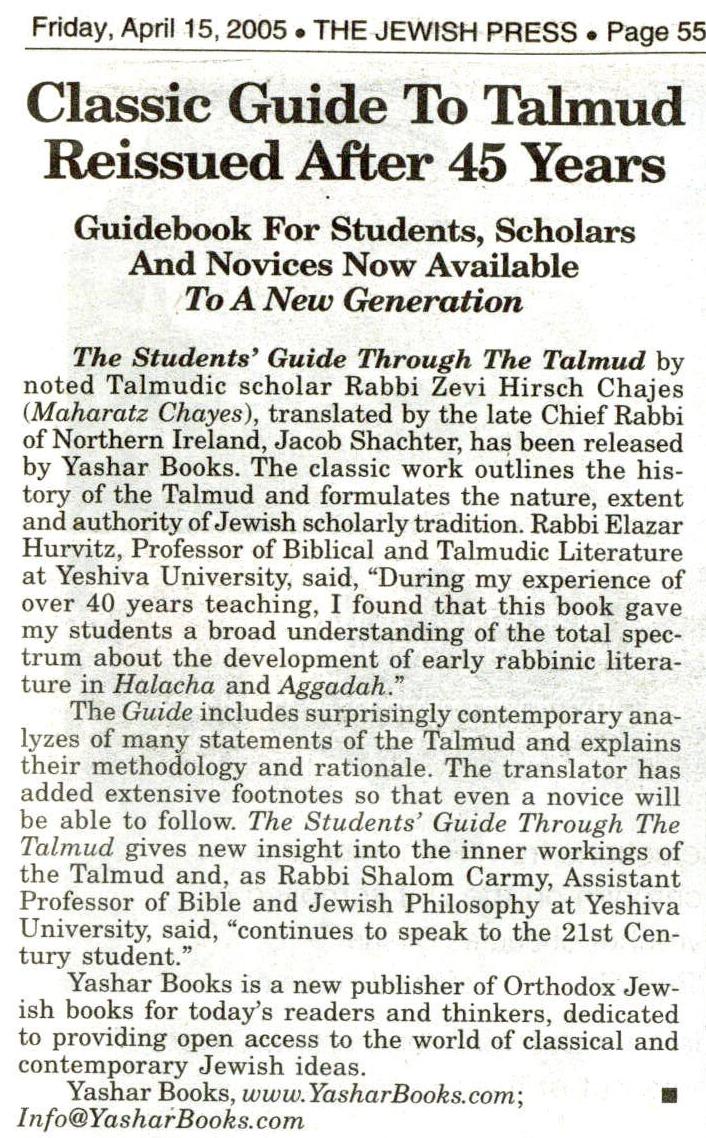
It is my distinct pleasure to announce, 45 years after its last printing, that The Students' Guide through the Talmud, by R. Zevi Hirsch Chajes (Maharatz Chayes), is now back in print. Below is an article in last week's The Jewish Press about it.

The Students' Guide through the Talmud is divided, with half discussing halakhah and half aggadah. A significant portion of the first half of the book is the delineation of different types of laws, with explanations of their source and nature, and many examples to demonstrate the differences. In regard to all of this, the footnotes by R. Jacob Shachter, former Chief Rabbi of Northern Ireland, are invaluable. What follows is a short excerpt from Chapter 13: Enactments the Binding Force of which was Later Relaxed (pp. 103-104) [see notes 9 and 10 which are me-inyana de-yoma]:
Again, in many cases, we find that what had been definitely prohibited by earlier authorities was later permitted by the Beth Din, as in the following instance. According to the Biblical law, where the levirate marriage[1] could be performed, halitza[2] was not regarded as the fulfilment of the precept. Yet it was later ruled that halitza was preferable to the levirate marriage[3] (Yeb. 39b).

Indeed, even things prohibited by Biblical law were occasionally permitted by the Rabbis where only passive violation was involved,[4] and, in cases which appeared to them at the moment urgent, or where they had ground for apprehension that, in the absence of some guidance, the people would be led to more serious violations of the law, they felt prompted to set aside certain precepts, of which category the following are examples. They forbade the blowing of the shofar on a New Year's Day which fell on the Sabbath, lest one should inadvertently carry[5] the shofar four cubits in the public domain[6] (R.H. 29b).

They also forbade the taking of the lulab in hand on the Sabbath for the same reason[7] (Suk. 42b).

See Yeb. 90b for the following examples where the rabbis made their decisions in cases which would have entailed the punishment of Kareth,[8] even where there was involved only an abstention from performin the act in question, viz. the cases of the uncircumcised,[9] the sprinkling,[10] the knife.[11]

Similarly, they suspended Ezra's takkanah of immersion for those who had suffered pollution, see Ber. 22b and Yad, K. Shema 4,8,[12] and also the takkanah that a virgin should be married on a Wednesday,[13] v. Shittah Mekubezeth,[14] Keth. 3a.[15]

[1] See note 7, p. 9.
[2]See note 10, p. 6.
[3] Because it was noticed that the levirate marriage was not exercised for the fulfilment of the precept, but was prompted by other and selfish motives.
[4] Violation of the law by abstention, i.e. by passively not doing what one is commanded to do; this was in certain cases under the jurisdiction of the Rabbis (see Yeb. 90b), as distinct from active violation, i.e. by actually doing what one is commanded not to do, as this involved the defiance of a Pentateuchal law.
[5] As not all are skilled in the blowing of the shofar, some might be tempted to carry it to an expert to learn, and thus commit a transgression.
[6] The law prohibiting the transporting of things four cubits in the pbulic domain comes down by tradition (see Sab. 96b).
[7] See Rashi, Suk. 42b, s.v. ללמוד, who shows that the waving of the lulab required some teaching.
[8] i.e. precepts the violation of which involved the punishment of Kareth could be suspended by rabbinical ordinances.
[9] This refers to the proselyte who is circumcised on the Passover Eve. Although pentateuchally he would, as an Israelite, be obliged to keep the Passover, the rabbis pronounced him unclean (see Pes. 92a), and he was, in consequence, prevented from participating in the said celebration, even though failing to do so involved the violation of a precept carrying the punishment of Kareth.
[10] Sprinkling an unclean person on the Sabbath is only rabbinically forbidden (see Pes. 92a). If then the eve of the Passover fell on the Sabbath and also happened to be the seventh day of the purification of a person unclean according to Pentateuchal law, he would be permitted to participate in the Paschal-lamb celebration. Yet the Rabbis, by prohibiting the sprinkling, prevented him from fulfilling the Pentateuchal precept of the Paschal-lamb, even though its violation, as said before, involved the punishment of Kareth.
[11] i.e. circumcision, the violation of which involved Kareth. It was found sometimes necessary to postpone circumcision when it fell on a Sabbath, although it generally supersedes the Sabbath. That might happen through the rabbinic prohibition against carrying the knife on the Sabbath even along the roofs (see Sab. 130b).
[12] The author's reference in the text to the concluding paragraph of Tefillah is erroneous.
[13] See M. Keth. 1,1 because the Courts sat on Mondays and Thursdays, so that in the event of a man having a case regarding his wife's virginity, he could bring it forthwith before the court. Although a similar reason could be advanced for a Sunday that day was nevertheless excluded on account of the Sabbath which would interfere with the necessary preparations.
[14] See note 1, p. 31.
[15] Which states that where the Courts meet every day, the restriction to a particular day is suspended.
This classic book is now available to the public. Please ask for it in your local bookstores.


Saturday, April 16, 2005

Passover Riddles

Dr. Marc B. Shapiro has asked me to pose the following two riddles. The first person to correctly answer the first riddle will be rewarded with a free copy of Kisvei Ha-Seridei Esh vol. 2.

1. In Hilkhos Pesah there is a slip of the pen (i.e. something that is incorrect) made by the Rema.

Hint 1: It is found between simanim 450 and 470.

Hint 2: You will be able to find it easier if you keep in mind that the Rema did not think in Hebrew.

Hint 3: If we weren't so technologically advanced, it would apply this year


2. Come up with a case, no matter how unusual where a melakhah done on next Sunday (first day of Pesah) will get you makkos, but you can do the same melakhah on Shabbos le-khat'hilah.


Friday, April 15, 2005

Guidelines for Next Shabbos

Note that different rabbis rule differently on how to handle next Shabbos. This is what my rabbi wrote. Ask your own rabbi what to do:
Dear מתפללים,

As you are aware ערב פסח this year is שבת. This affects numerous changes from the normal procedure of חמץ removal and of ushering in פסח. Halachic complexities and practical considerations germane to the occasion may give way to confusion and frustration, sentiments in discord with the spirit of שבת. I hope that with a clear delineation of times and activities this may be avoided.
  • Thurs. Apr. 21 – תענית בכורים

  • Fri. Apr. 22 – חמץ should be burned by 12:55 PM. בדיעבד it may be burned all day

  • Fri. Apr. 22 – No כל חמירא is recited at the burning of the חמץ

  • שבת Apr. 23 – 7:30 AM שחרית

  • שבת Apr. 23 –חמץ may be eaten until 10:38 AM (10:14 AM למהדרין)

  • שבת Apr. 23 – All חמץ must be disposed by 11:40 AM (appr.)

  • שבת Apr. 23 – כל חמירא must be said before 11:40 AM (appr.)

  • שבת Apr. 23 – For שלש סעודות one should wash (with ברכה) on egg מצה* – recite המוציא, eat one whole מצה with a piece of fish & condiment & desset (e.g. fruit), and bentch as normal

  • שבת Apr. 23 – One must finish eating שלש סעודות by 4:05 PM

I hope this outline will prove helpful. As usual, I may be contacted for any questions. Wishing everyone aחג כשר ושמח!

* הערה להלכה: היות ורבו הדעות בענין שלש סעודות בשבת זו, אמרתי אעלה בתמר לסמוך על שיטת ר"ת שהתיר מצה עשירה בכה"ג כמבואר בתוס' (פס' צט: ד"ה לא) ובשאר ראשונים, ושיטת הנו"ב (מ"ק, כא) שמצה עשירה מותרת כל יום יד'. ומי יבא אחרי המלכים האלו ודוק.


Ask OU - Woodmere

REMINDER!!

ASK OU PESACH SEMINAR

THIS COMING SUNDAY EVENING, APRIL 17TH

BETWEEN 7:00PM AND 10:00PM

AT THE YOUNG ISRAEL OF WOODMERE IN WOODMERE, NY

DIRECTIONS: VAN WYCK OR BELT PKWY. TO NASSAU EXPY TO ROCKAWAY TPKE. CONTINUE STRAIGHT ON ROCKAWAY TPKE. PAST COSTCO (DON'T MAKE A RIGHT AT COSTCO) TO PENINSULA BLVD (ONE LIGHT AFTER COSTCO) MAKE A LEFT ONTO PENINSULA TO THE YOUNG ISRAEL AT 859 PENINSULA.

HOPE YOU CAN ATTEND AND BRING A FRIEND.

Rabbi Yosef Grossman
Rabbinic Coordinator
Director - ASK OU
Editor - The Daf HaKashrus
Orthodox Union
11 Broadway, NYC, NY 10004
Tel: 212.613.8212
Fax: 212.613.0621
Email: grossman@ou.org


Barukh Dayan Ha-Emes

I was just informed that Dayan Berel Berkovits, in his early fifties, passed away unexpectedly last night. I join the Jewish community in London and around the world in mourning his passing.


Haaretz on Slifkin: CLARIFICATION

Haaretz has an article about the Slifkin Affair (here and in Hebrew here).

Let me be absolutely clear that I did not say the following quote attributed to me:
"Compared to rabbis in Israel, who are simply lacking in knowledge, these ultra-Orthodox Jews have knowledge of the sciences," he says. "The [Israeli] rabbis are being self-defensive. Most of them have not read the books at all; they don't know English." Among educated religious and ultra-Orthodox people in the United States, Student says, the generally accepted scientific theories are standard and no one questions them.
I also made it clear that The Science of Torah sold out before the ban became public.

UPDATE: Further clarification: I did not say that the rabbis in Israel are lacking in knowledge, nor did I say that the Israeli rabbis are being self-defensive or that R. Slifkin's views are generally accepted among ultra-Orthodox Jews in the United States and that no one questions them. Evidently, there was a misunderstanding.


Hillel, Bnei Beseira and Passover

Meiri, Introduction to Avos (Seder Ha-Kabballah, pp. 54-57):
The story is told in the Talmud (Pesahim 66a) that the elders of Beseira were the nesi'im (religious heads) in the land of Israel and were known as leaders in Torah teaching. It is said about them that once they forgot whether the Passover [sacrifice] take precedence over the Sabbath or not, whether this doubt was at it simply seems, or it has some secret hidden within it, or they forgot how to extract this matter through Talmudic exegesis. They were forced into this by someone who argued against the practice, and Bnei Beseira could not conclude this matter. They were embarrassed and ask if there is anyone who knows whether the Passover [sacrifice] taked precedence over the Sabbath or not, i.e. does anyone know how to respond to this arguer with conclusive arguments from the Torah, whether from analysis, comparison or from testimony of a tradition. They were told that there a certain man who had come from Babylonia, Hillel the Babylonian by name, who had studied under the two greatest sages Shemaiah and Avtalyon, and perhaps there is hope from him. They sent for him and he came. They asked him, "Does the Passover [sacrifice] take supersede over the Sabbath?" He said to them, "Does only one Passover [sacrifice] take supersede the Sabbath? Are there not more than 200 Passover [sacrifices] that supersede the Sabbath each year?" i.e. the [Sabbath] sheep sacrifices that are similar to the Passover sacrifices, of which four are brought every Sabbath... They said, "Did we not say that we would have from you hope? But from where do you know this?" He proceeded to expound from comparison, kal va-homer (a fortiori) and gezeirah shavah...

However, it is said there that they disagree with his proofs ... Even though he argued with them all day, they did not accept it from him until he said, "Let it be brough upon me, this is what I heard from Shemaiah and Avtalyon." Immediately, they accepted it from him, sat him first and appointed him the nasi.
In other words, they knew that the Passover sacrifice supersedes the Sabbath but could not prove it. This frustrated them immensely, and Hillel attempted to prove it to them. However, they did not accept any of his logical proofs and only accepted his testimony that he had a tradition from Shemaiah and Avtalyon that this was the halakhah.

This is not, of course, the only way to explain this exchange.


Thursday, April 14, 2005

Geology and the Age of the Universe

Sorry for continuing on the Slifkin issue, but I got an e-mail today from my best friend in elementary school whom I've seen maybe once in the past fifteen years, and that was over a decade ago. He contacted me because yesterday a mutual friend had to get in touch with me for work purposes and passed along my e-mail address. This best friend of mine was, for many years, the only strictly Shomer Shabbos Jew of my generation whom I knew. Anyway, what does he have to do with the age of the universe? After learning in Gush for a while, he entered a doctoral program for geology. As he put it, he is studying "geology/ geochemistry/ planetary science."

This is what he is currently doing: "Radioisotope studies of the ages of meteorites, and comparing the various meteorites. Recently I've been working on the decay constant of 87Rb."

So I asked him what he thinks about the theories about how the decay constants are actually speeding up over time, and what that implies for the age of the universe. Would any serious scientists take such a theory seriously? And even if not, is it impossible or just implausible because it is unprovable?

Here is what he replied, with a little editing:
The way I generally answer this question is to say that "all the scientific evidence indicates that the solar system is 4.566 billion years old". Now, one could argue that God created a world that APPEARS this way, but is really 5765 years old...

As for decay constants changing, there is SOME evidence that might suggest SLIGHT changes in decay constants over GEOLOGICAL time. Hence, there are a few fringe researchers (serious scientists, but on the fringe in the sense that this is not generally accepted) who might explain the discrepancy between Rb-Sr and U-Pb ages based on changing decay constants. But this doesn't help in our issue - it makes the earth 4.466 billion years old instead of 4.566 or something like that.

Your final question, "Is it impossible or just implausible because it is unprovable?" is in a sense the basic question of philosophy of science. Nothing really can be PROVED. We can't PROVE gravity - all we can do is observe that in every case EVER, the laws of gravity seem to apply, and we can PREDICT things based on it, and after enough observations and predictions which come true we consider it proved. So yes, it cannot be PROVED that those who argue for a young universe are wrong, but if you consider the isotopes, and the glaciers, and the astronomical observations, and the tree rings etc., you must conclude that all the scientific evidence indicates a very very very old world.
(No, I don't know what all those letters stand for)


Atheist Turned Deist

Christianity Today has an interesting article about Antony Flew, "one of the world's leading philosophers," who recently declared his abandonment of Atheism for a belief in God. The article, based on an extensive interview, makes it clear that Flew is not a Christian but a Deist. He does not believe in miracles, although he concedes their theoretical possibility, nor does he believe in eternal damnation (someone should introduce him to the writings of the Rambam, specifically Shemonah Perakim ch. 8 and Hilkhos Teshuvah 8:5).

He was particularly influenced by philosopher Alvin Plantinga and Israeli physicist Gerald Schroeder (no kidding!).
Actually, Flew has been rethinking the arguments for a Designer for several years. When I saw him in London in the spring of 2003, he told me he was still an atheist but was impressed by Intelligent Design theorists. By early 2004 he had made the move to deism. Surprisingly, he gives first place to Aristotle in having the most significant impact on him. "I was not a specialist on Aristotle, so I was reading parts of his philosophy for the first time." He was aided in this by The Rediscovery of Wisdom, a work on Aristotle by David Conway, one of Flew's former students.

Flew also cites the influence of Gerald Schroeder, an Israeli physicist, and Roy Abraham Varghese, author of The Wonder of the World and an Eastern Rite Catholic. Flew appeared with both scientists at a New York symposium last May where he acknowledged his changed conviction about the necessity for a Creator. In the broader picture, both Varghese and Schroeder, author of The Hidden Face of God, argue from the fine-tuning of the universe that it is impossible to explain the origin of life without God. This forms the substance of what led Flew to move away from Darwinian naturalism.
Quite astonishing!

(thanks to R. Yitzchok Adlerstein)


Seder in Bnei Brak

Sukkah 27b tells the story of R. Eliezer chastising his student R. Ilai for visiting his mentor on the holiday. R. Eliezer was of the view that part of the Biblical mitzvah of enjoying the holiday is remaining in one's house. He said, "I praise the lazy who do not leave their houses on the holiday."

R. Tzvi Hirsch Chajes, in his glosses to Sanhedrin 32b, asks that if that is the case, why does the Haggadah tell of a time during which R. Eliezer spent the Passover seder in Bnei Brak with R. Yehoshua, R. Elazar, R. Akiva and R. Tarfon? Should he not have felt obligated to remain in his house in Lod?

R. Yehiel Mikhel Epstein, the author of the Arukh Ha-Shulhan, asks this question in his commentary to the Haggadah and points to the Gemara at the very end of Makkos (24a-b). That passage describes how a number of those sages were distraught over the destruction of the Temple and R. Akiva found ways to encourage and inspire them by reminding them of the inevitable redemption. This communal seder, R. Epstein suggests, was a continuation of that discussion in which the sages discussed the future redemption in the context of the Passover story. Perhaps one could call it a group session of mutual encouragement (yes, I am taking liberties in how I portray R. Epstein's answer). This, R. Epstein suggests, particularly noting the thanks that was due to R. Akiva, overrode the obligation to remain in one's house.

R. Reuven Margoliyos, in his Margoliyos Ha-Yam (Sanhedrin 32b:18), offers an historical explanation. The Gemara (Sukkah 23a) tells of a time when Rabban Gamliel and R. Akiva had to build a sukkah on a boat. Later (41b), the Gemara tells of a time when Rabban Gamliel, R. Yehoshua, R. Elazar ben Azariah and R. Akiva were on a boat and had only one set of four species for Sukkos. Similarly, the Mishnah (Ma'aser Sheni 5:9) tells of a time when Rabban Gamliel had to take tithe from produce by stating, from a boat, that the part belonging to Levites belonged to R. Yehoshua and the part belonging to the poor belonged to R. Akiva. It is important to note that the Rambam explains that this happened right before Passover, the zeman ha-bi'ur for ma'asros.

R. Yitzhak Halevi (Doros Ha-Rishonim, part 3 volume 5 ch. 19 = volume 4 pp. 275-278) explains that when the Roman emperor Domitian was killed, the elderly and sickly senator Nerva succeeded him as emperor. His ascension to the throne happened on September 18th, 96 CE. Nerva was known as being sympathetic to Jews. When the sages of the Mishnah learned of the change of regime in Rome, and that the new emperor was extremely ill, they immediately traveled to Rome. Given the time of the year of Nerva's crowning, it is understandable why they were on a boat during the holiday of Sukkos. Their haste, due to Nerva's poor health, explains why they were not fully prepared for the holiday and had only one set of four species that they had bought at an extravagant price. (Their haste was well-advised, as Nerva died a mere 14 months after taking the throne, less than a year after the rabbis returned home.)

Evidently, their eventful stay in Rome, which is mentioned in many places throughout rabbinic literature, lasted around six months and they returned immediately prior to Passover. Perhaps, R. Margoliyos suggests, they arrived at the port in Jaffa right before the onset of the holiday and quickly went to R. Akiva's nearby home in Bnei Brak to spend the holiday. R. Eliezer, therefore, was not home for the holiday due to circumstances beyond his control. (Rabban Gamliel might have been absent from the communal seder in Bnei Brak because of his duties as Nasi or in order to allow his colleagues to recline, which they would not be permitted to do if he were in attendance.)


Wednesday, April 13, 2005

Alumni Survey

I was just called by someone taking a survey of YU alumni. The questions were clearly probing to see what attracts people to YU, what is most important, what is unimportant, and how successful are current efforts to fundraise from alumni. Very astute questions, which gives me more faith in the new administration.

Toughest question: Are you part of the Modern Orthodox community? I didn't know what to respond to that and actually had the interviewer go back and change my answer.

(This reminded me of this post)


Guilt

This lecture by R. Yisrael Reisman (here, thanks to Staying Orthodox) is an instant classic. He talks about guilt for doing aveiros. On the one hand, it is important to believe that others do not sin because that will help keep you in line (see here). On the other hand, it is important not to give up after minor setbacks. No one is perfect.

R. Reisman tells how he once spoke to his congregation about a kabballah (optional practice) he had accepted upon himself, and how he succeeded in fulfilling it about 10% of the time. A congregant later told him that he had given up on accepting kabballos because he had trouble sticking to them. But when he heard that R. Reisman had trouble also, it reassured him that he was not a failure.

He quotes Rav Pam as pointing out a Yerushalmi in which Shmuel, the Amora, said that he thanks his head that when he reaches "modim" in the prayers and is not paying attention, his head still bows down. In other words, even a great Amora like Shmuel did not always pay attention while davening. The point, of course, is not that we need not pay attention while davening, but that we need not consider ourselves lost if we cannot always reach the highest levels of kavanah.

R. Reisman points something very interesting out. R. Yehiel Ya'akov Weinberg, in a responsum printed in Seridei Esh 3:130, starts out apologizing for not responding earlier but he had been sick, suffering from eye pains and depression. Depression! And stated as a simple matter of fact. Granted, he was a Holocaust survivor. But still, it is important to know that everyone gets depressed and it is nothing of which to be ashamed.


Tuesday, April 12, 2005

Kiddush Clubs and Zionism

A particular website has found the source of the practice called "Kiddush Clubs" -- Zionism. This is what follows in a discussion titled "Zionist Crazy Hatred":
To the Zionists, if youre against Zionism, nothing you do matters; youre no good. The latest issue of Jewish Action, a Modern Orthodox magazine of the OU... In that same issue, there was an article decrying the disgusting practice of "kiddush clubs" that many Shuls have in their community. A Kiddush club is - I promise I am not making this up - where in the middle of davening, ususally during the haftorah or leining, a bunch of peopel go out and make kiddush, while the shul is stil ldavening, and often come back drunk, or close to drink. It's sick, I know, but thats what they do.

I was talking to one of those people who doesnt see the disgustingness of these kiddush clubs... So I asked him, "What wouls you think if they walked out in the middle of the Tefilah L'shlom Hamedinah (the prayer for the State of Israel, that Zionists say in Shul on Shabbos), to make kiddush and get drunk?"

The guy freaked... So I asked him why is the Haftorah less deserving of respect than the Tefilah Lsholom Hamedinah?
I'm not quite sure if he pointed out that the leaders of the campaign against Kiddush Clubs, including R. Tzvi Hersh Weinreb, are staunch Zionists.

I'm pretty sure that he did not point out the common practice in shtiebels and small yeshivish shuls to start setting up for a kiddush during davening. In one very yeshivish shul in which I sometimes used to daven, it was done during the mussaf hazaras ha-shatz. No, I'm not kidding. The rav is a huge talmid hakham for whom I have tremendous respect. But he's not a fighter. And the guys setting up go to the best yeshivos in Brooklyn. I have yet to hear non- or anti-Zionists make a peep about that practice.

Is this post a cheap shot? Without a doubt. But that guy deserves it without a doubt.


The Lonely People of Faith

Essays about R. Joseph B. Soloveitchik's The Lonely Man of Faith.

Authors include: R. Yitzchak Blau, R. Shalom Carmy, R. Mayer Schiller and others

(From Lamed)


Holding Children During Davening

The Shulhan Arukh (Orah Hayim 96:1) quotes the Gemara (Berakhos 23b) that, while reciting the Shemoneh Esreh prayer, one may not hold in one's hands tefillin, a Torah scroll, a knife, a plate, money or bread. The reason, Rashi explains, is that one is concerned that they might fall and this disturbs one's concentration on the prayer. The Beis Yosef records a debate whether this prohibition applies to holding anything in one's hands or only things that one is concerned if they fall. In other words, may one hold a tissue or handkerchief while praying. According to the lenient view, yes, and according to the strict view, no. The Taz (no. 2) rules strictly, as do later posekim (cf. Mishnah Berurah, no. 6; Arukh Ha-Shulhan, par. 1).

The Birkei Yosef (no. 1) states that one may not hold a child in one's arms while praying Shemoneh Esreh. Clearly, this should be true according to both opinions cited above: Since one would not want to drop the child, everyone would agree that one may not hold one during prayer.

However, the Taz (no. 1) states that the shali'ah tzibbur, who is leading services, may hold a Torah scroll in his hands while reciting the Yekum Purkan prayer because it adds to his concentration. Since that prayer is about those who learn and support Torah, the scroll adds to the prayer's intent rather than detracting from it. Perhaps one could say the same about someone who is praying for his children's welfare and future. Maybe for someone truly praying with that intention, holding one's child would add to the concentration and emotion of the prayer rather than detracting from it.

However, the Taz continues and states that while his reasoning should also allow someone to hold a Torah scroll while praying the Shemoneh Esreh, since no one before has permitted it, he cannot either. The same would apply to holding a child. Since no one has permitted it in the past, we cannot either.

Therefore, do not hold your babies while praying. Find another way to handle the situation. According to the Bah, one who prays while holding something must repeat the prayer. While most posekim disagree with this and do not require repeating, they would certainly advise one to forgo prayer at that time rather than pray while holding a baby. So either plan in advance so you do not have to hold a baby while praying, or hold off on praying until you can find someone else to hold the baby.

(Ask your rabbi before following any halakhic advice given here)


Monday, April 11, 2005

Periodicals

Hirhurim has a new feature, over on the right (here). It's a list of Jewish periodicals that I read. If you want your periodical on the list, feel free to contact me for information on where to send my free subscription.

Hey, it's worth a try. I'm sure that I'd even blog about articles in journals like this or this if I had them in a format I could read on Shabbos (that does not involve printouts, which already flood my house).


Individual Providence

I recently saw the following exchange on a website:
Someone recently informed me that he doesnt beleive in hashgacha pratis. He claims that the Ramban didnt either, that he wrote in ten places that theres no such thing and in one place he merely alluded to the idea\'s truth. Is that true; do you know about it; whats up with that? Please can you check out this inyan for me? Thanks. Peace.
It's not so. Simple as that.

Maybe the person meant the RambaM, but that also isn't true. But at least the Rambam says that Hashgachah Pratis is only on humans, not animals (they have Hashgachah minis - a species-wide hashgachah, not individual aminal by animal hashgachah). That's the closest thing to what the person told you.
The response is clearly well-meaning but it is also slightly disingenuous. When and if the questioner investigates further, she might be surprised at what she discovers and conclude that her respondent lied to her. He did not, because his answer is technically correct. However, he certainly concealed critical information from her. If I were dealing with Bais Yaakov girls, I might answer as follows:
All rishonim accepted hashgacha pratis. However, the issue within some rishonim is complex because they were trying to explain it based on Greek philosophy. We, who live in the modern world and reject Greek philosophy, cannot accept their complicated approaches. We can certainly ask many questions -- good questions -- about how hashgacha pratis works. But we cannot accept answers that are based on Greek philosophy and should, instead, look for answers rooted in our tradition that do not utilize philosophy that has been widely rejected in our time. Your friend is both mistaken and, even if he were correct, is basing his approach on an ancient Greek worldview that no one today, not even gentiles, accept.
But more to the point. What is the Rambam's view on Individual Providence, hashgahah peratis? This is no simple matter!

R. Shmuel Ibn Tibbon, while translating the Moreh Nevukhim (henceforth MN) from Arabic into Hebrew, wrote an extensive letter to the Rambam for clarification of his view on this topic. The problem is that in MN 3:17-18, 22-23, the Rambam seems to accept that Individual Providence means an acquisition of wisdom -- an intellectual connection with God and not a direct Divine intervention to protect him from harm. However, in MN 3:51, the Rambam posits that Individual Providence means "that individual can never be afflicted with evil of any kind." R. Shmuel Ibn Tibbon suggests a number of resolutions to this contradiction, rejecting them all and asking the Rambam for assistance. It seems that he never received a response. However, his son, R. Moshe Ibn Tibbon, offered two solutions to the problem. The second answer is that the first set of passages deal with the Individual Providence bestowed upon a philosopher while the second passage discusses the Individual Providence visited on an intellectually and religious perfect person.

This problem has been dealt with many times over the centuries, most recently by Charles Raffel in his unpublished 1983 doctoral dissertation (if anyone is in contact with him, please let him know that I am interested in scanning in his dissertation and posting it for free download on Open Access; he can reach me here). Let us assume the maximalist position -- that the Rambam's position is exactly as he states it in MN 3:51. Even so, it is still a position of "providence according to the intellect."
We have already stated in the chapters which treat of Divine Providence, that Providence watches over every rational being according to the amount of intellect which that being possesses. Those who are perfect in their perception of God, whose mind is never separated from Him, enjoy always the influence of Providence. But those who, perfect in their knowledge of God, turn their mind sometimes away from God, enjoy the presence of Divine Providence only when they meditate on God; when their thoughts are engaged in other matters, divine Providence departs from them...

Hence it appears to me that it is only in times of such neglect that some of the ordinary evils befall a prophet or a perfect and pious man: and the intensity of the evil is proportional to the duration of those moments, or to the character of the things that thus occupy their mind. Such being the case, the great difficulty is removed that led philosophers to assert that Providence does not extend to every individual, and that man is like any other living being in this respect, viz., the argument based on the fact that good and pious men are afflicted with great evils. We have thus explained this difficult question even in accordance with the philosophers' own principles. Divine Providence is constantly watching over those who have obtained that blessing which is prepared for those who endeavour to obtain it. If man frees his thoughts from worldly matters, obtains a knowledge of God in the right way, and rejoices in that knowledge, it is impossible that any kind of evil should befall him while he is with God, and God with him. When he does not meditate on God, when he is separated from God, then God is also separated from him; then he is exposed to any evil that might befall him; for it is only that intellectual link with God that secures the presence of Providence and protection from evil accidents. Hence it may occur that the perfect man is at times not happy, whilst no evil befalls those who are imperfect; in these cases what happens to them is due to chance. (Friedlander translation)
Thus, those who are not meditating on God lose their Individual Providence. When one is not thinking about God, "chance" rules over one's life and evil can, therefore, occur to a righteous person.

The Ramban, in his commentary to Job 36:7, essentially follows the position of the Rambam:
To the extent that this individual comes close to God by cleaving to him, he will be guarded especially well, while one who is far from God in his thought and deeds, even if he does not deserve death because of his sin, will be forsaken and left to accidents...

Those who are close to God are under absolute protection, while those who are far from him are subject to accidents and have no one to protect them from harm...

Since most of the world belongs to this intermediate group, the Torah commanded that warriors be mobilized...
There is an important difference between the Rambam's and the Ramban's formulations, in that the Rambam refers only to intellectual achievement while the Ramban refers to piety and not intellectual achievement. Even according to R. Moshe Ibn Tibbon's second explanation of the Rambam, the Rambam still requires both intellectual achievement and piety while the Ramban only piety.

Be that as it may, and there is much more to be said about the positions of the Rambam and the Ramban (see this post), they clearly believe that Individual Providence is severely limited in application, both in regards to the people to whom it applies and the circumstances in which it is invoked.

The most comprehensive treatment that I have found of theses views in yeshivishe works, as opposed to academic works, is in R. Hayim Friedlander's Sifsei Hayim, Emunah u-Vitahon, vol. 1 p. 96 ff. R. Friedlander points out that the Rambam seems to contradict various passages in Hazal that imply constant, universal providence, and then proceeds to explain that even "chance" is merely God's hidden providence. This seems to me to be a very difficult position to read into the Rambam and the Ramban.

Given the Rambam's and Ramban's views of Individual Providence, one is struck by man's inability to rely on God for protection. How are we supposed to respond to tragedy when, ultimately, it is most likely that God will not stop it from happening to us again? R. Joseph B. Soloveitchik addresses this in his Halakhic Man, p. 128:
The fundamental of providence is here transformed into a concrete commandment, an obligation incumbent upon man. Man is obliged to broaden the scope and strengthen the intensity of the individual providence that watches over him. Everything is dependent on him; it is all in his hands. When a person creates himelf, ceases to be a mere species man, and becomes a man of God, then he has fulfilled that commandment which is implicit in the principle of providence.
In other words, we should take this idea as a challenge. We must make ourselves worthy of Individual Providence. Our response to tragedy should be the realization that we are capable of avoiding it in the future if we improve ourselves and make ourselves worthy of Individual Providence.


Sunday, April 10, 2005

Zoo Rabbi Admits to Driving on Shabbos

To the hospital, where his wife gave birth to a son. Mazel tov!


Friday, April 08, 2005

Rome and Romi

The Gemara in Avodah Zarah 10b says that Antoninus (Marcus Aurelius--see R. Aaron Hyman, Toledos Tanna'im Ve-Amora'im, vol. 2 pp. 580-582) and R. Yehudah Ha-Nasi had a tunnel between their two homes that they would travel each day. It is certainly possible that there was a miraculous tunnel between Rome and Israel that someone could miraculously travel in under a day, and it is also possible that this is all an allegorical description of a close friendship that is not meant to be taken literally.

However, the Seder Ha-Doros (sv. R. Yossi ben Kisma, cited by R. Reuven Margoliyos, Margoliyos Ha-Yam, 32b:19) quotes R. Moshe Alshikh's commentary to Shir Ha-Shirim 7:6 that, living in the land of Israel, he had personally seen a place called Rome, near the city of Sephoris. Similarly, R. Shlomo Ibn Parhon writes in his Mahberes Ha-Arukh that Rome (with an aleph) is the city in Italy, while Rome (or Romi, with a yud) is a town in Israel.

About this Palestinian Rome, R. Moshe Alshikh wrote that it was from there that there was a tunnel between Antoninus and R. Yehudah Ha-Nasi.


The Twelfth Torah U-Madda Conference

הכנס ה- 12 לתורה ומדע
יום שני, ט' בניסן, 18 באפריל 2005
באוניברסיטת בר-אילן
הרצאות בנושא תורה ומדע:

דברי ברכה: פרופ' משה קוה, נשיא, אוניברסיטת בר-אילן
דברי פתיחה: פרופ' יעקב נאמן, יו"ר ועד מנהל, אוניברסיטת בר-אילן, שר האוצר ושר המשפטים לשעבר
עקרונות שקבעו חז"ל כיסוד למדיניות כלכלית

טבורו של החלום וגבול האמונה:
פסיכואנליטיקאי מתמודד בגבול שבין "אמת" פסיכולוגית ל"אמת" דתית
פרופ' משה הלוי ספירו, בי"ס לעבודה סוציאלית, איניברסיטת בר-אילן,
פסיכולוג קליני בכיר, מרכז רפואי שערי צדק ובית חולים ע"ש שרה הרצוג, ירושלים

גבולות המחקר וגבולות החוקר על-פי התורה
פרופ' יוסף בודנהיימר, נשיא, בי"ס גבוה לטכנולוגיה, ירושלים

השנה השמינית הייחודית במחזור בן 19 השנים של הלוח העברי
אינג' יעקב לוינגר, ת"א

הקשת ו"עץ הדעת": תופעות טבעיות או על-טבעיות?
פרופ' נתן אביעזר, המחלקה לפיסיקה, אוניברסיטת בר-אילן

האינטרנט בהלכה – מבט רב-תחומי (קנינים, שבת, נזיקין, גזל, הכשלה וכד')
הרב ישראל רוזן, מהנדס, ראש מכון "צמת"

פענוח אוטומטי של ראשי תיבות רב-משמעיים בטקסטים תורניים
ד"ר יעקב הכהן-קרנר, אריאל פרץ ואריאל קאס, המח' למדעי המחשב, בי"ס גבוה לטכנולוגיה, ירושלים

לזיהוי האגסים והקרוסטמלין במשנה
פרופ' מרדכי כסלו, הפקולטה למדעי-החיים, אוניברסיטת בר-אילן

היבטים היסטוריים של מחלות המעיים בתקופת התלמוד:
אמצעי אבחנה, אמצעי טיפול והשלכתם לימינו
ד"ר אריאל לוינגר, בי"ח בילינסון, פתח-תקוה

סוגיית דם ביצים – התנגשות מדומה בין תורה למדעה
רב חננאל סרי

המצוה לחשב תקופות ומזלות
דניאל משה לוי, ישיבת דרך אפרת, בית לחם

ביקורתו של מ"ד קאסוטו על ביקורת המקרא
ראובן קמפניינו

הענק והננס לעומת השתנות הטבעים בפסיקה ההלכתית
פרופ' קופל רבינוביץ

Modern Precision Cosmology and the Torah
Dr. Alexander Bershadskii, International Center for Theoretical Physics, Trieste, Italy

Matan Torah and the Invention of the Alphabet
Prof. Shubert Spero, Department of Jewish Studies, Bar-Ilan University

האם כלכלת השוק החופשי מתיישבת עם ערכי התורה?
הרב יוסף יצחק ליפשיץ, מרכז שלם, ירושלים
הרב ד"ר אשר מאיר, מנהל המחקר, אתיקה - המרכז לערכים בעסקים, ירושלים
פרופ' יהושע ליברמן, בי"ס למינהל עסקים, אוניברסיטת בר-אילן


Thursday, April 07, 2005

Metzitzah V

On various e-mail lists and in private correspondence, I have clashed with R. Dr. Meir Shinnar on many occasions. His latest is, well, over the top. Here is an excerpt from a letter he wrote to The Jewish Week:
We cannot understand how the RCA can say that it recognizes the legitimacy of those who would continue to mandate using direct oral contact during circumcision (metziza b'peh). This practice poses real health dangers to the infant. Therefore, a mohel who is going to use direct oral suction has the halachic status of a rodef, a pursuer who intends to murder. It is the duty of the community to stop this rodef by all means possible. We have an obligation to all Jewish babies.
Such careless use of the term "rodef," pursuer -- someone whom we must stop at all costs, including using lethal force -- is irresponsible and overly sensational. I also question that halakhic rationale behind calling a mohel who performs metzitzah be-feh a rodef.


Giving Away Books Online II

As mentioned before (here), a PDF version of the book Israel Salanter: Religious-Ethical Thinker is available for free download on the web (here).

As of yesterday, more copies have been downloaded than were originally printed of the book.

Are we crazy for doing this? Quite possibly. But we are convinced that people who like this book will want to buy a copy for their library so they can enjoy it for years to come. Those who wish to do so can buy it at their local bookstores or online.


Calling Women to the Torah II

R. Aryeh Frimer, in the Winter 2005 issue of the JOFA Journal (here - PDF), p. 6, offers the following brief critique of R. Daniel Sperber's approach to allowing women to be called to the Torah (about this, see here):
As a practical example of the use of sensitivity, Prof. Sperber justifies women's aliyot by suggesting that kevod ha-beriyot can be utilized to set aside kevod ha-tsibbur. An in-depth survey of the responsa literature makes it clear, however, that this approach is seriously flawed for a host of reasons. Four follow: (1) It is illogical that the honor of the individual should have priority over that of the community. (2) Kevod ha-beriyot requires an objective standard - not a subjective one. (3) The "dishonor" must result from an act — not from something that was not done. (4) Kevod ha-beriyot can only temporarily set aside a rabbinic ordinance, not uproot it completely.


Wednesday, April 06, 2005

Leading by Teaching

Dr. Marvin Schick on leading by teaching vs. leading by prohibition (here).


Riverbanks, Horse's Necks and Really Long Articles

The Gemara in Bava Metzi'a 108a says:
Shmuel said: That one who took possession of [land on a] riverbank is an impudent person, but we certainly cannot remove him. But nowadays that the Persians write [in a title], "It [a field on a river] is acquired by you as far as the depth of the water reaching up to the horse's neck," we certainly remove him.
In other words, the land near the riverbank is never built upon nor fenced in, because the owner of adjacent property needs access to that area for loading and unloading from boats. This leaves open the opportunity for someone to come in, lay claim to that land and build on it. The halakhah disapproves of that action but cannot force the person off of the property. However, Persian (i.e. Babylonian) law changed at some point and included the stipulation that someone owning land near a riverbank also owns the adjacent riverbank and even into the river up to the depth of a horse's neck. Once that became the law, halakhah can allow forcing such a person off of the property.

Dr. Yaakov Elman researched this matter in Sasanian law books (the Sasanian dynasty ruled Babylonia from 224-651, i.e. the Amoraic period) and found a somewhat corresponding law. In Madayan i Hazar Dadistan, the "Book of a Thousand Decisions," an early seventh century compilation of earlier legal material, there is an indication that one can own a canal up to an ear's length. Dr. Elman suggests that it is referring to a horse's ear, and points out that a horse's ear ends at its neck, so that the Talmudic measure of a horse's neck and the Sasanian measure of an ear are one and the same. Dr. Elman then proceeds into a long discussion of Sasanian attitudes towards canal digging and taxation, and then uses it to explain the Talmudic passage above: Given what we now know of the economic and legal environment, why was Shmuel unwilling to remove an interloper from the riverbank? How did that change after the Sasanian tax reform?

This 55-page article reminded me, once again, how utterly boring academic study of the Talmud is.

(Full article here - PDF)
(See also this post)


Tuesday, April 05, 2005

Papal Funeral

From TorahWeb:
Regarding the upcoming papal funeral TorahWeb's Rabbinic Board (Rabbi Michael Rosensweig, Rabbi Hershel Schachter, Rabbi Mayer Twersky, Rabbi Mordechai Willig) would like to inform the public of the following

In 1963 Rav Soloveitchik zt"l reacted to reports of Jews watching television coverage of President John F. Kennedy's funeral service. At that time the Rov was distressed and stated that, according to Halachah, it is forbidden for a Jew to watch such a religious funeral service.
See Nefesh Ha-Rav, p. 230. I'll add that I reminded people about this regarding Princess Diana's and President Reagan's funerals.


Glatt Yacht

In the early 90s, there was a ship called the "Glatt Yacht" that provided short dinner cruises on the Hudson River with glatt kosher food. A controversy ensued when the agency that provided kosher supervision revoked the Glatt Yacht's kosher certification because it allowed mixed dancing. I recently saw that R. Aaron Levine, whose forthcoming book Moral Issues in the Marketplace and Jewish Law will be published shortly by Yashar Books, discusses this issue in his book Case Studies in Jewish Business Ethics, pp. 49-59. His main interest is in whether Glatt Yacht, actually he changes the name to Glatt Boat to protect the innocent, must state its dancing policy in its marketing material, but in the process he discusses the permissibility (or not) of such a cruise.

R. Levine accepts that mixed dancing is prohibited (see here on this subject). The question then boils down to whether the owners of the Glatt Yacht are allowed to provide a venue for this prohibited dancing. R. Levine quotes a responsum from R. Moshe Feinstein (Iggeros Moshe, Yoreh De'ah 1:72) about whether a caterer may allow his hall to be used for a wedding that will definitely include mixed dancing. R. Feinstein permitted it for two reasons:

1. A. Since other caterers will provide a hall if this caterer will not, there is no biblical prohibition of lifnei iver.
   B. Since the dancers are intentionally violating the prohibition, there is not rabbinic prohibition of mesaye'a yedey ov'rei aveirah.
   C. Furthermore, if this caterer refuses to provide his hall, people might use other caterers whose kashrus is less reliable

As R. Levine points out in an extensive note, this reasoning is somewhat controversial because there are those who disagree with both A & B (see here). Nevertheless, R. Feinstein ruled leniently on these issues.

2. Lifnei iver only applies to objects that are primarily used for prohibitions. However, objects (such as pots and pans) that are primarily used for permitted activities but might be used for prohibited activities (such as cooking non-kosher food) do not fall under this prohibition. Therefore, renting a hall for a wedding and dinner that will also be used for dancing is permissible.

R. Levine proceeds to apply these two rationales to the case of the Glatt Yacht. According to the first reason, it all depends on whether someone else will create the equivalent service in the absence of the Glatt Yacht. If so, then the owners of the Glatt Yacht are allowed to provide that service. Since the closing of the Glatt Yacht, the kosher cruise industry has blossomed and I would be (pleasantly) surprised if those cruises do not allow mixed dancing. However, I do not believe that short dinner cruises around Manhattan exist. This would imply that the first rationale does not apply and the owners of the Glatt Yacht are not halakhically allowed to provide the opportunity for mixed dancing.

However, R. Moshe Feinstein's second rationale seems to apply entirely to the Glatt Yacht. The owners are providing a nice dinner on a boat. "If customers choose to use their access to the vessel to engage in social dancing, the owners would then be technically disassociated from the activity and therefore would not be regarded as abetting transgressors" (Levine, p. 51).

Therefore, R. Levine concludes, "Halakhah does not compel Glatt [Yacht] to adopt a no-dance policy."

HOWEVER, the above applies to a theoretical case that is not publicized. Once it has been made famous, as the case of the Glatt Yacht, there are other issues to consider. If rabbis were to permit the Glatt Yacht now, after the whole controversy, it would imply that mixed dancing is permissible. There is little question that such a move would be interpreted in that way by many in the Jewish community. Therefore, I would suggest that the case has changed and involved more subtle and complex issues. However, had it never made it into the newspapers then the above analysis would apply.


Monday, April 04, 2005

How Long Since Purim?

An anonymous commenter asked me to post a picture of myself. I decided that it is only right that I fulfill the request of this anonymous commenter. I will also be posting my social security number and bank account numbers in the near future. Here's the only digital picture I could find of me.


Reb Yitz Responds

Menachem posts about a recent article in The Commentator by R. Yitz Greenberg about his tenure at YU. Once again, I am stunned by the leeway The Commentator has given to authors in its YUdaica series to criticize YU. R. Greenberg also takes the opportunity to criticize "the right wing," Modern Orthodox leadership and, in particular, R. Aharon Lichtenstein. R. Greenberg also makes it clear, again and again, why he is no longer considered part of normative orthodoxy.

As a bonus, Menachem directs us to copies of R. Greenberg's original article(s) from 1966 in The Commentator and R. Aharon Lichtenstein's response (here, PDF). In the current article, R. Greenberg refers to his second article (or first, depending on how you count them) as disingenuous.


Greek Influence on the Sages

Louis Feldman, Jew & Gentile in the Ancient World, p. 419:
The inclusion of between twenty-five hundred and three thousand words of Greek origin in the Talmudic writings and a number of changes made in the Hebrew language under apparent Greek influence are, to be sure, abundant testimony of Hellenization. And yet these words are almost never from the realm of ideas; and the alleged correspondences with motifs in Stoicism, Epicureanism, and Cynicism are generally commonplaces. Nowhere in the rabbinic corpus do we find the names of Socrates, Plato, or Aristotle; and, in fact, there is not a single Greek philosophical term to be found in this literature. Unlike the Middle Ages, when rabbinic scholars wrote major philosophical works in Arabic, we know of not one Talmudic rabbi who distinguished himself in philosophy, let alone wrote a work in Greek. Moreover, though the development of the great system of Roman law is almost exactly contemporaneous with the development of the Talmud, not a single legal term from Latin entered the rabbis' active legal vocabulary. Furthermore, the Greek concept of "oral law" is very different in meaning from that of the Talmud. The one rabbi who was deeply influenced by Hellenism, Elisha ben Avuyah, is roundly condemned. If the study of Greek culture was permitted, it was only under the careful guidance of the patriarch himself.


Saturday, April 02, 2005

YGB

A respected talmid hakham who has served as a rabbi, a rosh yeshiva and an author has started a new blog. If that was not news enough, here is a real innovation. It is under his real name (with a picture)! So I welcome to the blogosphere my friend R. Yosef Gavriel Bechhofer - YGB.


Friday, April 01, 2005

Pope

The Town Crier is reporting that the pope has died.

I only hope that in the ensuing discussions, much of will be in public, over whether the pope was good for the Jews or bad, we keep in mind that we live in golus and have very good reasons to refer kindly to the most important religious figure for millions of people.


Passover Eve on the Sabbath

Once again, YU has done us the service of making available R. J. David Bleich's guide to Passover ever that falls on the Sabbath. I still have my copy from when I was in yeshiva. You can download it here.

Important (and disputed) point:
If for any reason it is feared that the use of chometz on Shabbos will in any way lead to inadvertent transgression of the laws of Pesach, egg matzah should be substituted for challah or bread. [According to some authorities the blessing for bread is said before the meal and Grace after Meals afterwards when egg matzah is used in conjunction with the Shabbos meals regardless of the amount consumed. Nevertheless, in view of conflicting opinions, an effort should be made to eat an amount of egg matzah equal to at least approximately 200 grams or 7 ounces at each of the Shabbos meals. The weight of each matzah may be ascertained by dividing the net weight appearing on the label by the number of matzos in the box.] Even if egg matzah is used rather than challah or bread the meal should be completed before the period during which chometz may be eaten has elapsed...

If for some reason it is impossible to complete the chometz meal within the prescribed time, some authorities permit the meal to be eaten at a later hour using egg matzah instead of bread. The use of egg matzah after the time during which chometz may be eaten has elapsed is, however, to be discouraged since egg matzah is ordinarily permitted only to the sick and infirm.
Not all authorities agree with this, so ask your local rabbi for an authoritative ruling.


Da'as Torah

R. Mordechai Willig on Da'as Torah:
...Advice is, by definition, not binding. One who seeks rabbinic advice and chooses to ignore it does not violate halachah. Indeed, if he is convinced, based on superior information , that the Rabbi has erred, he should ignore the advice. Many rabbis do not offer specific counsel when the expertise of others in a particular area exceeds their own. Instead, they advise the questioner to follow the opinion of an expert in the field.

The possibility that the greatest of scholars can err in strict halachah is explicit in Vayikra (4:13 see Rashi). Even in that case, an individual who is convinced that the Sanhedrin erred may not rely on their decision (Horayot 2b).

The Talmud (Gittin 56b) cites the view of Rabbi Akiva that Rabbi Yochanan ben Zakai, the greatest Torah leader of his day, erred grievously in a political decision equivalent to advice for Klal Yisrael. While it is true that the Talmud defends Rabbi Yochanan ben Zakai’s view, and, assuming it is wrong, attributes it to divine intervention which confounded the wisdom of a chacham, nonetheless, the principle of rabbinic fallibility is extended from pure halachah to more general matters.

This exception does not detract from the idea of the medrash cited earlier. Just as in halachah we must follow rabbinic rulings, despite the possibility of error rather than lapse into halachic anarchy (see Sefer HaChinuch, 496) so too in the realm of advice, both personal and communal, we do well by adhering to the counsel of Ziknei Yisrael, even though it is sometimes wrong...
On a related note, an audio of R. Nosson Kamenetsky's recent speech in Boro Park about the ban on his book has been posted online here. At 1 hour 0 minutes, he quotes Rav Elyashiv as telling him that he did not know that he (Rav Elyashiv) had been lied to about a specific matter because he does not have ru'ah ha-kodesh. (At 1 hour and 1 minute, he starts talking about R. Nosson Slifkin.)


Twitter Delicious Facebook Digg Favorites More